LogisticsInformational
If you import goods into the United States, you’ve probably seen the acronym CTPAT on a freight forwarder’s website or heard a customs broker mention it — usually right after “fewer inspections” and “faster clearance.” But what CTPAT actually is, who it applies to, and why it matters to your bottom line is often left unexplained.
This guide breaks down everything importers need to know: what CTPAT is, how CTPAT certification works, the real benefits behind the marketing language, and why partnering with a CTPAT certified freight forwarder like TEU Global can directly protect your supply chain — and your delivery timelines.
What Is CTPAT?
CTPAT — the Customs Trade Partnership Against Terrorism — is a voluntary supply chain security program run by U.S. Customs and Border Protection (CBP). It was created in the aftermath of the September 11 attacks to strengthen the security of the international supply chain while keeping legitimate trade moving efficiently
In simple terms, CTPAT is a partnership between CBP and private companies — importers, exporters, manufacturers, carriers, customs brokers, and freight forwarders — who agree to secure their own operations against tampering, smuggling, and other security risks. In exchange, CBP treats certified members as lower-risk participants in global trade.
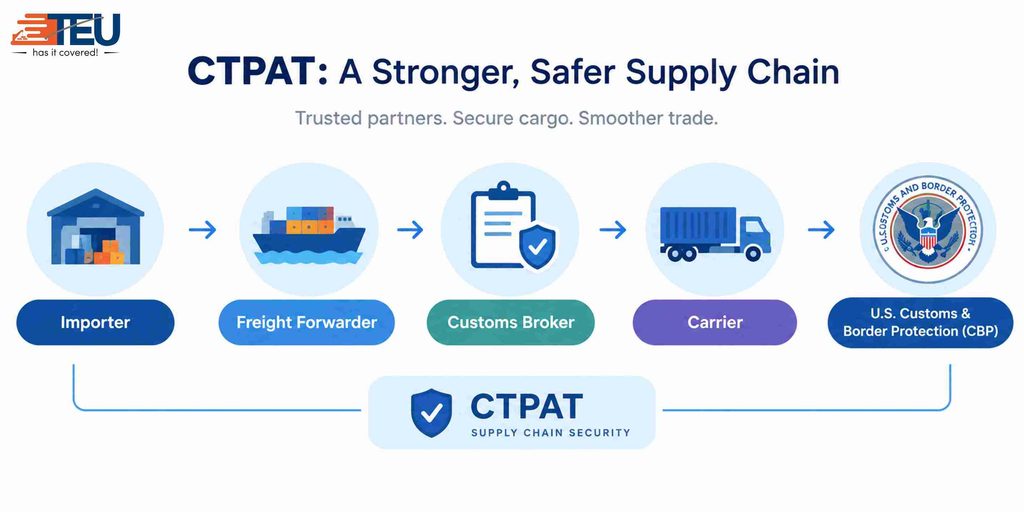
CTPAT is not a license and not mandatory. But for companies that move consistent volume across borders, it has become close to an industry standard, because non-certified shipments face more scrutiny by default.
How CTPAT Certification Works
CTPAT certification is CBP’s formal recognition that a company has built, documented, and implemented a supply chain security program that meets CBP’s Minimum Security Criteria (MSC). The criteria vary slightly depending on your role in the supply chain — importer, carrier, broker, or logistics provider — but generally cover:
- Physical security of facilities, containers, and cargo storage areas
- Personnel security, including background screening and access controls
- Procedural security, covering how shipments are documented, sealed, and tracked
- Cybersecurity, protecting systems that manage shipment and trade data
- Business partner requirements, extending security expectations to your vendors and carriers
The CTPAT Requirements Process
Getting certified isn’t a form you fill out once. The general process looks like this:
- Create an account in the CTPAT Portal and complete a Security Profile against the applicable Minimum Security Criteria.
- Submit supporting documentation showing the controls described in your profile are actually in place — not just written down.
- Undergo validation by a CBP Supply Chain Security Specialist, who may review your facilities, procedures, and in some cases your overseas partners.
- Maintain and update your security profile on an ongoing basis. CTPAT certification isn’t a one-time badge — CBP expects continuous compliance and periodic revalidation.
There’s no application fee, but the internal work — documenting procedures, training staff, and closing security gaps — is where most companies underestimate the effort involved.
CTPAT Benefits: What Certification Actually Gets You
The benefits CBP publishes for CTPAT members include:
- Fewer customs examinations — certified shipments are generally treated as lower risk in CBP’s targeting systems
- Front-of-line treatment when a certified shipment is selected for inspection
- Faster processing at ports of entry and land border crossings
- FAST lane eligibility at U.S.–Canada and U.S.–Mexico land crossings
- A dedicated CBP Supply Chain Security Specialist as a point of contact
- Priority admissibility review for shipments flagged under forced labor enforcement
- Public recognition as a validated trusted trade partner, which carries weight with partners and customers
A word of caution worth passing on: you’ll see specific numbers floating around online — claims like “four to six times fewer inspections.” CBP doesn’t publish an exact multiplier, and those figures don’t trace back to an official source. What’s verifiable is the outcome that matters most to importers: fewer random holds, fewer surprise inspection fees, and more predictable transit times — which is exactly what protects your inventory planning and reduces demurrage and detention costs.
Who Should Pursue CTPAT for Importers
CTPAT is open to a wide range of supply chain participants, but it’s especially valuable for:
- Importers who move regular international volume and want predictable clearance times
- Manufacturers and exporters shipping components or finished goods across borders
- Customs brokers and freight forwarders who want to offer clients a lower-risk shipping profile
- Carriers operating across land, air, and ocean modes
If your business already deals with tight delivery windows, high-value cargo, or frequent cross-border shipments, CTPAT isn’t optional in practice — it’s a competitive necessity. Buyers and retail partners increasingly expect their logistics vendors to be certified.
CTPAT Compliance Is Ongoing, Not a One-Time Milestone
A common misconception is that CTPAT compliance ends once certification is granted. In reality, CBP expects members to:
- Keep their Security Profile current as operations change
- Extend security expectations to business partners and overseas vendors
- Undergo periodic revalidation
- Respond promptly to any security incidents or gaps identified during review
Companies that let their compliance lapse risk losing certified status — and the benefits that come with it — right when they need reliability the most.
Why CTPAT Supply Chain Security Matters More in 2026
Regulatory pressure around import security and importer-of-record accountability has increased. Recent policy direction has pushed for tighter vetting of importers and greater CTPAT participation across the supply chain, particularly for higher-risk trade lanes. For businesses relying on ocean freight, drayage, or cross-border trucking, that means working with partners who are already ahead of the compliance curve — not scrambling to catch up.
Why Work With a CTPAT Certified Freight Forwarder
This is where the practical value of CTPAT becomes clear for importers who don’t want to pursue certification themselves. When you ship through a CTPAT certified freight forwarder, some of that lower-risk treatment extends to your shipments, because your logistics partner has already met CBP’s security bar for handling, documenting, and moving your cargo.
TEU Global is CTPAT certified. That means when you route your freight forwarding, customs clearance, drayage and domestic trucking, or warehousing and distribution through TEU Global, you’re working with a partner whose security practices have already been validated by CBP — reducing the chances that your shipments get flagged, delayed, or held for avoidable reasons.
We also encourage our clients and eligible partners to pursue their own CTPAT certification. A secure supply chain is a shared responsibility, and working with a certified logistics partner is one of the simplest ways to strengthen your own compliance posture without building a security program from scratch.
FAQs About CTPAT
Is CTPAT mandatory?
No. CTPAT is a voluntary program, but many importers pursue it because non-certified shipments face more inspections and less predictable clearance times by default.
How long does CTPAT certification take?
CBP’s statutory goal is to complete Tier 1 certification within 90 days of a completed application, though this timeline depends on practicability and the complexity of your application.
Does CTPAT certification cost money?
There’s no CBP application or membership fee. The real cost is internal — the time and resources needed to document and implement the required security controls.
What’s the difference between CTPAT and a customs bond?
A customs bond is a financial guarantee required to import goods into the U.S. CTPAT is a voluntary security certification. They serve different purposes and aren’t interchangeable.
Can a freight forwarder be CTPAT certified on behalf of my business?
Not exactly — CTPAT certification applies to the entity that holds it. However, shipping through a CTPAT certified freight forwarder like TEU Global means your cargo benefits from that partner’s validated security practices at every touchpoint they handle
Ship Smarter With TEU Global: Your CTPAT-Certified Partner`
Whether you’re exploring certification for your own company or simply want a logistics partner who already meets CBP’s security standards, TEU Global’s CTPAT certification is built into how we handle every shipment — from ocean freight and customs clearance to drayage and warehousing.
Get a Quote or contact our team to see how working with a CTPAT certified freight forwarder can reduce delays and protect your supply chain.




Comment(01)