Quick answer:
ETA stands for Estimated Time of Arrival. In shipping, it is the expected date and time a vessel, container, or shipment will reach its destination. To track a container, enter its container number, bill of lading (B/L) number, or booking number on the carrier’s website or a multi-carrier tracking platform. Then check the latest milestone and updated ETA.
Table of Contents
What Is Container Tracking?
Container tracking is the process of monitoring a shipping container’s location and status from the moment it is booked until it is delivered and the empty container is returned. Tracking data comes from several sources:
- Carrier systems: gate-in, loading, and discharge events reported by shipping lines
- Terminal and port data: gate movements and yard status
- AIS (Automatic Identification System): vessel position signals broadcast by ships
- Customs and trade systems: clearance status in some regions
Together, these tell you where your cargo is, whether it is on schedule, and what happens next.
What You Need to Track a Container
You can usually track a shipment with any one of these three identifiers:
| Identifier | Where to find it | Example format |
| Container number | Bill of lading, packing documents, container door | 4 letters + 7 digits (e.g., ABCU 123456 7) |
| Bill of lading (B/L) number | Issued by the carrier or forwarder | Often starts with the carrier’s code |
| Booking number | Booking confirmation | Carrier-specific |
How to read a container number (ISO 6346):
- First 3 letters: owner code
- 4th letter: equipment category (U = freight container)
- 6 digits: serial number
- Last digit: check digit that validates the number
If a tracking site rejects your number, check for typos first. A wrong check digit is a common cause. The format is defined by ISO 6346.
How to Track a Container Step by Step
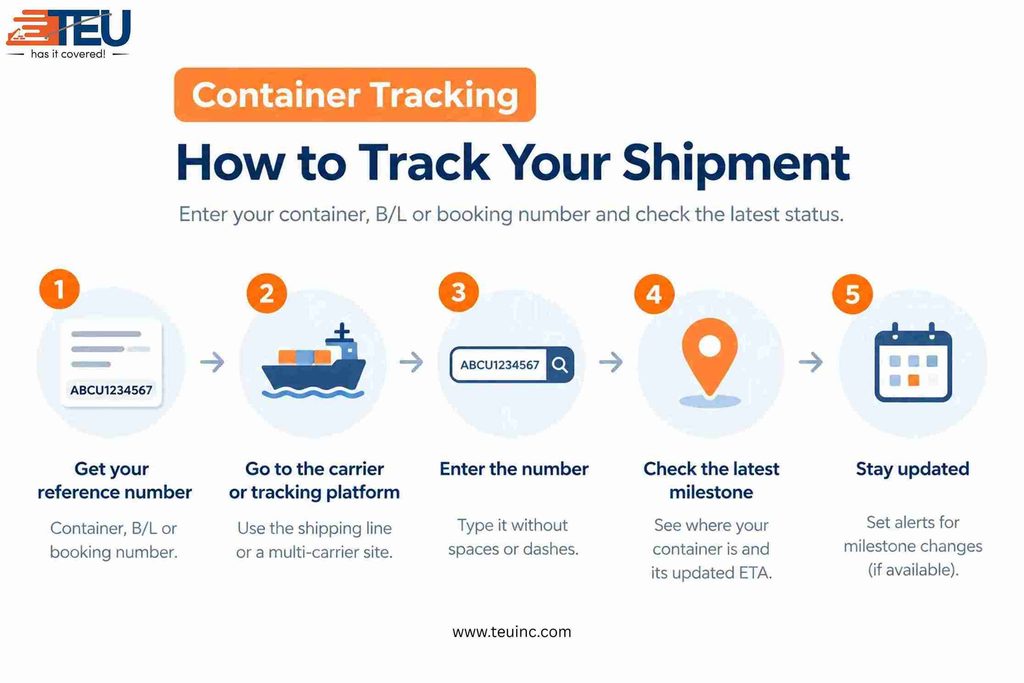
- Get your reference number from your forwarder, such as TEU Global, or from your shipping documents.
- Identify the shipping line. Look at the first three letters of the container number (owner codes are listed in the BIC registry), or ask your forwarder.
- Open the tracking page of the carrier or a multi-carrier platform.
- Enter the number without spaces or hyphens.
- Read the latest event, such as “Loaded on vessel” or “Discharged at port”.
- Check the vessel name and voyage number, then look up the vessel on an AIS map such as MarineTraffic or VesselFinder for its live position.
- Compare the current ETA to the original. A shift of more than a day or two is worth asking your forwarder about.
- Set up alerts for milestone changes if the platform offers them.
Container Journey Milestones Explained
| Milestone | What it means | What you should do |
| Booking confirmed | Carrier has accepted the booking | Prepare cargo and documents |
| Empty container released | Empty box picked up for loading | Arrange stuffing |
| Gate-in at origin port | Loaded container entered the terminal | Confirm cut-off times were met |
| Loaded on vessel | Container is on the ship | Share the B/L and vessel details |
| Vessel departed | Voyage has begun | Track the ETA |
| Transshipment | Container is moved to another vessel at an intermediate port | Expect possible delay |
| Vessel arrived | Ship reached the destination port | Prepare for clearance |
| Discharged | Container unloaded from the ship | Customs and delivery order |
| Customs released | Cleared for pickup | Arrange trucking |
| Gate-out | Container left the terminal | Delivery in progress |
| Empty return | Empty box returned to the depot | Avoid detention charges |
ETA vs ETD vs ATA vs ATD
| Term | Full form | Meaning |
| ETD | Estimated Time of Departure | Planned departure |
| ATD | Actual Time of Departure | Real departure |
| ETA | Estimated Time of Arrival | Expected arrival |
| ATA | Actual Time of Arrival | Real arrival |
An ETA is a forecast, not a guarantee. It updates as conditions change.
Why Your Container’s ETA Changes
- Weather and sea conditions can slow or reroute vessels.
- Port congestion means ships wait at anchor for a berth.
- Blank sailings mean the carrier cancels a scheduled voyage.
- Transshipment delays happen when a connecting vessel is missed.
- Route changes happen when carriers avoid disrupted waterways, which adds transit days.
- Customs inspections can hold a container after discharge.
- Terminal or labor disruptions slow cargo handling.
- Documentation errors can block release even when the box has arrived.
Tip: ETA at the port is not the same as the date your goods reach your warehouse. Add time for discharge, clearance, and inland transport.
Container Tracking Tools Compared
| Tool type | Best for | Limitation |
| Carrier website | Accurate, carrier-sourced events | One carrier only |
| Multi-carrier tracker | Several carriers in one place | Data can lag behind the carrier |
| AIS vessel trackers | Live ship position | Shows the vessel, not your specific container |
| Forwarder tracking (TEU Global) | Full-journey updates plus human support | Depends on carrier data feeds |
Contact our team for live milestone and ETA updates.
Troubleshooting: Container Tracking Not Working?
- “No results found.” Data is often not yet available, especially within 24-72 hours of booking or gate-in. Try again later.
- Wrong carrier selected. Use the container prefix or ask your forwarder.
- Number format errors. Remove spaces and dashes, and check the check digit.
- No updates for several days. The vessel may be mid-ocean, since events are logged at ports, not at sea. Check the AIS position.
- Status stuck at “Discharged”. Check customs clearance and the delivery order.
Best Practices for Importers and Exporters
- Share the B/L and container number with all stakeholders early.
- Check tracking at key milestones, not hourly.
- Build buffer time into delivery promises.
- Confirm free time at the destination port to avoid demurrage and detention.
- Ask your forwarder for proactive delay notifications.
- Keep documents accurate, since they affect release.
FAQs
What does ETA mean in shipping?
Estimated Time of Arrival, the expected date and time a vessel or container reaches its destination.
How do I track a container without a B/L?
Use the container number or booking number on the carrier’s tracking page.
How accurate is a container’s ETA?
ETAs are forecasts and can shift because of weather, congestion, and routing changes. They are usually more reliable closer to arrival.
How often is container tracking updated?
It depends on the carrier and port. Most updates happen at milestone events, not continuously.
Can I track a container by ship name?
You can track the vessel on AIS maps, but to see your container’s status you need the container, B/L, or booking number.
What is a transshipment, and does it affect ETA?
It is when cargo moves to a different vessel at an intermediate port. It can add delay if connections are missed.
Why does tracking show “vessel arrived” but I can’t collect my cargo?
Discharge, customs clearance, and the delivery order must be completed first.