
InformationalLogistics
If you’ve ever ordered a bulk shipment, worked in a warehouse, or watched a forklift zip across a loading dock, you’ve seen a pallet in action — probably without giving it a second thought. But this simple, flat structure is one of the most important inventions in modern commerce. Without it, global shipping as we know it wouldn’t function.
In this guide, we’ll break down everything you need to know about pallets in shipping: what they are, the different types of shipping pallets, standard pallet sizes, how palletized freight works, and the age-old debate of pallet vs skid.
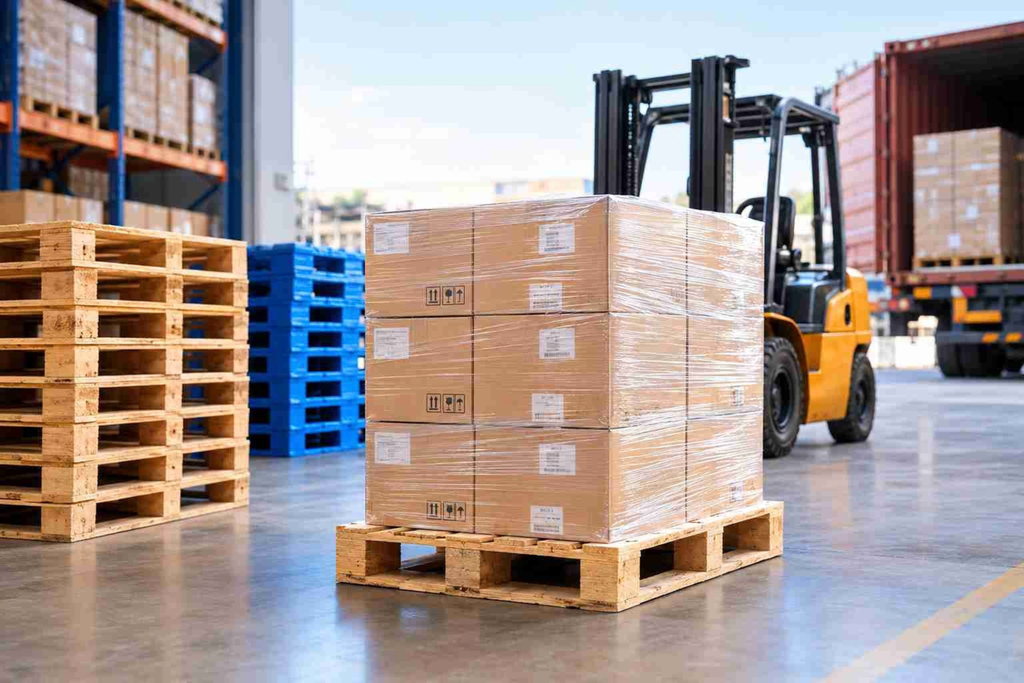
A pallet is a flat, portable platform — usually made of wood, plastic, or metal — used to stack, store, and transport goods safely and efficiently. Pallets are the backbone of palletized freight, allowing forklifts and pallet jacks to move large quantities of goods at once, reducing labor costs and shipping damage.
What Is a Shipping Pallet?
A shipping pallet is a structural foundation used to group, stack, and move goods as a single unit rather than handling individual boxes one by one. Pallets typically consist of two main parts:
- Deckboards – the flat top (and sometimes bottom) surface where goods are placed
- Stringers or blocks – the support beams underneath that create space for forklift forks or pallet jacks to slide in
This design allows heavy or bulky loads to be lifted, stacked, and transported with minimal manual handling — which is exactly why pallets are considered essential infrastructure in warehouses, ports, and distribution centers worldwide.
Did You Know?
Roughly 2 billion pallets are in circulation in the U.S. alone at any given time, and nearly 80% of all goods in the world are shipped on a pallet at some point in their journey.
Why Pallets Matter in Shipping and Logistics
Pallets in logistics aren’t just a convenience — they’re a core efficiency tool that impacts nearly every stage of the supply chain.
Key Benefits of Using Pallets:
- Faster loading/unloading — forklifts can move an entire pallet in seconds
- Reduced product damage — items stay stacked securely and off the ground
- Lower labor costs — fewer workers needed to handle bulk goods
- Better space utilization — pallets stack cleanly in trucks, containers, and warehouse racks
- Standardization — uniform sizes simplify planning across the entire supply chain
Pro Tip When choosing a pallet size, always match it to your shipping container or truck dimensions first. Mismatched pallet sizes waste space and increase freight costs
Types of Shipping Pallets
Not all pallets are created equal. The right pallet depends on your industry, budget, load weight, and shipping distance. Here are the most common types of shipping pallets:
1. Wood Pallets
The most widely used pallet type globally. Wood pallets are affordable, repairable, and recyclable, making them ideal for domestic shipping and one-way or multi-use trips.
2. Plastic Pallets
Durable, lightweight, and resistant to moisture, chemicals, and pests. Plastic pallets are popular in the food, pharmaceutical, and export industries where hygiene standards are strict.
3. Metal Pallets
Made from steel or aluminum, these pallets are built for heavy-duty industrial loads, extreme durability, and long-term reuse — though they come at a higher cost.
4. Presswood/Molded Wood Pallets
Made from compressed wood fibers, these pallets are lightweight and consistent in size. Certain processed-wood pallets may be exempt from ISPM 15 treatment requirements depending on how they are manufactured and the applicable regulations.
5. Corrugated/Cardboard Pallets
Lightweight and cost-effective, ideal for lighter loads, air freight, or single-use shipments where reducing weight matters most.
| Pallet Type | Best For | Durability | Cost |
| Wood | General/domestic shipping | Medium-High | Low |
| Plastic | Food, pharma, export | High | Medium-High |
| Metal | Heavy industrial loads | Very High | High |
| Presswood | International export | Medium | Low-Medium |
| Cardboard | Lightweight/air freight | Low | Very Low |
Standard Pallet Size Guide
One of the most searched questions in logistics is: “What is the standard pallet size?” The truth is, it depends on your region and industry.
Common Standard Pallet Sizes:
| Pallet Standard | Dimensions (LxW) | Common Region/Use |
| GMA Pallet (North America) | 48″ x 40″ | Most common in the U.S. |
| Euro Pallet | 1200mm x 800mm | Europe |
| Australian Standard | 1165mm x 1165mm | Australia |
| Asia Pallet | 1100mm x 1100mm | Asia-Pacific |
| Half Pallet | 24″ x 40″ | Retail/lighter loads |
Global Insight The GMA (Grocery Manufacturers Association) pallet at 48″x40″ accounts for nearly 30% of all pallets used in North America, making it the unofficial “standard pallet size” in the U.S. shipping industry.
What Is Palletized Freight?
Palletized freight refers to goods that are loaded onto pallets before being shipped, rather than being shipped as loose, individual items. This method is widely used in LTL (Less Than Truckload) and FTL (Full Truckload) freight shipping.
Why Shippers Use Palletized Freight:
- Simplifies freight classification and pricing
- Speeds up dock-to-dock transfers
- Minimizes handling touchpoints (less risk of damage/loss)
- Improves tracking accuracy (each pallet = one trackable unit)
How It Works
- Goods are stacked and secured on a pallet (often with stretch wrap or strapping)
- The pallet is weighed and measured for freight class
- It’s loaded onto a truck, rail car, or shipping container
- At the destination, forklifts unload the entire pallet at once
Pallet vs Skid: What’s the Difference?
This is one of the most common points of confusion in logistics. So, pallet vs skid — are they the same thing?
Short answer: Not exactly.
| Feature | Pallet | Skid |
| Bottom deck | Has a bottom deck (double-face) | No bottom deck (single-face) |
| Structure | Deckboards on top and bottom | Only top deckboards on stringers/legs |
| Stability | More stable for stacking | Less stable for stacking |
| Common Use | General warehousing & shipping | Moving heavy machinery/equipment short distances |
| Cost | Slightly higher | Generally lower |
A skid is similar to a pallet but does not have a bottom deck. Because of this difference in construction, skids and pallets can serve different handling and storage purposes.
Frequently Asked Questions About Pallets
Q: What is a pallet used for in shipping?
A pallet is used to consolidate multiple boxes or items into a single stackable unit, making loading, transport, and storage faster and safer.
Q: What is the most common standard pallet size?
In North America, the 48″ x 40″ GMA pallet is the most widely used standard size.
Q: Are wood or plastic pallets better?
Wood pallets are cheaper and more repairable, while plastic pallets are more durable, hygienic, and better suited for export or food-grade shipping.
Q: Can a pallet and a skid be used interchangeably?
In casual conversation, yes — but technically, a skid lacks a bottom deck, making it structurally different from a true pallet.
Q: How much weight can a standard pallet hold?
Most standard wood pallets can hold between 2,000–4,600 lbs statically, though capacity varies by material and construction.
Need Help With Your Freight Shipment?
Choosing the right pallet is only one part of moving your cargo efficiently. Whether you’re shipping palletized freight, coordinating domestic deliveries, or managing an international shipment, TEU Global can help you plan the right logistics solution for your cargo.
From freight forwarding and ocean freight to air freight, drayage, warehousing, and distribution, our team helps businesses move cargo safely and efficiently.
Ready to simplify your next shipment?
Request a Freight Forwarding Quote from TEU Global →