
LogisticsInformational
Free time in shipping is the number of days a carrier or terminal lets you keep a container without paying demurrage or detention. Once free time ends, daily charges begin. Knowing exactly how many free days you have, and when the clock starts, is the most effective way to keep a shipment inside budget.
This guide explains what free time means, the two types of free time, how to count free days, what happens when they run out, and how to get extra time. If you want the full picture of the fees that follow, read our guide to demurrage and detention charges.
Table of Contents
What Is Free Time in Shipping?
Free time is the grace period built into a container shipment. During this period you can leave the container at the terminal, move it to your warehouse and unload it, with no daily fee. The carrier or terminal sets it, and it is written into the carrier’s tariff, your booking terms or your service contract.
In simple terms, free time answers one question: how long can this container stay out of circulation before it starts costing money?
It exists because ports have limited space and carriers have limited equipment. Free time gives importers a fair window to clear customs and collect cargo, while the charges after it encourage containers to keep moving.
The Two Types of Free Time
Most shipments carry two separate free time allowances. They run at different stages and are counted separately.
| Type | Where the container is | What it covers | What happens after it ends |
| Demurrage free time | Inside the port or terminal | Time to clear customs and pick up the loaded container | Demurrage charges start |
| Detention free time | Outside the terminal (truck, yard or warehouse) | Time to deliver, unload and return the empty container | Detention charges start |
Some carriers offer a combined free time that covers both stages as one block of days. Others set them separately. Always check which applies to your booking, because a combined allowance and two separate ones behave very differently when a delay hits.
When Does Free Time Start and Stop?
This is where most importers get caught. Vessel arrival does not mean your container is available, so the clock does not always start when the ship docks.
| Free time | Clock usually starts | Clock usually stops |
| Demurrage free time | After the container is discharged from the vessel (some carriers count from the arrival notice) | When the container leaves the terminal |
| Detention free time | When the container leaves the terminal (gate-out) | When the empty container is returned to the designated depot |
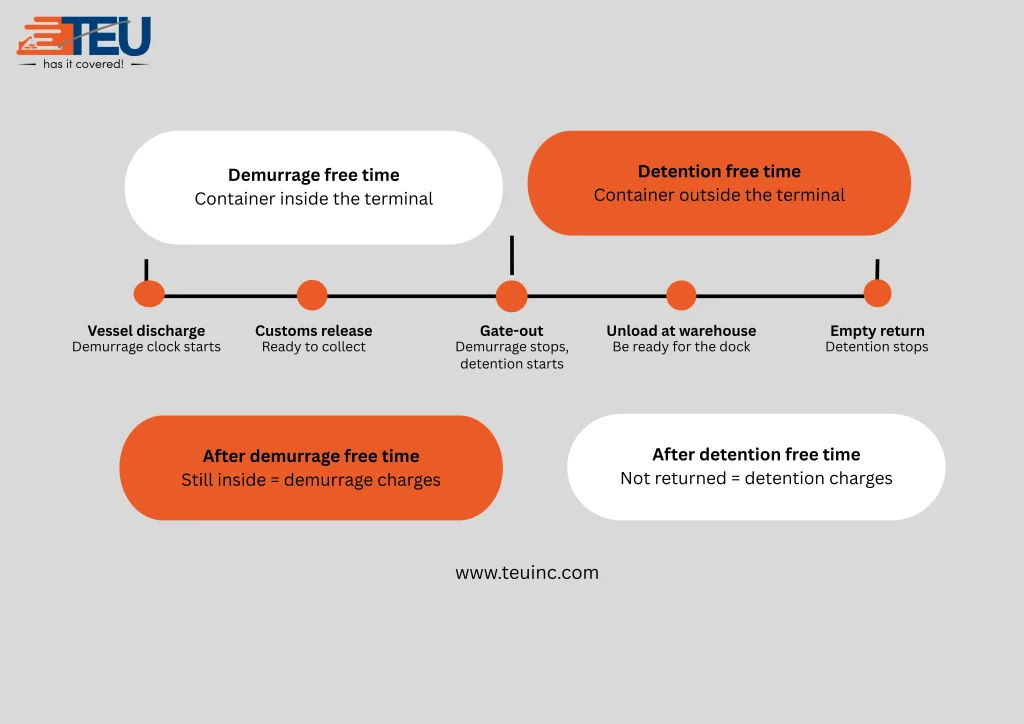
The exact start and stop points differ by carrier, port and contract, so confirm them in writing before the vessel arrives. Ask for the last free day (LFD), which is the final day you can use without a charge. Marking the LFD on your calendar on day one prevents most surprise invoices.
How to Count Free Days
Free days are most often counted in calendar days, which means weekends and holidays are included. Some terminals count only working days, so never assume.
Use this simple method:
- Find the start event. Discharge, arrival notice or gate-out, depending on the free time type.
- Confirm the counting rule. Check whether day one is the event day or the day after, and whether weekends count.
- Add the free days. The last day of the allowance is your last free day.
- Note the first chargeable day. This is the day after the last free day.
Worked Example
Assume a container with 5 days of demurrage free time and 4 days of detention free time, both counted in calendar days from the day after the event.
| Day | Event | Demurrage | Detention |
| Monday | Container discharged | Clock starts | Not started |
| Friday | Truck collects container (day 4) | Stops, no charge | Clock starts |
| Saturday to Tuesday | Unloading at warehouse | Not applicable | Free (4 days) |
| Wednesday | Empty not yet returned | Not applicable | First chargeable day |
| Thursday | Empty returned | Not applicable | Second chargeable day, clock stops |
In this case the importer paid no demurrage but two days of detention. The weekend counted as free time, but it also used up two of the four detention days, which is why a Friday pickup with a slow weekend unload is a common trap.
What Happens When Free Time Expires?
Once free time ends, daily charges begin and usually follow a tiered rate that rises the longer the container stays out. A short delay can turn into a large bill quickly. We break down rates, causes and invoices in our full guide to demurrage and detention charges.
A useful rule: free time expires quietly, but the charges do not. There is rarely a warning, so tracking the last free day yourself, or through your forwarder, is essential.
What Affects How Many Free Days You Get?
There is no universal number. Free time varies with:
- The carrier and its tariff. Each shipping line sets its own allowance.
- The port or terminal. Busy ports may allow fewer days.
- Container type and size. Reefer, high-cube and special equipment often differ from a standard dry container.
- Your contract or volume. Service contracts can include longer free time than spot bookings.
- The trade lane and season. Peak season and congestion can shorten or tighten free time.
Because of this, comparing free time is as important as comparing freight rates when you choose a carrier or route. A cheaper rate with short free time can cost more overall.
How to Get Extra Free Time
If the standard allowance is too short for your supply chain, you can often ask for more. Importers use these steps:
- Ask at booking. Requesting extended free time before the shipment sails gives you the strongest position. Some carriers, such as Maersk, let customers purchase extra days at the time of the import booking.
- Negotiate in your contract. Higher volumes and long-term service contracts are the best leverage for more days.
- Request an extension early. If a delay is coming, ask before the last free day, not after charges start.
- Document the cause. Customs holds, terminal closures or equipment shortages that are not your fault support a waiver request.
- Use your forwarder. An experienced forwarder can raise the request with the carrier and often has better results than a direct request.
7 Ways to Protect Your Free Time
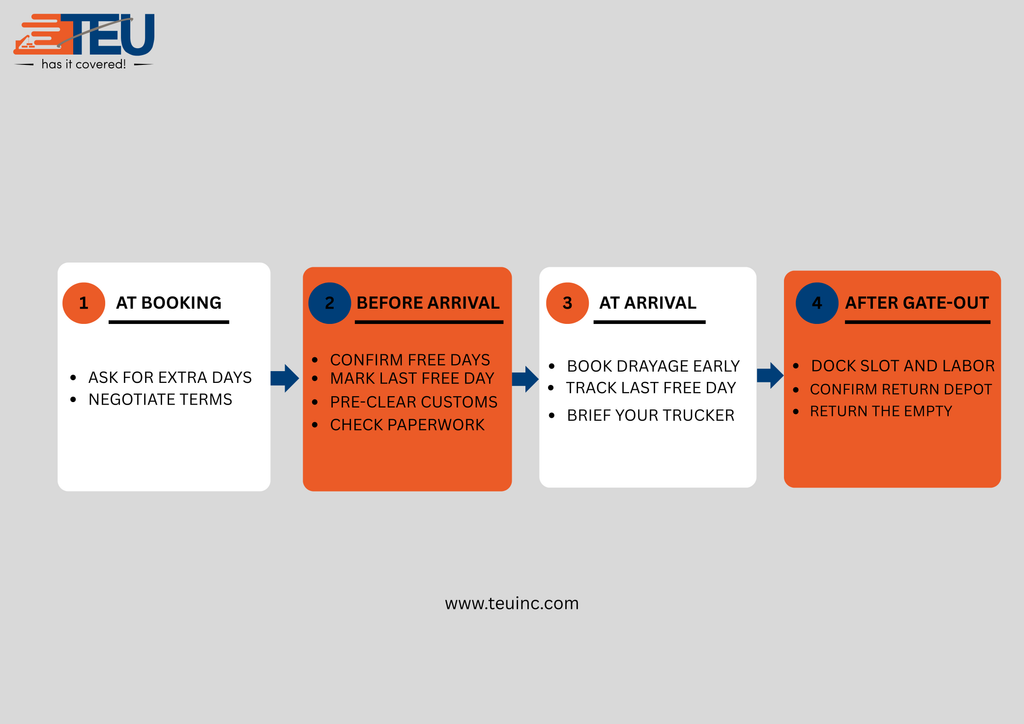
- Know your terms before arrival. Get free days, start points and counting rules in writing.
- Track the last free day. Put it in your calendar and share it with your trucker and warehouse.
- Pre-clear customs. File entry data early so the container can be released on arrival. Our customs clearance team handles this ahead of the vessel.
- Check your paperwork. A mismatch on the bill of lading or invoice can hold the release and burn free days.
- Book drayage early. A confirmed truck and chassis lets the container leave inside demurrage free time. See our drayage and domestic truck delivery service.
- Be ready to unload. Schedule dock appointments and labor, or use warehousing and distribution so the container is not waiting on you.
- Plan the empty return. Confirm the depot, its hours and the deadline before you gate out.
Do Importers Have Protection Around Free Time Charges?
In the United States, the Federal Maritime Commission (FMC) sets billing rules for charges that follow free time. Under the FMC final rule on demurrage and detention billing, invoices must be issued within 30 calendar days, and billed parties have at least 30 calendar days to request mitigation, a refund or a waiver. Check any invoice against your own free time records before paying it.
Frequently Asked Questions
What does free time mean in shipping?
Free time is the number of days a carrier or terminal allows you to keep a container without paying demurrage or detention. When it ends, daily charges begin.
How many free days do you get in shipping?
It varies by carrier, port, container type and contract. The allowance is not standard, so always confirm it in writing before the vessel arrives.
Does free time include weekends and holidays?
Usually yes, because free time is commonly counted in calendar days. Some terminals count working days only, so check the tariff or your contract.
What is the last free day (LFD)?
The last free day is the final day you can keep the container without a charge. The first chargeable day is the day after it.
Can free time be extended?
Often, yes. Ask at booking, negotiate it into your contract or request an extension before the last free day. Extra days may carry a fee, and waivers are more likely when the delay was not your fault.
What is the difference between free time and demurrage?
Free time is the period with no charge. Demurrage is the daily charge that starts after demurrage free time ends and the container is still inside the terminal.
Final Thoughts
Free time is simple in theory and costly in practice. The importers who avoid fees know their free days, confirm when the clock starts, track the last free day and line up customs, trucking and warehouse space before the container arrives.
At TEU Global, our team coordinates ocean freight shipping, customs clearance, drayage and warehousing so your containers move inside their free time and your landed costs stay predictable. Not sure which forwarder to trust with it? Our guide on how to choose a freight forwarder is a good place to start.
Want to keep your containers inside free time? Get a quote from TEU Global or contact our team today.