Logistics
You booked the shipment, paid the freight and tracked the vessel all the way to port. Then a bill arrives for hundreds or even thousands of dollars in fees you never budgeted for. For many importers, that bill is for demurrage and detention.
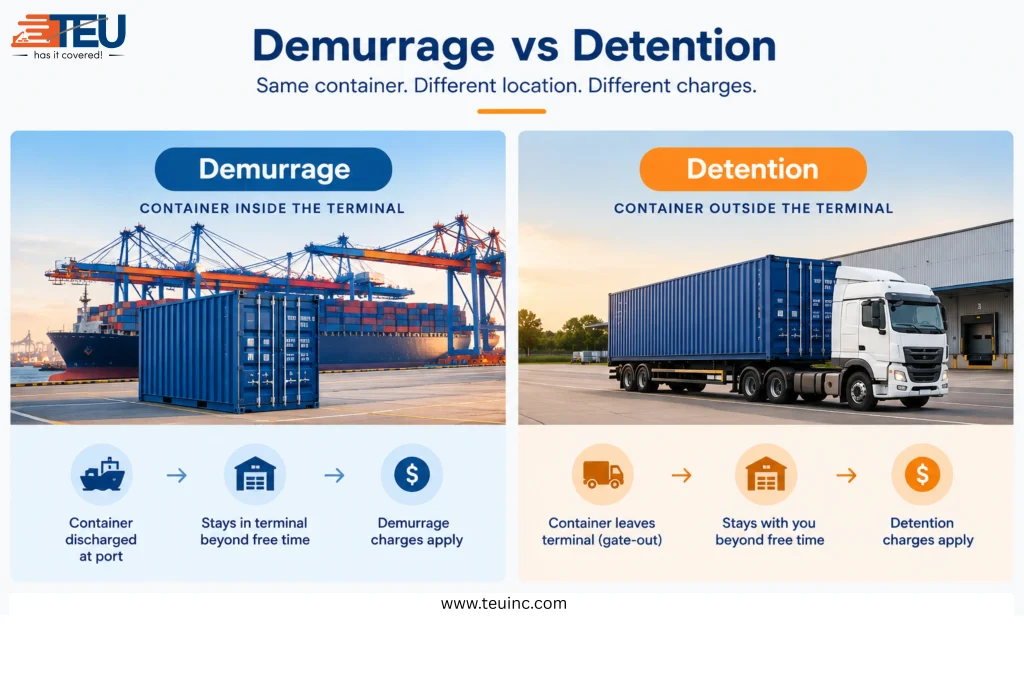
Demurrage and detention are the daily penalties carriers and terminals charge when a container stays in the wrong place for too long. Demurrage applies when a container sits inside the port or terminal past its free time. Detention applies when a container stays outside the terminal with you, past its free time, before the empty is returned.
In this guide, TEU Global explains how demurrage and detention work, how the charges are calculated, the key differences between them, and practical steps to avoid them.
Table of Contents
What Is Demurrage in Shipping?
Demurrage is a charge that applies when a container stays inside a port or terminal beyond its allowed free time.
Detention is a charge that applies when a container has left the terminal but is not returned within the carrier’s allowed free time.
The easiest way to remember the difference:
Demurrage = inside the terminal
Detention = outside the terminal
Both charges can increase daily after free time expires, so knowing your free-time allowance and planning customs clearance, trucking, unloading, and empty-container returns can help avoid unexpected costs.
Demurrage is a charge from the ocean carrier or terminal operator when a loaded container remains in the port or terminal beyond the agreed free time. It exists to keep containers moving, because terminal space is limited and every day a box sits there blocks capacity for other cargo.
Demurrage charges usually start when:
- The container is discharged from the vessel and the free time clock begins.
- Customs clearance is delayed, so the container can’t be released.
- Terminal fees, freight or other charges remain unpaid and the carrier holds the release.
- A trucker isn’t available to pick up the container in time.
Once free time ends, a daily rate applies for every extra day, including weekends and holidays in most cases.
What Are Detention Charges in Shipping?
Detention charges apply after the container has left the terminal. If you keep the carrier’s container, whether loaded or empty, beyond the free time allowed for unloading and returning it, the carrier charges a daily fee. Detention is the carrier’s way of making sure its equipment returns to circulation.
Detention charges commonly arise when:
- The consignee takes too long to unload at the warehouse.
- There is no dock appointment available at the receiving facility.
- The empty container return location is closed, full or far away.
- Trucking delays leave the container waiting on a chassis.
Demurrage vs Detention: Key Differences
Many importers confuse the two because both are “per day” container fees. The easiest way to separate them is location: demurrage happens inside the terminal, detention happens outside it.
| Factor | Demurrage | Detention |
| Where the container is | Inside the port or terminal | Outside the terminal (your warehouse, yard or truck) |
| What triggers it | Container not picked up before free time ends | Container not returned empty before free time ends |
| Who usually charges it | Carrier or terminal operator | Ocean carrier |
| Clock starts | After vessel discharge | After gate-out from the terminal |
| Clock stops | When the container leaves the terminal | When the empty container is returned |
| Common causes | Customs holds, unpaid fees, no truck | Slow unloading, no dock appointment, return delays |
If you’re also new to the terms around container movement, our guide to what is drayage in shipping explains how the trucking leg connects the port to your door.
How Demurrage and Detention Charges Are Calculated
There is no single global rate. Charges depend on the carrier, the port, the container type and the trade lane. Most follow the same structure:
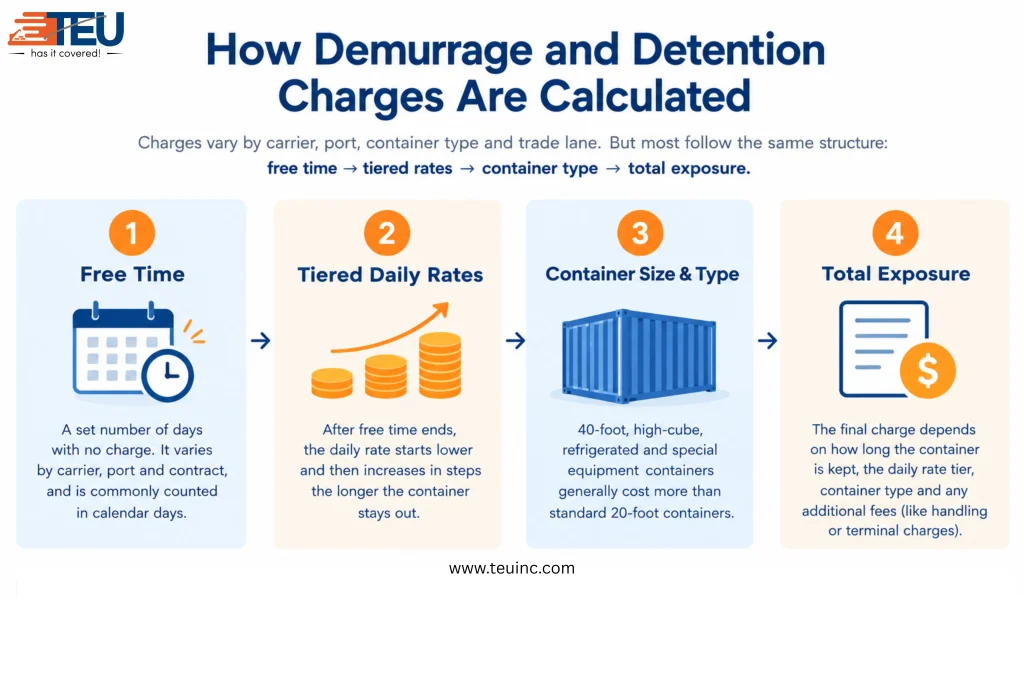
- Free time. A set number of days with no charge. It varies by carrier, port and contract, and is commonly counted in calendar days.
- Tiered daily rates. After free time ends, the daily rate starts lower and then climbs in steps the longer the container stays out. A later tier can be several times the first-day rate.
- Container size and type. 40-foot, high-cube, refrigerated and special equipment containers generally cost more per day than a standard 20-foot box.
- Combined exposure. If a container is delayed at the port and then held at your warehouse, you can owe demurrage and then detention on the same shipment.
Worked example (illustrative only): Suppose a 40-foot container has 4 days of demurrage free time. It clears customs on day 7, so three chargeable days apply. If the carrier’s tiers run higher each day, those three days could already add up to a few hundred dollars. Add a missed dock appointment that leaves the container with you for five days beyond detention free time, and the same shipment can pass the thousand-dollar mark.
The exact rates, free time and day-counting rules are set out in the carrier’s tariff and your contract, so always confirm them before the vessel arrives.
What Causes Demurrage and Detention Charges?
Most demurrage and detention bills trace back to a handful of avoidable problems:
- Customs clearance delays: incorrect HTS codes, missing documents or inspection holds. Our HTS code classification guide shows how classification errors turn into costly holds.
- Document errors: a mismatched commercial invoice, packing list or bill of lading. See our explainer on the bill of lading for what has to match.
- Unpaid freight or terminal fees: carriers can hold the release until every charge is settled.
- Port congestion and vessel delays: sometimes outside your control, which is why planning buffer time matters.
- Trucking and chassis shortages: no driver or chassis means no pickup.
- Warehouse readiness: no dock slot, no labor or no space to receive the freight.
- Empty return problems: closed return depots or unclear return instructions.
How Much Do Demurrage and Detention Charges Cost?
Costs vary widely, but as a general guide, daily charges for a standard container often start in the double digits per day and can climb to several hundred dollars per day in later tiers during congestion or for specialized equipment. Because the rate typically escalates, the cost of delay grows faster than the number of days. A shipment that sits for ten days rarely costs twice as much as one that sits for five.
This is why a small delay at the start of the import process can quietly become one of the most expensive line items on a landed cost sheet.
Do Importers Have Any Protection? The FMC Billing Rule
In the United States, the Federal Maritime Commission (FMC) has set billing requirements for demurrage and detention invoices. Under the rule, which took effect in 2024, invoices must be issued within a set window and must include key information, such as the dates and the basis for the charges. The rule also sets a timeframe for disputing an invoice.
That means an invoice that arrives late or without the required details may be challenged. Check the current FMC requirements, or ask your forwarder to review any invoice you think is incorrect, before you pay it.
8 Ways to Avoid Demurrage and Detention Charges
The good news is that most demurrage and detention costs are preventable. Here is what experienced importers do differently.
1. Know Your Free Time Before the Vessel Arrives
Ask for the free time terms for both demurrage and detention at booking, not after arrival. Confirm how days are counted and whether weekends and holidays are included.
2. Get Documents Right the First Time
Check the commercial invoice, packing list and bill of lading for consistency before departure. Small errors in descriptions, weights or consignee details are among the most common causes of customs holds.
3. Pre-Clear Your Shipment
Submit customs entry data before the vessel arrives so clearance can happen as soon as the container is discharged. Working with an experienced partner for customs clearance removes much of the guesswork. If you export or import into a regulated program, a trusted-trader approach such as CTPAT can also help cargo move more smoothly.
4. Pay Freight and Terminal Fees on Time
Unpaid charges can prevent release. Confirm payment status and release instructions before arrival.
5. Book Drayage in Advance
Secure your trucker and chassis before the container is available. Reliable drayage and domestic truck delivery means the container leaves the terminal inside free time.
6. Have Your Warehouse Ready
Schedule dock appointments, labor and space to match the container’s arrival. If your own facility can’t take the freight right away, warehousing and distribution or transloading can move cargo out of the container and off your detention clock quickly.
7. Plan the Empty Return
Know where and when the empty container must be returned, and confirm the depot’s operating hours and capacity. Return the box promptly after unloading.
8. Work With a Forwarder That Tracks the Clock
A good forwarder monitors free time, alerts you before charges start and coordinates every party in the chain. Our guide on how to choose a freight forwarder lists what to look for. For end-to-end ocean moves, TEU Global’s ocean freight shipping team manages these handoffs for you.
What to Do If You Receive a Demurrage or Detention Invoice
Before You Pay a Demurrage or Detention Invoice
Check these five things first:
☑ Discharge, gate-out and return dates
☑ Free-time allowance
☑ Carrier’s day-counting rules
☑ Any carrier or terminal-caused delays
☑ Dispute deadline and supporting documents
- Check the dates. Compare discharge, gate-out and return dates with your own records.
- Confirm free time. Make sure the carrier applied the correct free time and day-count rules.
- Look for carrier-caused delays. If the carrier or terminal caused the delay, such as a closed terminal or unavailable equipment, you may have grounds to dispute.
- Dispute inside the deadline. Send your dispute with supporting documents quickly.
- Ask your forwarder for help. An experienced forwarder can often negotiate waivers or reductions.
Frequently Asked Questions
What is the difference between demurrage and detention?
Demurrage is charged when a container stays inside the port or terminal past free time. Detention is charged when a container stays outside the terminal past free time. In short, demurrage is about storage at the terminal, and detention is about the carrier’s equipment being kept too long.
Who pays demurrage and detention charges?
The party responsible under the contract and Incoterms pays, which is usually the importer or consignee. If a delay is caused by the shipper or the forwarder, responsibility can shift, so agree on who bears these risks in advance. Our guide to Incoterms explains how responsibility is split.
How many free days do I get?
It depends on the carrier, the port, the container type and your agreement. Free time is often a few days, but it is not standard, so always confirm it in writing before arrival.
Can demurrage and detention be waived?
Sometimes. Waivers are more likely when the delay was caused by the carrier or terminal, or when you can show documented, uncontrollable circumstances. Requests work best when made early and backed by evidence.
Do weekends and holidays count?
In most cases, yes. Many tariffs count calendar days, though some terminals count only working days. Check the tariff and your contract.
Is there a difference between demurrage and per diem?
The term “per diem” is often used for the daily equipment charge, which is similar to detention. Terminology varies by carrier and region, so check how your carrier describes the charge on its invoice.
Final Thoughts
Demurrage and detention charges are not unavoidable costs of importing. They are the result of delays in clearance, paperwork, trucking, unloading or empty return, and almost all of them can be planned for. Know your free time, get your documents right, book trucking early and keep a close eye on the clock.
At TEU Global, our team coordinates ocean freight, customs clearance, drayage and warehousing under one roof so your containers keep moving and your landed costs stay predictable.
Need help keeping demurrage and detention under control? Get a quote from TEU Global or contact our team today.