LogisticsInformational
Imagine you’re buying products from another country for the first time. You’ve found the right supplier, agreed on the price, and are ready to place your order. Then you come across shipping terms such as FOB, CIF, EXW, and DDP. Suddenly, you’re faced with questions like: Who pays for shipping? Who arranges transportation? What happens if the cargo is damaged during transit?
These are some of the most common questions businesses encounter when trading internationally, and the answers often come down to one important concept—international shipping terms.
Whether you’re a small business importing products, a manufacturer exporting goods overseas, or simply curious about how international shipping works, understanding Incoterms is essential.
Knowing the right Incoterm can help businesses avoid unexpected costs, reduce misunderstandings, and ensure everyone involved knows exactly who is responsible for transportation, customs clearance, insurance, and delivery.
What Does Incoterms Mean?
Incoterms stands for International Commercial Terms. These are a standardized set of trade rules published by the International Chamber of Commerce (ICC) that define the responsibilities of buyers and sellers in international shipping.
If you’re wondering, “What does Incoterms mean?” they are internationally recognized guidelines that clarify who pays for transportation, insurance, customs clearance, and when the risk transfers from the seller to the buyer.
What Are Incoterms?
Incoterms, short for International Commercial Terms, are a set of globally recognized trade rules that define the responsibilities of buyers and sellers during the shipment of goods.
In simple terms, Incoterms explain who pays for shipping, who arranges transportation, who handles customs clearance, and when the risk of the goods transfers from the seller to the buyer.
Think of them as a rulebook for international trade. Instead of negotiating every shipping detail separately, buyers and sellers can agree on an Incoterm, ensuring everyone understands their responsibilities before the shipment begins.
Whether you’re shipping a single pallet or multiple containers across the world, knowing what are Incoterms in shipping helps prevent confusion, unexpected costs, and delays.
Why Are Incoterms Important?
International shipping involves multiple parties, including manufacturers, freight forwarders, customs authorities, carriers, and buyers. Without clear responsibilities, shipments can quickly become complicated.
Incoterms help businesses by:
- Clearly defining buyer and seller responsibilities.
- Reducing misunderstandings and costly disputes.
- Identifying who pays transportation costs.
- Explaining when the risk transfers from seller to buyer.
- Simplifying international trade agreements.
- Making global shipping more transparent.
For businesses involved in international trade, understanding these international trade rules is essential for smoother logistics and better decision-making.
Who Uses Incoterms?
Incoterms are widely used across global supply chains. They are important for:
- Importers
- Exporters
- Manufacturers
- Freight forwarders
- Customs brokers
- Logistics companies
- Wholesalers
- Retailers
- E-commerce businesses
Whether you’re a small business importing products or a multinational company exporting goods worldwide, Incoterms help everyone work from the same set of rules.
The 11 Incoterms 2020 Explained
The latest version, Incoterms 2020, includes 11 internationally accepted rules.
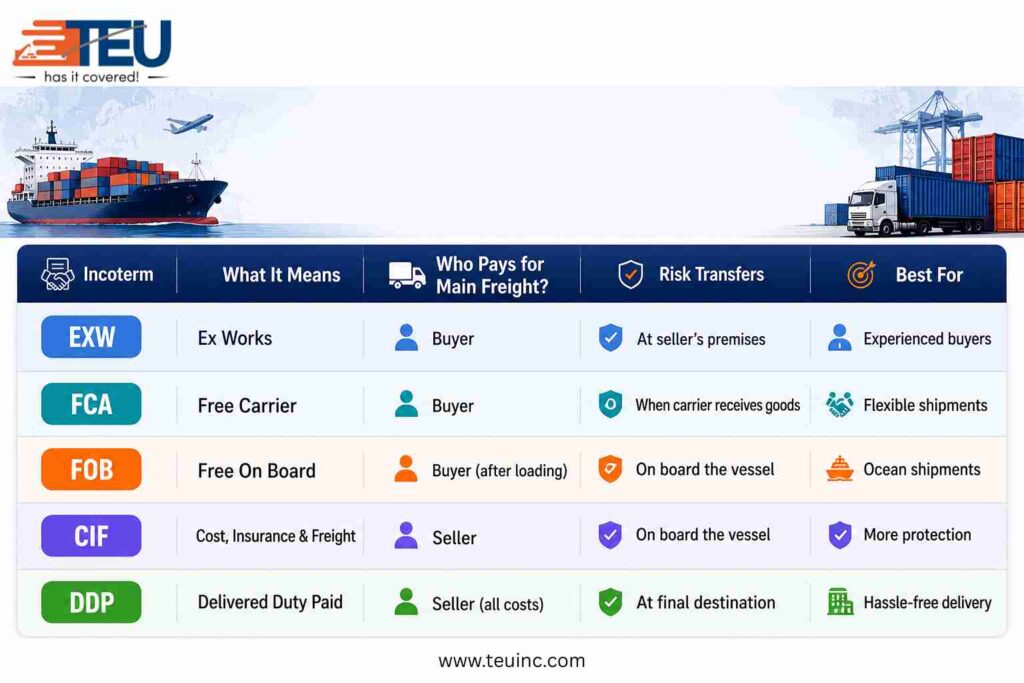
EXW (Ex Works)
The seller’s responsibility ends once the goods are available at their premises. The buyer is responsible for transportation, export documentation, customs clearance, and final delivery.
Best for: Buyers with strong logistics experience.
FCA (Free Carrier)
The seller delivers the goods to a carrier chosen by the buyer and completes export customs clearance.
CPT (Carriage Paid To)
The seller pays transportation costs to the agreed destination, but the risk transfers to the buyer once the goods are handed to the first carrier.
CIP (Carriage and Insurance Paid To)
Similar to CPT, but the seller also provides cargo insurance until the agreed destination.
DAP (Delivered at Place)
The seller delivers the shipment to the agreed destination. The buyer is responsible for unloading the goods and completing import customs procedures.
DPU (Delivered at Place Unloaded)
The seller is responsible until the goods are delivered and unloaded at the destination.
DDP (Delivered Duty Paid)
DDP places the highest responsibility on the seller. The seller handles transportation, customs clearance, duties, taxes, and delivery, allowing the buyer to simply receive the goods.
FAS (Free Alongside Ship)
The seller delivers the goods alongside the vessel at the port of shipment. The buyer assumes responsibility from that point.
This Incoterm is mainly used for bulk cargo.
FOB (Free On Board)
FOB is one of the most commonly used international shipping terms.
The seller is responsible until the goods are loaded onto the ship. Once loaded, the buyer assumes both the cost and risk of transportation.
CFR (Cost and Freight)
The seller pays the ocean freight to the destination port, but the buyer assumes the shipping risk once the goods are loaded onto the vessel.
CIF (Cost, Insurance and Freight)
CIF is similar to CFR, but the seller also provides cargo insurance during ocean transportation.
Common Mistakes Businesses Make
Even experienced importers and exporters can misunderstand Incoterms. Some common mistakes include:
- Choosing an Incoterm without understanding its responsibilities.
- Assuming insurance is included in every shipment.
- Confusing the transfer of risk with ownership of the goods.
- Ignoring import duties and taxes.
- Using outdated shipping terms instead of Incoterms 2020.
Understanding these rules before shipping helps businesses avoid unnecessary costs and delays.
How to Choose the Right Incoterm
The right Incoterm depends on several factors, including:
- Your shipping experience.
- The type of goods being transported.
- The destination country.
- Customs requirements.
- Who wants greater control over transportation.
- Which party is responsible for insurance and freight costs.
Discussing these details before signing a sales agreement helps both buyers and sellers avoid confusion later.
Need Expert Help with International Shipping?
Understanding Incoterms is only one part of successful international trade. Choosing the right shipping terms, managing customs requirements, and coordinating freight can quickly become complex—especially if you’re new to importing or exporting.
At TEU Global, we help businesses simplify global logistics with expert freight forwarding, customs clearance, cargo insurance, and end-to-end shipping solutions. Whether you’re shipping a single container or managing a global supply chain, our team can help you choose the right Incoterm and keep your cargo moving efficiently.
Get in touch with TEU Global to discuss your shipping needs and find the right logistics solution for your business.
Faq’s
What are Incoterms in shipping?
Incoterms are internationally recognized trade rules that define the responsibilities of buyers and sellers during international shipments.
What does Incoterms mean?
Incoterms stands for International Commercial Terms, a standardized set of rules created by the International Chamber of Commerce (ICC).
How many Incoterms are there?
There are 11 official Incoterms 2020 used worldwide.
Are Incoterms legally binding?
Incoterms are not laws, but when included in a sales contract, they become contractually binding for the parties involved.
Which Incoterm is best?
There is no single best Incoterm. The right choice depends on the shipment, destination, and the responsibilities agreed upon by the buyer and seller.