InformationalLogistics
If you’re importing or exporting goods internationally, “how much does freight forwarding cost in 2026?” is probably the first question on your mind — and the hardest one to get a straight answer to.
The answer: it depends. Your rate is shaped by your shipping route, cargo volume, transportation mode, container size, origin and destination charges, customs requirements, fuel costs, and current market conditions. A freight forwarding quote isn’t just “moving a box from Point A to Point B” — it can bundle ocean or air freight, documentation, port handling, customs clearance, drayage, warehousing, and insurance into one number.
In 2026, freight costs are moving fast. Ocean rates are being pushed and pulled by shifting demand, fuel prices, port congestion, geopolitical disruption, and new tariff policy. Right now, Asia–U.S. routes are running hot, while some Asia–Europe lanes are cooling off from earlier peaks. This guide breaks down exactly what drives freight forwarding pricing and what to check before you accept a quote.
What’s Included in Freight Forwarding Cost?
There’s no single “average” freight forwarding price — every shipment is priced differently. Here’s what typically shows up on your invoice:
- Ocean, air, rail, or truck freight
- Origin handling charges
- Destination handling charges
- Documentation fees
- Customs clearance
- Port and terminal charges
- Fuel and security surcharges
- Drayage and domestic transportation
- Warehousing and storage
- Cargo insurance
- Duties and taxes
- Demurrage and detention (when applicable)
Key takeaway: the cheapest-looking quote isn’t always the lowest total cost. Freightos points out that international freight quotes often contain multiple separate fees and surcharges — so understanding what’s actually included matters more than the headline rate.
What Is Freight Forwarding, Exactly?
Freight forwarding is the coordination of cargo transportation and logistics from origin to destination. A freight forwarder manages the moving pieces — carriers, documentation, customs, delivery — so you don’t have to juggle multiple vendors yourself.
For businesses importing into (or exporting from) the U.S., this reduces the delays that come from paperwork errors or compliance gaps. TEU Global handles freight forwarding alongside customs clearance, ocean freight, cargo insurance, drayage, warehousing, and purchase order management — all under one roof.
10 Factors That Drive Freight Forwarding Costs in 2026
1. Shipping Mode
Ocean, air, road, rail, or multimodal — your mode of transport is the single biggest cost lever. Ocean freight suits larger, less time-sensitive shipments; air freight is faster but pricier, especially for heavy cargo.
2. FCL vs. LCL Shipping
- FCL (Full Container Load): you book the whole container (20-ft, 40-ft, or 40-ft high-cube), priced per container regardless of how full it is.
- LCL (Less than Container Load): your cargo shares space with other shipments, typically priced by volume and/or weight.
Choosing FCL vs. LCL can swing your total freight forwarding cost significantly — more on this below.
3. Origin Charges
Costs incurred before your cargo even leaves the exporting country: pickup, export documentation, terminal handling, container loading, CFS/warehouse charges, and export clearance. These vary a lot by origin country and port.
4. Ocean or Air Freight Charges
This is usually the largest single line item — but it’s rarely the whole story once surcharges and local charges are layered on. As of August 2026, Freightos reported rates of roughly $7,400/FEU on Asia–U.S. West Coast lanes and about $9,400/FEU on Asia–U.S. East Coast lanes. That’s exactly why a generic “2026 freight cost” figure can be misleading — rates move by lane and by week.
5. Fuel Surcharges
Fuel costs remain a major variable in 2026. Maersk’s Q2 2026 results showed average bunker prices running well above last year, pushing ocean operating costs higher — which is why the rate you lock in today may not hold for your next shipment.
6. Port and Terminal Charges
Terminal handling, port fees, container handling, documentation, security, and equipment charges all vary by origin and destination port. A trustworthy quote spells out which of these are included versus billed separately.
7. Customs Clearance Costs
Brokerage, entry preparation, Importer Security Filing (ISF), classification, customs bonds, duties, and taxes — the total depends heavily on your commodity, country of origin, declared value, and HTS classification. TEU Global’s customs clearance services cover ISF, cross-border clearance, classification, and bond processing.
8. Drayage and Domestic Delivery
Once your container clears the port, it still needs to reach a warehouse, distribution center, or final destination. That short-haul move — drayage — should be factored into your total logistics budget, not treated as an afterthought.
9. Warehousing and Storage
Pallet count, storage duration, location, and handling requirements all affect warehousing costs, which matter most for businesses managing ongoing inventory flow.
10. Cargo Insurance
Insurance adds a line item, but it protects the value of your goods against loss or damage in transit. Coverage needs depend on cargo type, transport mode, and value.
Sample Freight Forwarding Cost Breakdown
| Cost Component | What It Covers |
| Ocean Freight | Main international transportation |
| Origin Charges | Handling and services at origin |
| Documentation | Shipping and administrative paperwork |
| Terminal Charges | Port and container handling |
| Customs Clearance | Import entry and compliance |
| Duties & Taxes | Government-imposed charges |
| Drayage | Port-to-warehouse transportation |
| Warehousing | Storage and handling |
| Cargo Insurance | Protection against covered losses |
| Additional Surcharges | Fuel, security, congestion, or other fees |
Don’t budget off the advertised ocean freight rate alone — it’s one line among many.
Why One Freight Quote Can Look So Different From Another
Ask three forwarders for a quote and you’ll likely get three different numbers. That’s not necessarily overcharging — it usually comes down to differences in carrier contracts, consolidation options, port arrangements, transit routes, and what’s actually bundled into the price. One quote might be door-to-door with customs included; another might only cover port-to-port. Always compare full scope of service, not just the headline rate.
6 Ways to Reduce Freight Forwarding Costs in 2026
- Plan shipments in advance — last-minute bookings limit your options and your negotiating leverage.
- Consolidate shipments — smaller loads may benefit from LCL consolidation instead of multiple separate shipments.
- Compare FCL and LCL every time — don’t assume LCL is automatically cheaper; at higher volumes, FCL often wins.
- Optimize packaging — tighter packaging improves container utilization and can lower dimensional-weight charges.
- Avoid demurrage and detention — know your free-time windows and return equipment on schedule.
- Work with an experienced freight forwarder — the goal isn’t the lowest rate, it’s the best balance of cost, reliability, transit time, compliance, and visibility.
Freight Forwarding Cost vs. Total Landed Cost
The biggest mistake importers make is comparing freight rates in isolation. Your real cost is your total landed cost:
Total Landed Cost = Product Cost + Freight + Insurance + Duties + Taxes + Customs + Port Charges + Inland Transportation + Other Logistics Costs
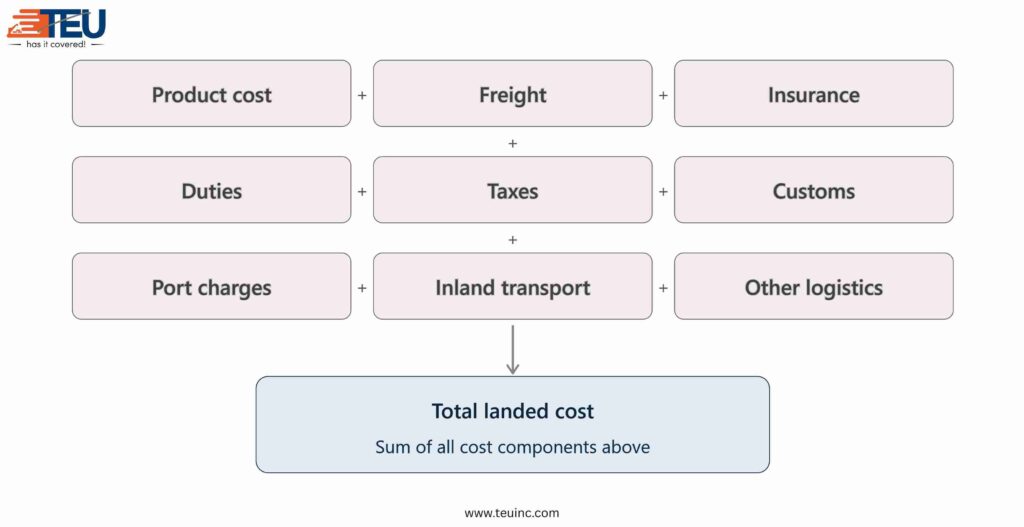
A shipment with a lower ocean freight rate can still end up more expensive once you add higher destination charges, extra handling fees, or costly inland transport. Compare the full landed cost — not just the sticker price on freight.
How 2026 Market Conditions Are Moving Freight Rates
2026 shipping costs are being shaped by fuel prices, port congestion, geopolitical disruption, shifting trade routes, seasonal demand, tariff changes, carrier capacity, and canal/waterway disruptions. In Freightos’s August 11, 2026 weekly update, Asia–U.S. West Coast rates rose 11% while Asia–U.S. East Coast rates rose 1% — and Asia–Northern Europe rates had already pulled back from their July peak. Translation: evaluate a quote by shipment date and trade lane, not by an outdated “average” you saw online.
Questions to Ask a Freight Forwarder Before You Book
- What exactly is included in the quoted price?
- Is the rate port-to-port or door-to-door?
- Are origin charges included?
- Are destination charges included?
- Is customs clearance included?
- Are duties and taxes included?
- Are fuel and security surcharges included?
- How much free time is available before demurrage/detention kicks in?
- What are the expected transit times?
- Are drayage and final delivery included?
- What happens if the shipment is delayed?
- Are there any potential additional charges I should know about now?
Getting clear answers up front is the single easiest way to avoid a surprise invoice.
How TEU Global Helps You Control Freight Forwarding Costs
At TEU Global, freight forwarding is one piece of a full 3PL solution built to simplify international logistics: freight forwarding, ocean freight, customs clearance, cargo insurance, drayage and domestic delivery, warehousing and distribution, purchase order management, and customs compliance coaching — coordinated through one partner instead of five.
Final Thoughts: What Will Freight Forwarding Cost You in 2026?
There’s no single price tag that fits every shipment. Your final number depends on your origin, destination, cargo type and volume, container size, transport mode, season, carrier, fuel costs, port charges, customs requirements, and inland transportation needs.
2026 freight markets are volatile — which makes a shipment-specific quote far more useful than any generic online estimate. The smartest move is to compare total logistics cost, know exactly what’s included in your quote, and partner with a forwarder who can coordinate transportation, customs, and delivery under one roof.
Request a Freight Forwarding Quote from TEU Global →https://teuinc.com/services/freight-forwarding
Frequently Asked Questions
How much does a freight forwarder charge?
It varies by shipment. Charges typically include transportation, documentation, handling, customs, surcharges, warehousing, and delivery services.
Is freight forwarding expensive?
It depends on the shipment and scope of service. Forwarder fees add a cost, but professional coordination often prevents far costlier delays, documentation errors, and inefficient routing.
What is included in freight forwarding costs?
Depending on your quote: freight transportation, origin and destination handling, documentation, customs clearance, port charges, surcharges, drayage, warehousing, and delivery.
Is ocean freight cheaper than air freight?
For large or non-urgent shipments, generally yes. The right choice depends on weight, dimensions, urgency, destination, and current market rates.
Can freight forwarding rates change?
Yes — fuel prices, carrier capacity, seasonality, port congestion, geopolitical events, trade policy, and supply/demand shifts can all move rates quickly.
How can I get an accurate freight forwarding cost?
Request a shipment-specific quote with your origin, destination, cargo type, dimensions, weight, volume, container size, shipping mode, and delivery requirements.
Need a freight forwarding solution for your next shipment? Contact TEU Global for a customized logistics quote.