LogisticsCompliance & RegulationsInformational
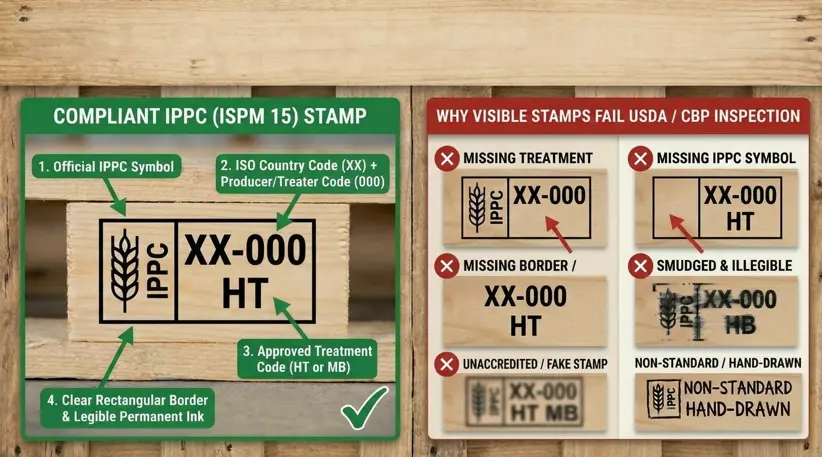
ISPM 15 wood packaging marks: compliant stamp components vs. common rejection triggers at U.S. ports.
An ISPM 15 wood packaging mark is the official international stamp certifying that solid wood pallets, crates, skids, and dunnage have been debarked and heat-treated or fumigated to prevent the spread of wood-boring pests. Under U.S. law (7 CFR § 319.40), every solid wood pallet entering the United States must carry a clear, compliant ISPM 15 stamp—and if the stamp is incomplete, smudged, or out of spec,
U.S. Customs and Border Protection (CBP) treats the pallet as completely unmarked.
This guide explains what the ISPM 15 mark means, the mandatory components of a compliant stamp, why visibly stamped pallets still fail CBP and USDA APHIS inspection, what happens when a 72-hour Emergency Action Notification (EAN) is issued, and how to protect your next container. If you want the full picture of how port holds affect container free days, read our guide to free time in shipping.
Table of Contents
What Is an ISPM 15 Wood Packaging Mark?
The ISPM 15 mark (International Standards for Phytosanitary Measures No. 15) is the global “passport” for solid wood packaging material (WPM). Because untreated raw lumber can carry invasive pests such as the emerald ash borer and Asian longhorned beetle, the United States and more than 180 countries require all solid wood pallets, crates, drums, and dunnage over 6 mm thick to be treated and stamped before export.
In simple terms, the ISPM 15 stamp answers one question: who treated this wood, in which country, and by what approved method?
Instead of requiring a paper phytosanitary certificate for every wooden pallet in a container, customs and agriculture inspectors rely on the physical stamp branded or inked directly onto the wood. That is why the physical quality of the stamp itself determines whether your container clears customs or gets locked in an examination hold.
The Four Mandatory Parts of an ISPM 15 Stamp
Under ISPM 15 Annex 2 and CBP WPM guidelines, every valid wood packaging mark must contain four specific elements enclosed inside a clear rectangular border with an internal vertical dividing line:
| Stamp Component | Where It Appears | What It Means |
| 1. IPPC Symbol | Left side of the vertical | The official International Plant Protection |
| dividing line | Convention wheat-ear logo with vertical IPPC | |
| lettering | ||
| 2. Country Code (XX) | Top right, before the | The two-letter ISO country code where the |
| hyphen | wood packaging was treated (for example, | |
| DE, IN, JO, CN) | ||
| 3. Producer / Treater Code | Top right, after the hyphen | The unique registration number assigned by |
| (000) | the exporting country’s National Plant | |
| Protection Organization (NPPO) to the | ||
| accredited treatment facility | ||
| 4. Treatment Code (YY) | Bottom right, below the country and producer code | The approved treatment method: HT (Heat Treatment), MB (Methyl Bromide fumigation), |
| or DH (Dielectric Heating) |
Every pallet must be marked with this complete stamp in permanent dark ink (or heat-branded) on at least two opposite sides so an inspector can read it without unstacking the cargo. Red or orange ink is never permitted because those colors are reserved for dangerous-goods labeling.
Why Do “Stamped” Pallets Still Fail CBP and USDA Inspection?
This is where most importers get caught. Your overseas supplier confirms that the pallets were stamped prior to loading, yet CBP Agriculture issues an Emergency Action Notification citing “Lacking ISPM 15 Marking.”
Under 7 CFR § 319.40-3(b), a stamp that is missing a required element or fails accreditation checks is legally treated the same as no stamp at all. During physical exams at Centralized Examination Stations (CES), USDA and CBP Agriculture Specialists reject visibly stamped pallets for six common reasons:
1. Missing Treatment Code (HT or MB). The pallet displays the country and producer number (XX-000), but omits the HT or MB treatment code underneath.
2. Missing or Non-Standard IPPC Symbol. The wheat-ear logo on the left side is left off, hand-drawn, or out of proportion.
3. Missing Border or Vertical Divider. The codes are stamped onto the wood without the outer rectangular box or the internal vertical line separating the IPPC symbol from the text.
4. Smudged, Illegible, or One-Sided Ink. The stamp is split across a gap between pallet slats, blurred beyond recognition, or applied on only one side of the pallet.
5. Unaccredited or Suspended Facility Number. The producer code (XX-000) is expired, revoked by the foreign ministry of agriculture, or flagged in USDA’s counterfeit stamp database.
6. Repaired “Mixed-Wood” Pallets or Bark. A stamped pallet was repaired with an unstamped replacement board, or the wood still carries bark strips exceeding ISPM 15 tolerances.
A useful rule: a partial stamp is an invalid stamp. Even if 90% of the mark is visible, a missing border line or unreadable treatment code renders the entire pallet non-compliant.
What Happens When Pallets Fail Inspection? (The 72-Hour EAN Clock)
When CBP Agriculture discovers non-compliant wood packaging material (NCWPM) during an exam, the officer issues an Emergency Action Notification (EAN, PPQ Form 523). Two operational rules immediately apply:
No U.S. fumigation is allowed. You cannot pay to heat-treat or fumigate non-compliant pallets at a
U.S. port to release them into commerce. The non-compliant wood must be re-exported from the United States.
CBP does not share exam photos. CBP policy prohibits officers from sending photographs of examined cargo to importers or brokers. If your supplier did not photograph the pallets before loading, you will not see what the stamp looked like unless you arrange a supervised manipulation at the CES warehouse.
Once the EAN is issued, you are typically given 72 hours to select a disposition, sign and return the EAN, and start remedial action. At many U.S. ocean ports, the non-compliant wood must be re-exported directly via ocean freight to a non-North American foreign destination (meaning it cannot be moved by truck or rail to Canada or Mexico).
Worked Example
Assume a container of industrial chemicals arrives at a U.S. port loaded on 23 wooden pallets. All 23 pallets carry a visible producer stamp, but USDA determines the stamps do not meet IPPC standards.
| Stage | Event | Cargo Status | Importer Cost & Clock Impact |
| Day 1 | Container drayed to CES for | Held at CES warehouse | CES drayage and exam fees |
| Agriculture exam; 23 pallets found | apply; port free time | ||
| non-compliant | continues to run | ||
| Day 2 | CBP issues Emergency Action | Locked under | Importer has 72 hours to elect |
| Notification (EAN) with a 72-hour action window | Agriculture Hold | Option 1 (Manipulation) or Option 2 (Immediate Export) | |
| Day 4 | Importer elects Option 1, submits signed EAN + CBP Form 3499, | Pending CBPmanipulation approval | Importer coordinates labor quote and replacement pallets |
| and books an outbound Export | with the CES warehouse | ||
| Container | |||
| Day 7 | CES unstacks cargo onto | Product released into | Import container returned to |
| compliant pallets under CBP | the U.S.; 23 empty | carrier (stopping per diem); | |
| supervision and loads the 23 bad | pallets staged for | outbound ocean booking | |
| pallets into the Export Container | export | submitted to CBP | |
| Day 12 | Outbound vessel sails with the 23 | EAN formally closed | Importer pays CES |
| empty pallets; Export Bill of Lading | manipulation labor, CBP | ||
| sent to CBP | supervision, and outbound | ||
| ocean freight for the pallets |
Your Two Options: Cargo Manipulation vs. Immediate Export
When you receive an EAN for non-compliant wood packaging, Box 16 of the form gives you two practical paths forward:
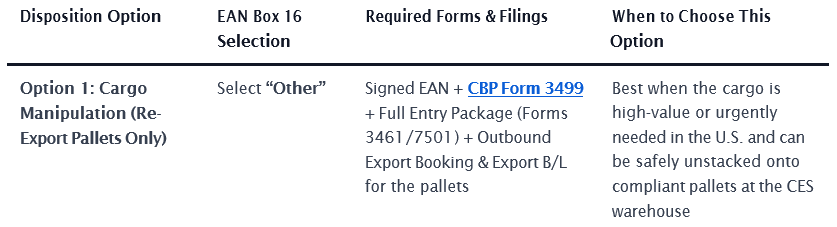
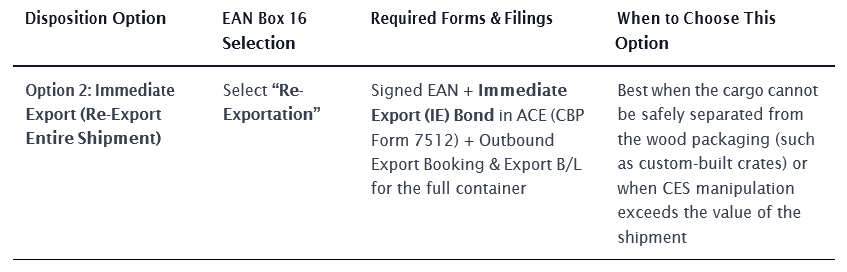
In both cases, CBP warns that importing non-compliant wood packaging violates the IPPC international agreement and 7 CFR § 319.40, which can trigger a Title 19 penalty under 19 U.S.C. § 1595a up to the domestic value of the merchandise.
What Affects the Cost of a Wood Packaging Hold?
There is no fixed fee for resolving a WPM violation. Total costs depend on:
How the cargo is packed. Palletized cartons or drums are much faster for CES warehouse crews to transfer than loose bags, fragile glass, or custom timber crating.
Number of non–compliant pallets. Even if only a few pallets are non-compliant, you must secure and
pay for an outbound ocean export container to re-export the rejected wood.
CES storage and carrier detention. Every day spent waiting for an export booking or CBP Form 3499 approval adds CES warehouse storage and carrier per diem charges once your free days expire.
Prior compliance history. Repeat WPM violations under the same Importer of Record or foreign shipper significantly increase the likelihood of a formal Title 19 penalty claim.
7 Ways to Protect Your Shipments from a WPM Hold
1. Require stamp photos before loading. Add a strict clause to your purchase orders requiring the overseas supplier to photograph the ISPM 15 stamps on two opposite sides of every pallet before the container doors close.
2. Audit all four parts of the mark. Verify that the supplier’s stamp shows a complete outer rectangular border, internal vertical divider, IPPC wheat symbol, two-letter ISO country code + producer number (XX-000), and HT or MB treatment code.
3. Ban repaired “Frankenstein” pallets. Instruct overseas warehouses never to repair a heat-treated pallet with an unstamped board. A single untreated board invalidates the entire pallet unless it is re-treated and re-stamped in full.
4. Switch to exempt pallets for high–risk cargo. USDA APHIS completely exempts plastic pallets, plywood, pressboard, oriented strand board (OSB), and metal frames from ISPM 15 rules. Using plastic or engineered-wood pallets eliminates WPM hold risk entirely.
5. Keep supplier treatment certificates on file. Require your exporter to provide the pallet manufacturer’s accreditation certificate and heat-treatment/fumigation log so you can prove due
diligence if CBP initiates a traceback or penalty review.
6. Respond within the 72-hour EAN window. If an EAN is issued, have your customs broker contact the port’s CBP Agriculture unit and the CES warehouse on Day 1 to price out Form 3499 manipulation versus immediate export.
7. Coordinate drayage and export bookings under one roof. Moving an import container into a CES while simultaneously booking an outbound export container for rejected pallets requires tight timing across customs clearance, drayage, and ocean freight.
Frequently Asked Questions
What does ISPM 15 mean in shipping?
ISPM 15 (International Standards for Phytosanitary Measures No. 15) is the international phytosanitary rule requiring solid wood packaging material—such as pallets, crates, and dunnage—to be debarked, heat-treated (HT) or fumigated with methyl bromide (MB), and stamped with an official IPPC mark before international shipment.
Why did CBP cite my stamped pallets as “Lacking ISPM 15 Marking”?
Under 7 CFR § 319.40-3(b), any stamp that is illegible, missing its outer border or vertical divider, missing the IPPC wheat logo or HT/MB treatment code, or tied to an unaccredited producer number is legally classified as unmarked (“Lacking ISPM 15 Marking”).
Can non–compliant pallets be fumigated at a U.S. port?
No. U.S. regulations do not allow post-arrival fumigation or heat treatment to bring non-compliant wood packaging into compliance for U.S. entry. The non-compliant wood must either be separated from the cargo and re-exported, or the entire shipment must be re-exported.
Why won’t CBP share photos of the rejected pallet stamps?
CBP operational policy prohibits officers from sharing photographs of examined cargo with external parties. To determine the exact defect on a rejected stamp, your customs broker can request a verbal or written clarification from the inspecting Agriculture Officer or inspect the pallets during an approved CES manipulation.
What is CBP Form 3499 used for in a WPM hold?
CBP Form 3499 (Application and Approval to Manipulate, Examine, Sample, or Transfer Goods) is the official application filed with CBP to authorize a CES warehouse to strip your merchandise off non-compliant wood pallets, transfer the cargo onto compliant pallets for U.S. release, and load the rejected wood into an export container under CBP supervision.
Which pallets are exempt from ISPM 15 requirements?
Pallets and packaging made entirely of plastic, metal, corrugated cardboard, or manufactured wood products—such as plywood, particleboard, oriented strand board (OSB), pressboard, and veneer—are exempt from ISPM 15 treatment and stamping rules.
Final Thoughts
A wood packaging hold is one of the most avoidable—yet expensive—disruptions in international shipping. Because CBP and USDA treat a smudged, incomplete, or unaccredited stamp the same as raw untreated lumber, relying on your supplier’s verbal assurance that pallets are stamped is a costly gamble. Requiring pre-loading stamp photos, auditing the four parts of the IPPC mark, or switching to plastic or engineered-wood pallets keeps your cargo out of the exam station.
At TEU Global, our team coordinates ocean freight shipping, customs clearance, customs compliance coaching, drayage, and warehousing—helping you prevent WPM holds upstream and resolving CBP Form 3499 manipulations quickly when port emergencies happen.
Need help resolving a CBP Agriculture hold or keeping your containers compliant? Get a quote from TEU Global or contact our customs compliance team today.
Author Bio: Lana Gorbunova, LCB, Ph.D., is a Licensed Customs Broker and Customs Compliance Associate at Trade Expeditors USA, Inc. (dba TEU Global), specializing in ACE trade compliance, PGA regulatory resolution, and customs enforcement strategy.