TEU Global
  • Home
  • About Us
  • Services
    • Ocean Freight Shipping
    • US Handling Agent
    • Freight Forwarding
    • Customs Clearance
    • Customs Compliance Coaching
    • Drayage & Domestic Truck Delivery
    • Warehousing and Distribution
    • Fleet Management
    • Purchase Order Management
    • Logistics Consultants
    • Cargo Insurance
    • TEU Skies by TEU Global
  • Resources
    • Payments
    • FAQs
    • Downloads
    • Knowledge Hub
    • Newsletter
  • TEU Canada
  • Contact Us
  • Blog

Type To Search

Get a Quote
  • Home
  • About Us
  • Services
    • Ocean Freight Shipping
    • US Handling Agent
    • Freight Forwarding
    • Customs Clearance
    • Customs Compliance Coaching
    • Drayage & Domestic Truck Delivery
    • Warehousing and Distribution
    • Fleet Management
    • Purchase Order Management
    • Logistics Consultants
    • Cargo Insurance
    • TEU Skies by TEU Global
  • Resources
    • Payments
    • FAQs
    • Downloads
    • Knowledge Hub
    • Newsletter
  • TEU Canada
  • Contact Us
  • Blog
teu global logo dark
  • Home
  • About Us
  • Services
    • Ocean Freight Shipping
    • US Handling Agent
    • Freight Forwarding
    • Customs Clearance
    • Customs Compliance Coaching
    • Drayage & Domestic Truck Delivery
    • Warehousing and Distribution
    • Fleet Management
    • Purchase Order Management
    • Logistics Consultants
    • Cargo Insurance
    • TEU Skies by TEU Global
  • Resources
    • Payments
    • FAQs
    • Downloads
    • Knowledge Hub
    • Newsletter
  • TEU Canada
  • Contact Us
  • Blog
Compliance & Regulations
HomeArchive by Category "Compliance & Regulations"

Category: Compliance & Regulations

LogisticsCompliance & RegulationsInformational
October 30, 2026 By TEU Global Editorial Team

Wood Packaging Material (WPM) Inspection Guide: Why Stamped Pallets Still Fail USDA & CBP Inspections
Air freight vs ocean freight shipping comparison

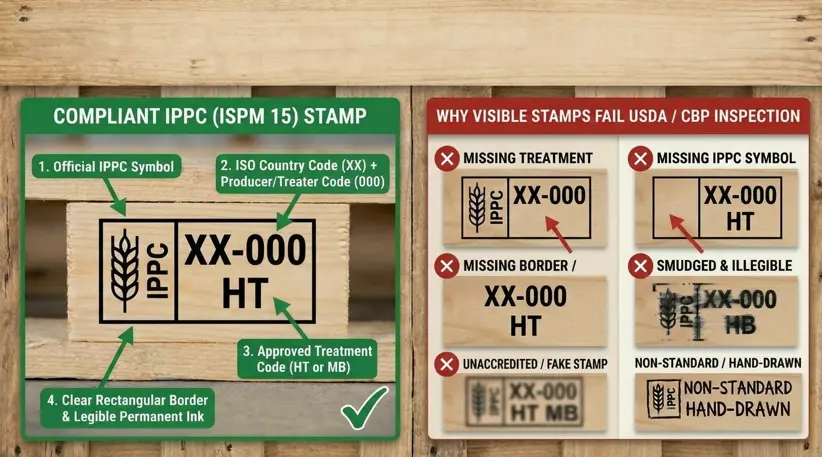
ISPM 15 wood packaging marks: compliant stamp components vs. common rejection triggers at U.S. ports.

An ISPM 15 wood packaging mark is the official international stamp certifying that solid wood pallets, crates, skids, and dunnage have been debarked and heat-treated or fumigated to prevent the spread of wood-boring pests. Under U.S. law (7 CFR § 319.40), every solid wood pallet entering the United States must carry a clear, compliant ISPM 15 stamp—and if the stamp is incomplete, smudged, or out of spec,

U.S. Customs and Border Protection (CBP) treats the pallet as completely unmarked.

This guide explains what the ISPM 15 mark means, the mandatory components of a compliant stamp, why visibly stamped pallets still fail CBP and USDA APHIS inspection, what happens when a 72-hour Emergency Action Notification (EAN) is issued, and how to protect your next container. If you want the full picture of how port holds affect container free days, read our guide to free time in shipping.

Table of Contents

  • What Is an ISPM 15 Wood Packaging Mark?
  • The Four Mandatory Parts of an ISPM 15 Stamp
  • Why Do “Stamped” Pallets Still Fail CBP and USDA Inspection?
  • What Happens When Pallets Fail Inspection? (The 72-Hour EAN Clock)
  • Your Two Options: Cargo Manipulation vs. Immediate Export
  • What Affects the Cost of a Wood Packaging Hold?
  • 7 Ways to Protect Your Shipments from a WPM Hold
  • Frequently Asked Questions
  • Final Thoughts

What Is an ISPM 15 Wood Packaging Mark?

The ISPM 15 mark (International Standards for Phytosanitary Measures No. 15) is the global “passport” for solid wood packaging material (WPM). Because untreated raw lumber can carry invasive pests such as the emerald ash borer and Asian longhorned beetle, the United States and more than 180 countries require all solid wood pallets, crates, drums, and dunnage over 6 mm thick to be treated and stamped before export.

In simple terms, the ISPM 15 stamp answers one question: who treated this wood, in which country, and by what approved method?

Instead of requiring a paper phytosanitary certificate for every wooden pallet in a container, customs and agriculture inspectors rely on the physical stamp branded or inked directly onto the wood. That is why the physical quality of the stamp itself determines whether your container clears customs or gets locked in an examination hold.

The Four Mandatory Parts of an ISPM 15 Stamp

Under ISPM 15 Annex 2 and CBP WPM guidelines, every valid wood packaging mark must contain four specific elements enclosed inside a clear rectangular border with an internal vertical dividing line:

Stamp ComponentWhere It AppearsWhat It Means
1. IPPC SymbolLeft side of the verticalThe official International Plant Protection
 dividing lineConvention wheat-ear logo with vertical IPPC
  lettering
2. Country Code (XX)Top right, before theThe two-letter ISO country code where the
 hyphenwood packaging was treated (for example,
  DE, IN, JO, CN)
3. Producer / Treater CodeTop right, after the hyphenThe unique registration number assigned by
(000) the exporting country’s National Plant
  Protection Organization (NPPO) to the
  accredited treatment facility
4. Treatment Code (YY)Bottom right, below the country and producer codeThe approved treatment method: HT (Heat Treatment), MB (Methyl Bromide fumigation),
  or DH (Dielectric Heating)

Every pallet must be marked with this complete stamp in permanent dark ink (or heat-branded) on at least two opposite sides so an inspector can read it without unstacking the cargo. Red or orange ink is never permitted because those colors are reserved for dangerous-goods labeling.

Why Do “Stamped” Pallets Still Fail CBP and USDA Inspection?

This is where most importers get caught. Your overseas supplier confirms that the pallets were stamped prior to loading, yet CBP Agriculture issues an Emergency Action Notification citing “Lacking ISPM 15 Marking.”

Under 7 CFR § 319.40-3(b), a stamp that is missing a required element or fails accreditation checks is legally treated the same as no stamp at all. During physical exams at Centralized Examination Stations (CES), USDA and CBP Agriculture Specialists reject visibly stamped pallets for six common reasons:

1.  Missing Treatment Code (HT or MB). The pallet displays the country and producer number (XX-000), but omits the HT or MB treatment code underneath.

2.  Missing or Non-Standard IPPC Symbol. The wheat-ear logo on the left side is left off, hand-drawn, or out of proportion.

3.  Missing Border or Vertical Divider. The codes are stamped onto the wood without the outer rectangular box or the internal vertical line separating the IPPC symbol from the text.

4.  Smudged, Illegible, or One-Sided Ink. The stamp is split across a gap between pallet slats, blurred beyond recognition, or applied on only one side of the pallet.

5.  Unaccredited or Suspended Facility Number. The producer code (XX-000) is expired, revoked by the foreign ministry of agriculture, or flagged in USDA’s counterfeit stamp database.

6.  Repaired “Mixed-Wood” Pallets or Bark. A stamped pallet was repaired with an unstamped replacement board, or the wood still carries bark strips exceeding ISPM 15 tolerances.

A useful rule: a partial stamp is an invalid stamp. Even if 90% of the mark is visible, a missing border line or unreadable treatment code renders the entire pallet non-compliant.

What Happens When Pallets Fail Inspection? (The 72-Hour EAN Clock)

When CBP Agriculture discovers non-compliant wood packaging material (NCWPM) during an exam, the officer issues an Emergency Action Notification (EAN, PPQ Form 523). Two operational rules immediately apply:

  No U.S. fumigation is allowed. You cannot pay to heat-treat or fumigate non-compliant pallets at a

U.S. port to release them into commerce. The non-compliant wood must be re-exported from the United States.

  CBP does not share exam photos. CBP policy prohibits officers from sending photographs of examined cargo to importers or brokers. If your supplier did not photograph the pallets before loading, you will not see what the stamp looked like unless you arrange a supervised manipulation at the CES warehouse.

Once the EAN is issued, you are typically given 72 hours to select a disposition, sign and return the EAN, and start remedial action. At many U.S. ocean ports, the non-compliant wood must be re-exported directly via ocean freight to a non-North American foreign destination (meaning it cannot be moved by truck or rail to Canada or Mexico).

Worked Example

Assume a container of industrial chemicals arrives at a U.S. port loaded on 23 wooden pallets. All 23 pallets carry a visible producer stamp, but USDA determines the stamps do not meet IPPC standards.

StageEventCargo StatusImporter Cost & Clock Impact
Day 1Container drayed to CES forHeld at CES warehouseCES drayage and exam fees
 Agriculture exam; 23 pallets found apply; port free time
 non-compliant continues to run
Day 2CBP issues Emergency ActionLocked underImporter has 72 hours to elect
 Notification (EAN) with a 72-hour action windowAgriculture HoldOption 1 (Manipulation) or Option 2 (Immediate Export)
Day 4Importer elects Option 1, submits signed EAN + CBP Form 3499,Pending CBPmanipulation approvalImporter coordinates labor quote and replacement pallets
 and books an outbound Export with the CES warehouse
 Container  
Day 7CES unstacks cargo ontoProduct released intoImport container returned to
 compliant pallets under CBPthe U.S.; 23 emptycarrier (stopping per diem);
 supervision and loads the 23 badpallets staged foroutbound ocean booking
 pallets into the Export Containerexportsubmitted to CBP
Day 12Outbound vessel sails with the 23EAN formally closedImporter pays CES
 empty pallets; Export Bill of Lading manipulation labor, CBP
 sent to CBP supervision, and outbound
   ocean freight for the pallets

Your Two Options: Cargo Manipulation vs. Immediate Export

When you receive an EAN for non-compliant wood packaging, Box 16 of the form gives you two practical paths forward:
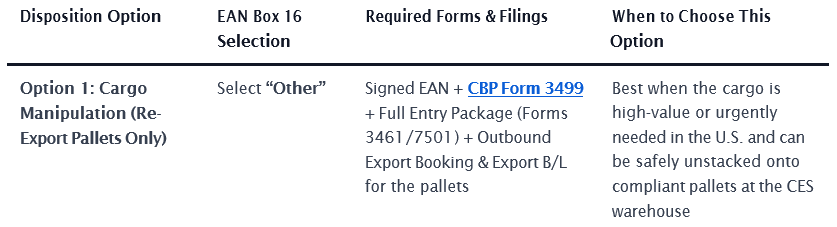
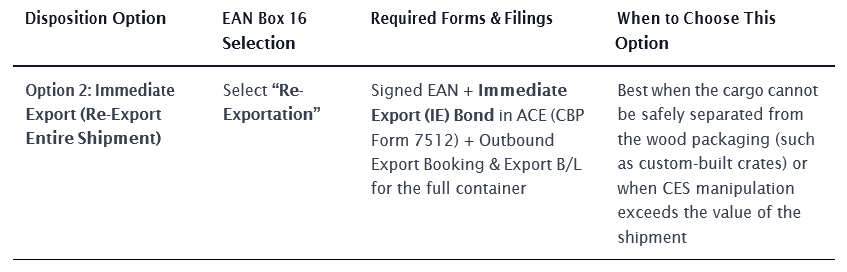
In both cases, CBP warns that importing non-compliant wood packaging violates the IPPC international agreement and 7 CFR § 319.40, which can trigger a Title 19 penalty under 19 U.S.C. § 1595a up to the domestic value of the merchandise.

What Affects the Cost of a Wood Packaging Hold?

There is no fixed fee for resolving a WPM violation. Total costs depend on:

  How the cargo is packed. Palletized cartons or drums are much faster for CES warehouse crews to transfer than loose bags, fragile glass, or custom timber crating.

  Number of non–compliant pallets. Even if only a few pallets are non-compliant, you must secure and

pay for an outbound ocean export container to re-export the rejected wood.

  CES storage and carrier detention. Every day spent waiting for an export booking or CBP Form 3499 approval adds CES warehouse storage and carrier per diem charges once your free days expire.

  Prior compliance history. Repeat WPM violations under the same Importer of Record or foreign shipper significantly increase the likelihood of a formal Title 19 penalty claim.

7 Ways to Protect Your Shipments from a WPM Hold

1.  Require stamp photos before loading. Add a strict clause to your purchase orders requiring the overseas supplier to photograph the ISPM 15 stamps on two opposite sides of every pallet before the container doors close.

2.  Audit all four parts of the mark. Verify that the supplier’s stamp shows a complete outer rectangular border, internal vertical divider, IPPC wheat symbol, two-letter ISO country code + producer number (XX-000), and HT or MB treatment code.

3.  Ban repaired “Frankenstein” pallets. Instruct overseas warehouses never to repair a heat-treated pallet with an unstamped board. A single untreated board invalidates the entire pallet unless it is re-treated and re-stamped in full.

4.  Switch to exempt pallets for high–risk cargo. USDA APHIS completely exempts plastic pallets, plywood, pressboard, oriented strand board (OSB), and metal frames from ISPM 15 rules. Using plastic or engineered-wood pallets eliminates WPM hold risk entirely.

5.  Keep supplier treatment certificates on file. Require your exporter to provide the pallet manufacturer’s accreditation certificate and heat-treatment/fumigation log so you can prove due

diligence if CBP initiates a traceback or penalty review.

6.  Respond within the 72-hour EAN window. If an EAN is issued, have your customs broker contact the port’s CBP Agriculture unit and the CES warehouse on Day 1 to price out Form 3499 manipulation versus immediate export.

7.  Coordinate drayage and export bookings under one roof. Moving an import container into a CES while simultaneously booking an outbound export container for rejected pallets requires tight timing across customs clearance, drayage, and ocean freight.

Frequently Asked Questions

What does ISPM 15 mean in shipping?

ISPM 15 (International Standards for Phytosanitary Measures No. 15) is the international phytosanitary rule requiring solid wood packaging material—such as pallets, crates, and dunnage—to be debarked, heat-treated (HT) or fumigated with methyl bromide (MB), and stamped with an official IPPC mark before international shipment.

Why did CBP cite my stamped pallets as “Lacking ISPM 15 Marking”?

Under 7 CFR § 319.40-3(b), any stamp that is illegible, missing its outer border or vertical divider, missing the IPPC wheat logo or HT/MB treatment code, or tied to an unaccredited producer number is legally classified as unmarked (“Lacking ISPM 15 Marking”).

Can non–compliant pallets be fumigated at a U.S. port?

No. U.S. regulations do not allow post-arrival fumigation or heat treatment to bring non-compliant wood packaging into compliance for U.S. entry. The non-compliant wood must either be separated from the cargo and re-exported, or the entire shipment must be re-exported.

Why won’t CBP share photos of the rejected pallet stamps?

CBP operational policy prohibits officers from sharing photographs of examined cargo with external parties. To determine the exact defect on a rejected stamp, your customs broker can request a verbal or written clarification from the inspecting Agriculture Officer or inspect the pallets during an approved CES manipulation.

What is CBP Form 3499 used for in a WPM hold?

CBP Form 3499 (Application and Approval to Manipulate, Examine, Sample, or Transfer Goods) is the official application filed with CBP to authorize a CES warehouse to strip your merchandise off non-compliant wood pallets, transfer the cargo onto compliant pallets for U.S. release, and load the rejected wood into an export container under CBP supervision.

Which pallets are exempt from ISPM 15 requirements?

Pallets and packaging made entirely of plastic, metal, corrugated cardboard, or manufactured wood products—such as plywood, particleboard, oriented strand board (OSB), pressboard, and veneer—are exempt from ISPM 15 treatment and stamping rules.

Final Thoughts

A wood packaging hold is one of the most avoidable—yet expensive—disruptions in international shipping. Because CBP and USDA treat a smudged, incomplete, or unaccredited stamp the same as raw untreated lumber, relying on your supplier’s verbal assurance that pallets are stamped is a costly gamble. Requiring pre-loading stamp photos, auditing the four parts of the IPPC mark, or switching to plastic or engineered-wood pallets keeps your cargo out of the exam station.

At TEU Global, our team coordinates ocean freight shipping, customs clearance, customs compliance coaching, drayage, and warehousing—helping you prevent WPM holds upstream and resolving CBP Form 3499 manipulations quickly when port emergencies happen.

Need help resolving a CBP Agriculture hold or keeping your containers compliant? Get a quote from TEU Global or contact our customs compliance team today.

Author Bio: Lana Gorbunova, LCB, Ph.D., is a Licensed Customs Broker and Customs Compliance Associate at Trade Expeditors USA, Inc. (dba TEU Global), specializing in ACE trade compliance, PGA regulatory resolution, and customs enforcement strategy.


READ MORE
HTS Code Classification
InformationalCompliance & Regulations
June 11, 2026 By TEU Global Editorial Team

HTS Code Classification Guide 2026: Avoid Customs Penalties and Reduce Import Duty Costs

Introduction

In today’s increasingly complex trade environment, accurate HTS code classification is more important than ever. With heightened customs enforcement, evolving tariff regulations, and stricter compliance requirements in 2026, importers face significant risks when products are classified incorrectly.

A single classification error can lead to customs delays, unexpected duties, penalties, cargo holds, or even government audits. Understanding customs tariff classification through this HTS classification guide helps businesses remain compliant, control costs, and maintain efficient supply chains. 

This guide explains how importers can avoid common classification mistakes, reduce duty expenses, and prepare for increased customs scrutiny in 2026.

What Is HTS Code Classification?

Import tariff classification is the process of assigning imported products to the correct Harmonized Tariff Schedule (HTS) code used by U.S.Customs and Border Protection (CBP).

Every imported product must be classified under a specific tariff code that determines:

  • Applicable duty rates
  • Trade restrictions
  • Import documentation requirements
  • Eligibility for trade programs
  • Additional tariff obligations

The HTS system is based on the international Harmonized System (HS), making proper HS code classification essential for global trade compliance.

Accurate classification ensures that importers pay the correct duties while avoiding customs violations.

Why HTS Classification Matters for Importers

Proper HTS code classification affects nearly every aspect of importing goods into the United States.

Key benefits include:

  • Accurate duty assessment
  • Faster customs clearance
  • Reduced compliance risk
  • Improved supply chain planning
  • Lower likelihood of audits

Incorrect classifications can result in costly corrections, shipment delays, and increased scrutiny from customs authorities.

As customs regulations continue to evolve in 2026, businesses that prioritize classification accuracy gain a significant competitive advantage.

Common HTS Classification Mistakes That Trigger Customs Penalties

Many customs penalties result from avoidable classification errors.

Common mistakes include:

Using Supplier-Provided Codes Without Verification – Foreign suppliers often assign tariff codes based on local regulations, which may not align with U.S. requirements.

Classifying Products Based Solely on Product Names – Classification depends on a product’s composition, function, and intended use-not its marketing description.

Overlooking Product Modifications – Even minor changes in materials or functionality may require a different tariff classification.

Failing to Update Classifications – Trade regulations and tariff schedules change regularly. Importers should review classifications periodically to ensure continued accuracy.

Maintaining Inadequate Documentation – Insufficient product specifications can make it difficult to support classification decisions during customs reviews.

These mistakes frequently lead to penalties, duty reassessments, and increased compliance costs.
Explore more about TEU Global’s HTS classification and trade compliance solutions.

The engineer is checking the safety of the container ship.

How Incorrect HTS Codes Increase Duty Costs

One of the most significant financial consequences of poor HTS code classification is the overpayment or underpayment of duties.

When a product is classified incorrectly:

  • Duty rates may be higher than necessary.
  • Additional tariffs may apply.
  • Customs may assess retroactive duty payments.
  • Interest and penalties may be imposed.

Accurate import duty calculation begins with selecting the correct HTS code.

Many importers uncover substantial savings opportunities by conducting comprehensive classification reviews and identifying more accurate tariff categories.

Proper classification can help businesses legally reduce import duties while maintaining full compliance.

How to Conduct an HTS Code Lookup Properly

Performing an accurate HS code search requires more than simply searching by product name.

Follow these steps:

Gather Complete Product Information

Collect detailed specifications, including:

  • Materials
  • Manufacturing processes
  • Product functions
  • Technical characteristics

Review Official HTS Resources

Use official tariff schedules and customs guidance documents to identify the most appropriate classifications.

Compare Similar Products Carefully

Products that appear similar may fall under entirely different tariff headings.

Document Your Analysis

Maintain detailed records that support classification decisions.

A thorough HTS classification process helps reduce errors and strengthens compliance efforts.

HTS Code Classification and U.S. Tariffs in 2026

Recent trade policy developments have increased the importance of accurate tariff classification Many tariff programs in 2026 apply only to specific classifications. Importers should monitor updates from the Office of the United States Trade Representative (USTR) to stay informed about tariff changes and trade policy developments.

  • Trigger unnecessary tariffs
  • Eliminate eligibility for trade programs
  • Increase landed costs
  • Result in customs regulatory issues 

As import regulations continue to change, businesses should review classifications whenever new tariff measures are introduced.

Understanding the relationship between customs tariff classification and tariff exposure helps companies manage import costs more effectively.

Preparing for a Customs Audit

Customs audits are becoming more common as regulatory agencies increase enforcement efforts.

Effective customs audit preparation begins with accurate classification procedures.

Importers should:

  • Maintain classification records
  • Preserve product specifications
  • Document classification methodologies
  • Conduct periodic internal reviews
  • Correct identified errors promptly

A well-documented classification program demonstrates good-faith compliance and may help reduce enforcement risks.

Best Practices for Customs Compliance

Successful importers treat classification as an ongoing compliance process.

Recommended practices include:

Conduct Regular Classification Reviews

Review classifications whenever products, suppliers, or regulations change.

Implement Internal Controls

Establish procedures for reviewing tariff classifications before importation.

Train Staff

Employees involved in sourcing, logistics, and compliance should understand classification fundamentals.

Monitor Regulatory Updates

Stay informed about tariff changes and customs guidance.

Strong import compliance programs reduce risk while improving operational efficiency.

When to Seek Professional Classification Assistance

Certain products require advanced classification analysis.

Professional assistance may be beneficial when dealing with:

  • Complex manufactured goods
  • Multifunction products
  • High-duty imports
  • Products subject to special tariffs
  • Customs disputes or audits

Expert classification reviews often identify risks and cost-saving opportunities that internal teams may overlook.

How TEU Helps Importers Stay Compliant

Managing tariff classifications can be challenging, particularly as customs regulations continue to evolve.

TEU helps importers improve compliance through:

  • HTS classification support
  • Customs consulting services
  • Tariff risk assessments
  • Duty optimization strategies
  • Trade compliance reviews
  • Import documentation assistance

Businesses can also benefit from TEU’s resources related to:

  • Tariff rate analysis
  • Import compliance consulting
  • Customs brokerage support
  • Supply chain optimization
  • Trade advisory services

By combining regulatory expertise with practical import solutions, TEU helps organizations reduce risk and improve operational efficiency.

Contact TEU for a classification review or compliance assessment.

Conclusion

Accurate HTS code classification plays a critical role in customs compliance, duty management, and supply chain efficiency. As tariff regulations continue to evolve in 2026, businesses that maintain accurate classifications can reduce costs, avoid penalties, and improve import operations. Regular reviews, proper documentation, and expert guidance help ensure long-term compliance and competitive advantage.

Because tariff obligations are often tied directly to product classifications, importers should also stay informed about the latest U.S. trade policies and duty changes. For additional insights, read our guide on U.S. Tariffs 2026: How Importers Can Reduce Costs and Stay Compliant.

READ MORE
Customs Clearance Process Documentation
Compliance & Regulations
January 7, 2026 By TEU Global Editorial Team

Customs Clearance Process: How We Handle It at TEU Global

At TEU Global, we deal with the customs clearance process every single day. It’s one of the most important parts of international logistics, and it’s also one of the most misunderstood. Many companies see customs as paperwork that just needs to be filed. From our experience, it’s far more than that.

Customs clearance is where preparation, accuracy, and judgment all come together. When it’s handled correctly, shipments move smoothly. When it isn’t, delays and unexpected costs tend to follow. Over the years, we’ve learned that success at customs starts long before cargo arrives at the border.

How We View the Customs Clearance Process

To us, the customs clearance process is not just a regulatory step. It’s a risk-management function. Every shipment tells a story through its documents, and customs authorities are trained to read that story closely.

We focus on consistency. Product descriptions, declared values, and classifications need to align not just within one shipment, but across multiple entries over time. When customs sees clear, repeatable information, they ask fewer questions. That consistency builds credibility, and credibility keeps cargo moving.

customs clearance process explained

Where We See Most Customs Issues Originate

Most customs problems don’t come from serious violations. They come from small oversights.

We often see issues caused by:

  • Vague or overly generic product descriptions
  • HS codes reused without proper review
  • Minor value discrepancies between documents
  • Assuming regulations haven’t changed

These details may seem minor, but they can slow the customs clearance process quickly. That’s why we place so much emphasis on reviewing documentation before a shipment is ever filed.

What Happens When Cargo Arrives

Once cargo arrives at a port or airport, the carrier submits a manifest to customs. A customs declaration is then filed, either by the importer or through a licensed customs broker.

From our experience, inspections are not truly random. Shipments with clear documentation and a solid compliance history tend to move faster. Customs authorities rely on risk profiling, and accurate data plays a major role in how that risk is assessed.

Over time, we’ve seen that preparation reduces friction at this stage of the customs clearance process.

Duties, Taxes, and Cargo Release

After reviewing the declaration, customs assesses duties and taxes based on classification, value, and applicable trade rules. Once payment is completed, the shipment is released.

When documentation is accurate and complete, this step is straightforward. When it isn’t, even small corrections can delay release. That’s why we treat duty assessment as part of planning, not an afterthought.

How We Support Customs Clearance at TEU Global

At TEU Global, our role is to make the Customs Clearance Process predictable and manageable for our clients. Through our dedicated customs clearance services, we support importers by reviewing classifications, validating documentation, and coordinating directly with customs authorities.

We don’t just focus on clearing a shipment. We focus on reducing the likelihood of issues on future shipments. That long-term approach is what helps our clients maintain consistency and avoid unnecessary delays.

Because customs is closely tied to transportation and compliance, our team works in coordination with other logistics functions. Clients can learn more about our broader capabilities through the TEU Global website.

Common Challenges We See in Customs Clearance

Even well-managed shipments can face challenges.

Regulations evolve constantly. Tariffs, sanctions, and documentation requirements change, sometimes with little notice. We also see delays caused by port congestion or inspections that are outside anyone’s control.

What makes the difference is how prepared a shipment is when those challenges arise. Clear documentation and strong compliance history often shorten resolution time.

How We Help Improve the Customs Clearance Process Over Time

We believe customs clearance improves with discipline and consistency.

We help clients standardize product descriptions, review classifications regularly, and maintain organized compliance records. When something isn’t clear, we address it early instead of making assumptions.

We also stay aligned with global and national guidance. Standards from the World Customs Organization influence how customs administrations operate worldwide. For U.S. imports, we closely follow updates from U.S. Customs and Border Protection to ensure our clients remain compliant.

Our goal isn’t perfection. It’s predictability and control.

Frequently Asked Questions

How long does the customs clearance process usually take?

When documentation is complete and accurate, clearance can often be completed within one business day. Inspections or missing information can extend that timeline.

Does customs clearance apply to exports as well?

Yes. Export shipments also go through a customs clearance process to meet regulatory and security requirements.

Can customs clearance be completed before cargo arrives?

In many cases, advance filing is possible and can significantly speed up the release process once cargo arrives.

What causes most customs delays?

The most common causes we see are incomplete documentation, incorrect classification, unpaid duties, and regulatory changes.

Is customs clearance only important for large importers?

No. Small and mid-sized businesses face the same customs requirements, and delays can have an even greater impact on their operations.

How does TEU Global reduce customs clearance risks?

We focus on proactive review, accuracy, and compliance consistency, helping our clients avoid avoidable delays and penalties.

Final Thoughts

At TEU Global, we see the customs clearance process as a critical part of successful global trade. When customs is treated as an afterthought, delays and costs increase. When it’s treated as part of a broader logistics strategy, it becomes far more manageable.

By combining experience, preparation, and regulatory awareness, we help our clients move goods across borders with greater confidence and fewer disruptions. Over time, that reliability becomes a competitive advantage.

READ MORE
cpsc e-filling system for compliance certificates
Compliance & Regulations
January 1, 2025 By TEU Global Editorial Team

CPSC to Roll Out Mandatory e-filing System for Compliance Certificates by 2025

The U.S. Consumer Product Safety Commission (CPSC) has announced the introduction of a new Electronic Filing (eFiling) system to enhance consumer safety across the United States. This new certification system is a step from paper to pixel, making it easier for the importers in numerous ways.

Is Your Business Ready For The eFiling System?

Washington, D.C. has made a significant move in the trading world. For consumer safety, CPSC has announced that US importers have to electronically submit crucial details at the time of import instead of current paper-based certifications. The initiative aims to modernize safety checks and reduce risks associated with unsafe imports. 

This move aims to ensure a fast process with minimum risks of unsafe products in the market. Businesses must adapt to this change to remain compliant. So, if you’re prepared to meet these requirements, your business will be set for success.

The Final Rule

December 18, 2024, marks the day when the final rule was approved which includes updates based on the feedback given: 

  • Extended preparation time for businesses. 
  • Elimination of duplicative testing requirements and automation bulk certificate attestations.
  • Clarified definitions for terms like “finished product” and “importer.” 
  • Exemptions for certain product categories outside CPSC jurisdiction. 
  • Alignment of certification processes with modern trade practices. 

Details Required For eFiling

The new system will have certain requirements from importers end. This includes submission of data or comprehensive information about every product via the e-filing system. The details of products include:

  • Product identification (e.g., GTIN). 
  • Safety rules applicable to the product. 
  • Date and location of manufacturing. 
  • Date and location of compliance testing. 
  • Contact details of the testing entity. 
  • Confirmation of an existing compliance certificate.

Which Products are Included? Who Can Participate?

The initiatives that are being aimed to minimize the risks that come along this process as this system will initially cover up to 300 products based on Harmonized Tariff Schedule (HTS) codes. The categories coming under this umbrella are:

  • Toys 
  • Rugs and mattresses 
  • Baby carriages and cribs 
  • Children’s furniture 
  • Bicycle helmets 
  • School supplies 

These products come under the existing CPSC standards, such as the Children’s Product Certificate (CPC) and General Certificate of Conformity (GCC). There is a chance that the new system might replace these paper-based certifications.

Implementation And Potential Outcome

Alex Hoehn-Saric, the chair of CPSC considers the eFiling system an important step ensuring imported products meet safety standards. According to him,

“This rule strengthens our ability to prevent unsafe goods from reaching consumers’ homes while rewarding compliant businesses with faster clearance,”

CPSC has invited up to 2,000 additional importers to participate in the voluntary testing phase. This system is a game changer yet flexible as an extended implementation period is being given to businesses to adjust beforehand.18 months after final rule approval, whereas 24 months are given to Foreign Trade Zones. Not only this but warehouses will be given a longer timeline to adjust accordingly.

Preparation For Importers

Importers can prepare themselves for the eFiling system by collecting the required data in advance and participating in CPSC’s voluntary phase to refine processes. Moreover, they can train their team for any unpredictable future events and collaborate with various logistics partners to get a better perspective of the whole scenario. Working with trusted logistics providers like TEU Global can make complex transitions like these easier and smoother for your business.

The Next Chapter in Global Trade

The e-filing system is expected to revolutionize the import process, making it stronger and faster. It also strengthens the CPSC’s ability to identify unsafe products, ensuring greater consumer protection. Importers are expected to act promptly before the system is implemented by CPSC or hire a company that handles these operations by teams of experts for less risk of loss like TEU Global.

Talk to one of the experts in the team to ensure a smooth Global journey.

Contact Us
READ MORE
TEU Global

TEU Global is a 3PL company, with a top reliable global agent network. From freight forwarding and customs clearance to warehousing and purchase order management, we provide the best services with extra personal care.

Services

Ocean Freight Shipping

US Handling Agent

Canada Handling Agent

Freight Forwarding

Customs Clearance

Cargo Insurance

Drayage & Domestic Truck Delivery

Warehousing and Distribution

Purchase Order Management

Logistics Consultants

Customs Compliance Coaching

Branches

CANADA Inc

51 Village Centre Place, Mississauga, Ontario, Canada 

Email : canada@teuinc.com
Phone : (+1) 732-564-6919
Phone : (+1) 437 326 1269

Phone : (+1) 908 758 7840

MIAMI

Distribution & Dispatch facility

5855 NW 159th St,

Miami Lakes FL 33014
Email : Mia@teuinc.com
Phone : 305-851-7818


UAE

Office No: 2311, The Prime Tower Business Bay, Dubai
Email: Gulf@teuinc.com
Phone: 971-4-422-1046


MALAYSIA

Teu Global Sdn. Bhd
B109 Kelana Square  No.17 Jalan SS 7/26, 47301 Petaling Jaya, Selangor MALAYSIA

Email: Malaysia@teuinc.com

Malaysia Landline : +60-36-789-2285

Phone : +60-12-656-8642


Head Office

NEW JERSEY

242 Old New Brunswick Road,
Suite 145 Piscataway, NJ 08854 USA

Email : info@teuinc.com
Phone : 732-515-9040
Fax # : 732-856-5008
Toll free: 877-414-8381

TwitterFacebookInstagramYoutubeLinkedin

Copyright © 2015-2026. TEU Global – All Rights Reserved.

Privacy Policy | Terms & Conditions