InformationalLogistics
If you’ve ever looked at a shipping quote, a port report, or a vessel’s specifications and seen the letters “TEU” staring back at you, you’re not alone in wondering what it actually means. It’s one of those terms the logistics industry throws around constantly, assuming everyone already understands it — but if you’re new to shipping, importing, or exporting, it can feel like a foreign language.
What is TEU in shipping?
TEU (Twenty-foot Equivalent Unit) is the standard unit used to measure shipping container capacity. One 20-foot container equals 1 TEU, while one 40-foot container equals 2 TEU. Shipping companies, ports, and freight forwarders use TEU to compare vessel capacity, cargo volume, and vessel size worldwide.
By the end of this guide, you’ll know exactly what TEU stands for, how it’s calculated, how it differs from FEU, and why it matters whether you’re shipping ten pallets or ten thousand.
Table of Contents
What Is TEU in Shipping?
TEU in shipping is a standardized unit of measurement used to describe cargo capacity, based on the size of a 20-foot shipping container. One TEU equals one 20-foot container, and the term is used across the industry to measure vessel capacity, port throughput, terminal handling capacity, and freight volume.
Instead of every carrier, port, and forwarder describing capacity differently based on whatever mix of container sizes they happen to be handling, TEU gives the whole industry one common unit to measure against. It shows up on shipping documents, vessel specification sheets, port statistics, and freight quotes — which is exactly why the term is so unavoidable once you start working in logistics.
What Does TEU Stand For?
TEU stands for Twenty-foot Equivalent Unit. It’s a standardized unit of measurement the shipping industry uses to describe cargo volume and container capacity, based on the size of a standard 20-foot shipping container.
In simple terms: one TEU equals one 20-foot container.
That’s the entire concept in a nutshell. Instead of describing a ship’s capacity as “it can carry 8,000 containers of various shapes and sizes,” the industry uses TEU as a common denominator so everyone — carriers, ports, freight forwarders, and customers — is speaking the same language.
Think of it like using “square footage” to describe the size of a house, regardless of how the rooms are laid out. TEU does the same job for shipping containers.
Understanding TEU in shipping helps importers, exporters, and logistics professionals compare container capacity across carriers, ports, and vessels using one universal measurement.
Why Was TEU Created in the First Place?
Before standardized container measurements existed, cargo was loaded in inconsistent shapes, sizes, and formats. This made it difficult to compare ship capacities, plan port operations, or calculate freight costs accurately.
The shipping industry needed one universal reference point. The 20-foot container became that reference point, and TEU became the unit used to express capacity across ships, ports, and terminals — no matter what mix of container sizes was actually being loaded.
This standardization is a big part of why global trade became so much faster and cheaper over the past several decades. Without it, comparing a 14,000-container ship to a 9,000-container ship (when both ships carry different container size mixes) would be almost impossible.
Today, TEU in shipping remains the global standard for measuring container capacity and reporting cargo volumes across the supply chain.
TEU Dimensions: What Does a 20-Foot Container Actually Look Like?
A standard 20-foot container (1 TEU) generally measures:
- Length: approximately 20 feet (6.06 meters)
- Width: approximately 8 feet (2.44 meters)
- Height: approximately 8.5 feet (2.59 meters)
It typically holds around 9 to 11 standard pallets in a single tier, and can carry up to roughly 28 metric tons, depending on the carrier’s weight limits and local road regulations.
One important detail many guides skip: TEU only accounts for length, not height. That means a standard 20-foot container and a 20-foot “high-cube” container (which is taller) are both still counted as exactly 1 TEU. Capacity planners factor height separately when it matters for a shipment.
How Is TEU Calculated?
The math behind TEU is refreshingly simple once you know the rule:
| Container Size | TEU Equivalent |
| 20-foot container | 1 TEU |
| 40-foot container | 2 TEU |
| 45-foot container | 2.25 TEU (often rounded to 2 TEU in practice) |
Calculating TEU in shipping is straightforward because every container is converted into its 20-foot equivalent for consistent reporting. So if a ship is carrying 5,000 forty-foot containers, its cargo is reported as 10,000 TEU — even though the physical container count is only 5,000.
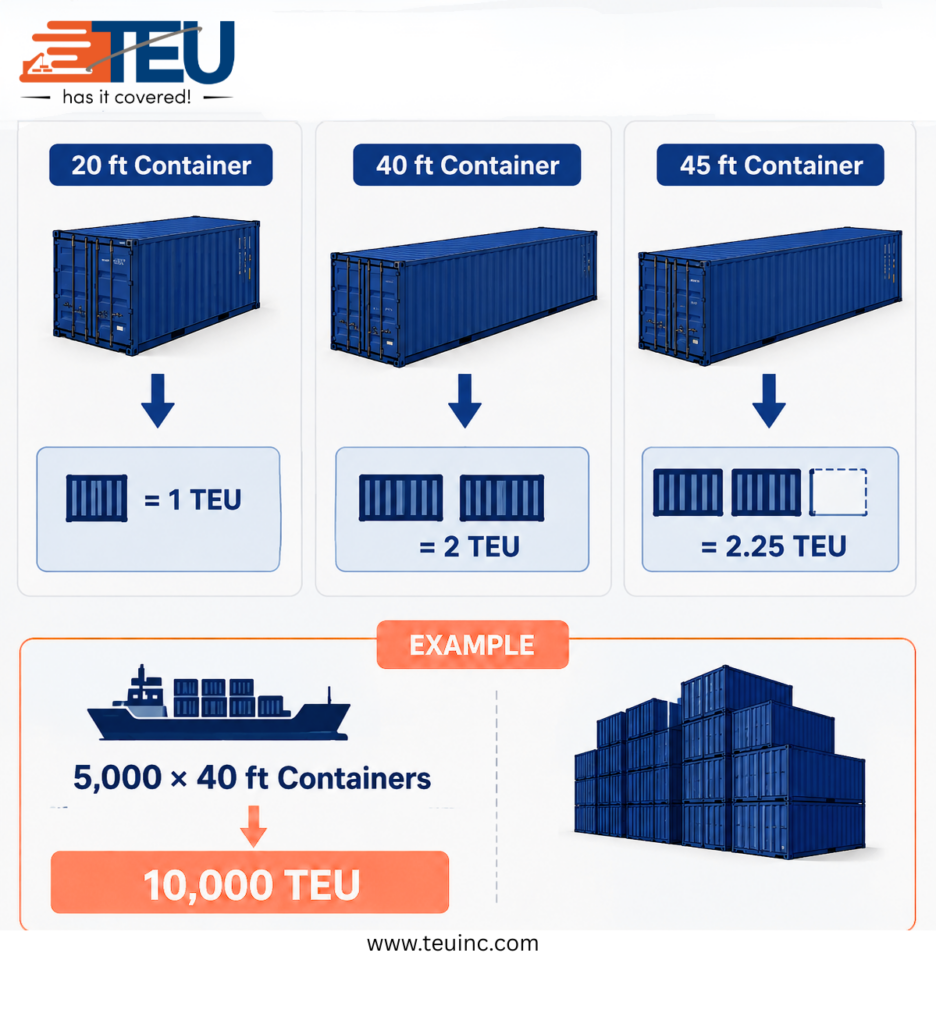
This is a detail that trips a lot of people up. If you’re comparing “number of containers” to “TEU capacity,” you’re not comparing the same thing. A ship’s TEU rating is almost always higher than its actual container count, since most modern shipments use 40-foot containers rather than 20-foot ones.
TEU vs FEU: What’s the Difference?
Alongside TEU, you’ll often see the term FEU, which stands for Forty-foot Equivalent Unit. An FEU represents the capacity of a standard 40-foot container — which, as covered above, equals exactly 2 TEU. Understanding the relationship between TEU and FEU makes TEU in shipping much easier to interpret when comparing freight quotes and vessel capacities.
Here’s a quick side-by-side comparison:
| Metric | TEU | FEU |
| Full Form | Twenty-foot Equivalent Unit | Forty-foot Equivalent Unit |
| Based On | 20-foot container | 40-foot container |
| TEU Equivalent | 1 TEU | 2 TEU |
| Common Use | Port throughput, vessel capacity | Freight rate quotes, container leasing |
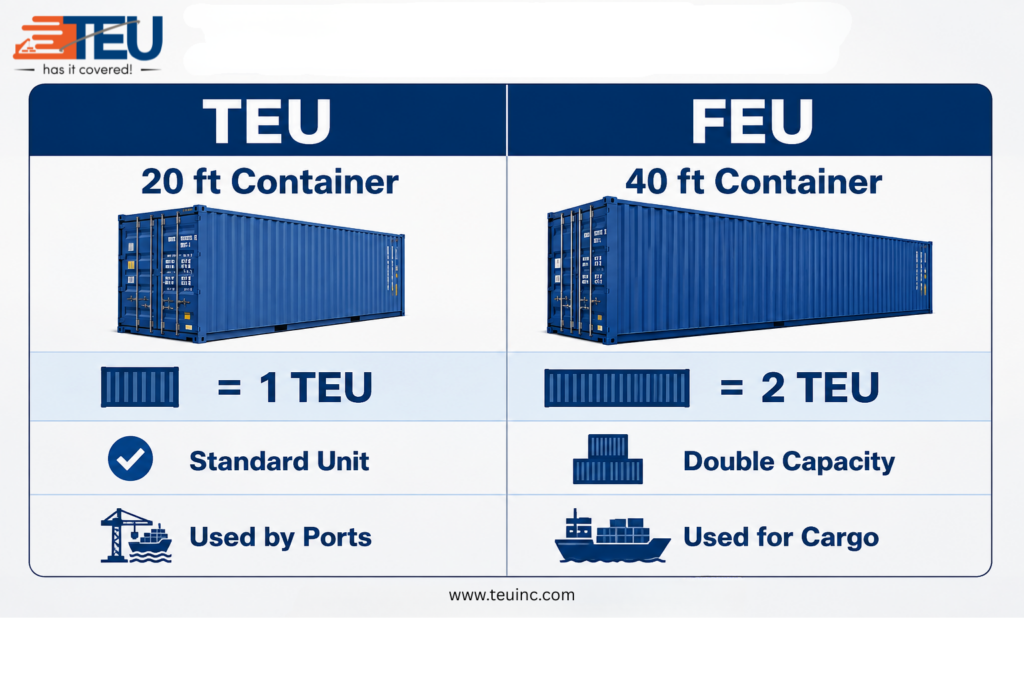
In practice, most cargo today actually moves in 40-foot containers, since they’re more cost-efficient per unit of cargo. But TEU remains the industry-standard reporting metric, even when most of the containers being counted are technically FEUs.
Where You’ll See TEU Used in the Real World
TEU in shipping isn’t just a technical term—it appears throughout the global logistics industry in several important areas:
- Vessel Capacity — Container ships are rated by how many TEU they can carry. Ultra-large container vessels today can carry upwards of 20,000+ TEU.
- Port Throughput — Ports report their annual cargo volume in TEU to measure efficiency and growth (for example, “Port X handled 40 million TEU last year”).
- Freight Rate Quotes — Ocean freight pricing is often quoted per TEU, especially for less-than-container-load (LCL) or partial shipments.
- Terminal and Yard Planning — Terminal operators use TEU to plan storage space, crane scheduling, and yard capacity.
- Trade Statistics — Government and industry bodies track import/export volumes in TEU to measure trade activity between countries.
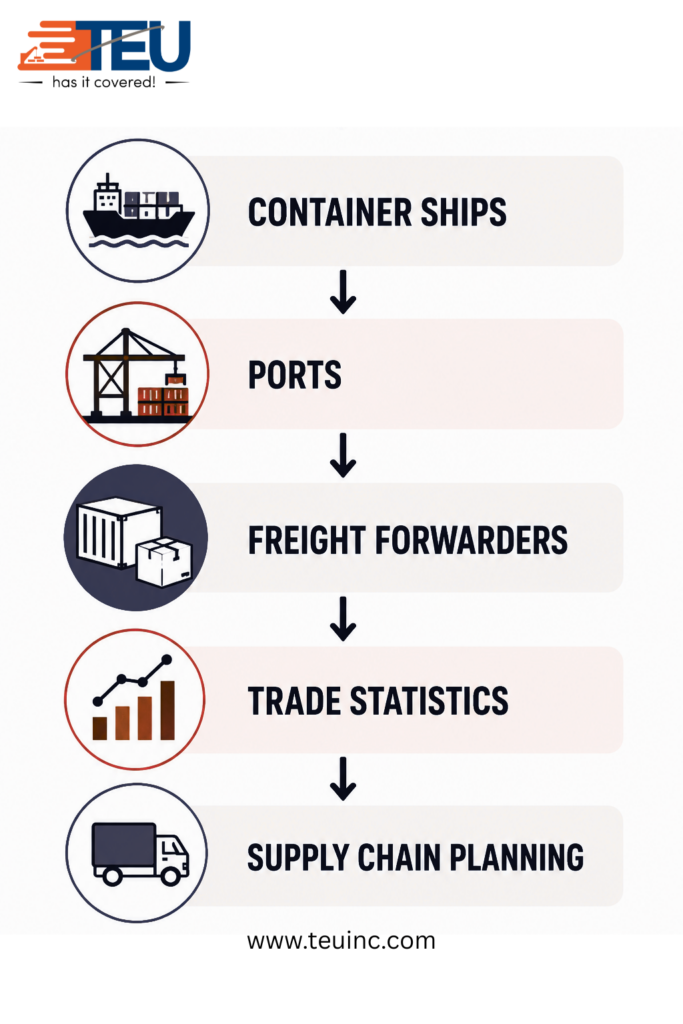
If you’re an importer or exporter, you’ll most likely encounter TEU when booking ocean freight, comparing carrier rates, or estimating how much of a container your cargo will actually fill.
Why TEU Matters for Your Business
Many people assume TEU in shipping measures cargo weight, but it only represents standardized container capacity. If you’re shipping goods internationally — whether you’re a small eCommerce brand or a large-scale importer — understanding TEU has real, practical value:
- Accurate Cost Estimates: Freight rates are frequently calculated per TEU, so knowing your shipment’s TEU equivalent helps you budget more precisely.
- Smarter Container Choices: Knowing how TEU and FEU relate helps you decide whether a 20-foot or 40-foot container is more cost-effective for your cargo volume.
- Better Supply Chain Planning: If you regularly track TEU volumes, you can better anticipate capacity constraints, especially during peak shipping seasons when container space is limited.
- Clearer Communication with Freight Forwarders: Speaking the same language as your logistics partner (in TEU terms) reduces confusion and miscommunication on bookings.
Common TEU Misconceptions
A few points worth clarifying, since they’re often glossed over or misunderstood:
- TEU is not a precise physical measurement — it’s a planning and reporting metric. Actual container dimensions can vary slightly by manufacturer, but TEU calculations don’t account for those small differences.
- TEU doesn’t measure weight. It’s purely a volume/capacity reference based on container length. A “heavy” TEU and a “light” TEU take up the same reported space.
- A higher TEU count doesn’t always mean more actual containers. As explained above, since most shipments move in 40-foot containers, a vessel’s TEU number is typically about double its physical container count.
Frequently Asked Questions About TEU in Shipping
What is the full form of TEU?
TEU stands for Twenty-foot Equivalent Unit, a standard measure of container shipping capacity based on a 20-foot container.
How many TEU fit on a container ship?
This varies enormously by vessel size. Smaller feeder ships may carry a few thousand TEU, while today’s largest container ships can carry over 20,000 TEU.
Is a 40-foot container 1 TEU or 2 TEU?
This varies enormously by vessel size. Smaller feeder ships may carry a few thousand TEU, while today’s largest container ships can carry over 20,000 TEU.
What’s the difference between TEU and a container?
TEU is a unit of measurement, while a container is the physical object. A single 20-foot container equals 1 TEU; a 40-foot container equals 2 TEU — meaning one container can represent multiple TEU depending on its size.
Why do ports report cargo in TEU instead of container counts?
Because container sizes vary, TEU gives ports and carriers a single, standardized way to measure and compare cargo volume regardless of the specific container mix being handled.
Final Thoughts
At its core, TEU is simply a standardized way of talking about shipping capacity — one 20-foot container equals one TEU, and everything else (40-foot containers, 45-foot containers, vessel size, port throughput) is measured relative to that baseline.
Once you understand this one concept, a huge portion of shipping terminology suddenly makes a lot more sense. Whether you’re booking your first ocean freight shipment or trying to make sense of global trade statistics, TEU is one of those foundational terms worth having down cold.
If you’re planning a shipment and want help figuring out how many TEU your cargo will need — or which container size makes the most financial sense — reach out to a logistics specialist who can walk you through your specific numbers.