
TEU Global
  • Home
  • About Us
  • Services
    • Ocean Freight Shipping
    • US Handling Agent
    • Canada Handling Agent
    • Freight Forwarding
    • Customs Clearance
    • Cargo Insurance
    • Drayage & Domestic Truck Delivery
    • Warehousing and Distribution
    • Purchase Order Management
    • Logistics Consultants
    • Customs Compliance Coaching
  • Resources
    • Payments
    • FAQs
    • Downloads
    • Knowledge Hub
    • Newsletter
  • Contact Us
  • Blog

Type To Search

Get a Quote
TEU Global
  • Home
  • About Us
  • Services
    • Ocean Freight Shipping
    • US Handling Agent
    • Canada Handling Agent
    • Freight Forwarding
    • Customs Clearance
    • Cargo Insurance
    • Drayage & Domestic Truck Delivery
    • Warehousing and Distribution
    • Purchase Order Management
    • Logistics Consultants
    • Customs Compliance Coaching
  • Resources
    • Payments
    • FAQs
    • Downloads
    • Knowledge Hub
    • Newsletter
  • Contact Us
  • Blog

Type To Search

Get a Quote
  • Home
  • About Us
  • Services
    • Ocean Freight Shipping
    • US Handling Agent
    • Canada Handling Agent
    • Freight Forwarding
    • Customs Clearance
    • Cargo Insurance
    • Drayage & Domestic Truck Delivery
    • Warehousing and Distribution
    • Purchase Order Management
    • Logistics Consultants
    • Customs Compliance Coaching
  • Resources
    • Payments
    • FAQs
    • Downloads
    • Knowledge Hub
    • Newsletter
  • Contact Us
  • Blog
teu global logo dark
  • Home
  • About Us
  • Services
    • Ocean Freight Shipping
    • US Handling Agent
    • Canada Handling Agent
    • Freight Forwarding
    • Customs Clearance
    • Cargo Insurance
    • Drayage & Domestic Truck Delivery
    • Warehousing and Distribution
    • Purchase Order Management
    • Logistics Consultants
    • Customs Compliance Coaching
  • Resources
    • Payments
    • FAQs
    • Downloads
    • Knowledge Hub
    • Newsletter
  • Contact Us
  • Blog
Trade & Tariffs
HomeArchive by Category "Trade & Tariffs"

Category: Trade & Tariffs

Tariffs and import costs impacting global shipping and trade.
InformationalTrade & Tariffs
June 26, 2026 By TEU Global Editorial Team

Tariff Guide for Importers: How Tariffs Affect Import Costs and Global Trade

In today’s global marketplace, importing products provides businesses with access to competitive pricing, diverse supplier networks, and expanded growth opportunities. However, import duties remain one of the most significant factors affecting import costs. 

For importers, these tariffs  are more than just government charges – they directly influence product pricing, landed costs, profit margins, cash flow, and supply chain decisions.  Whether you’re importing consumer goods, industrial equipment, raw materials, or eCommerce products, understanding tariffs is essential for maintaining profitability and avoiding unexpected costs.

At TEU Global, we help businesses navigate international shipping, customs clearance, and import compliance to ensure smooth and cost-effective trade operations. This guide explains how import duties and customs charges work, how they affect import costs, and how importers can manage their impact effectively. 

What Are Tariffs?

Tariffs are taxes imposed by governments on imported goods entering a country. These charges are typically paid before customs authorities release shipments for delivery.
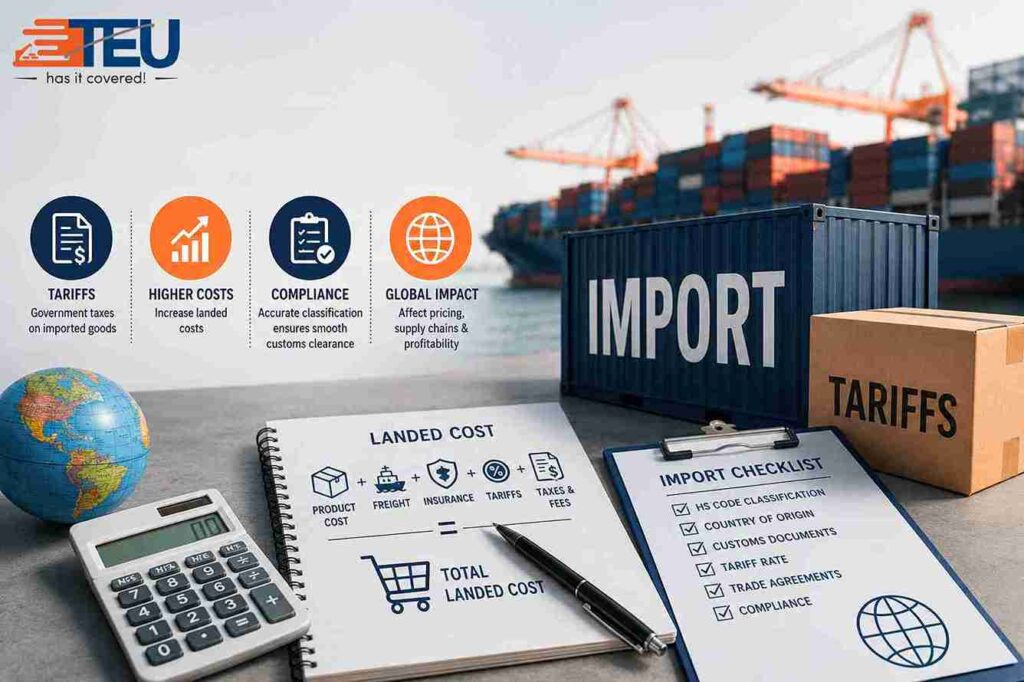
Import tariffs and landed cost calculation in global trade and shipping.

Governments implement these import duties for several reasons:

  • Protect domestic industries from foreign competition
  • Generate government revenue
  • Regulate international trade
  • Encourage local manufacturing
  • Influence trade relationships between countries

From an importer’s perspective, these customs charges increase the overall cost of bringing goods into a market. The amount payable depends on factors such as:

  • Product classification (HS/HTS Code)
  • Country of origin
  • Product value
  • Applicable trade agreements
  • Current trade policies

Major Factors That Affect Tariff Rates: 

Factor Impact on Tariff 
HS Code ClassificationDetermines applicable duty rate 
Country of OriginMay qualify for trade agreement benefits 
Product TypeDifferent products have different rates
Trade Policies Governments may increase or decrease tariffs 
Customs Valuation Affects total duty calculation

Source: World Customs Organization (WCO) 

Understanding import duty requirements before importing allows businesses to make informed sourcing and pricing decisions.

Why Should Importers Care About Tariffs?

Many importers focus primarily on supplier pricing and freight expenses. However, tariffs can significantly impact the total cost of imported goods and directly affect profitability.

Higher Landed Costs

Tariffs increase the total landed cost of a shipment.

Landed cost typically includes:

  • Product purchase price
  • Ocean freight or air freight charges
  • Insurance costs
  • Customs duties and tariffs
  • Taxes and government fees

Even a modest increase in tariff rates can significantly raise overall import costs. 

Reduced Profit Margins

Higher import costs can directly reduce profit margins.

When tariffs rise, businesses generally have three options: 

  1. Absorb the cost
  2. Increase product prices
  3. Find alternative sourcing solutions

Absorbing tariff costs may reduce profitability, while increasing prices can affect competitiveness.

Increased Product Prices

When import costs rise, businesses frequently pass those expenses to customers.

This can result in:

  • Higher retail prices
  • Reduced customer demand
  • Competitive disadvantages
  • Lower sales volumes

Importers must carefully balance pricing strategies to maintain market share.

Cash Flow Challenges

Tariffs are generally paid during customs clearance before products are released.

For importers moving large shipment volumes, tariff payments can create significant cash flow pressures.

Effective financial planning helps businesses mitigate disruptions caused by unexpected customs-related expenses. 

How Tariffs Affect International Shipping

Tariffs impact more than just taxes. They influence multiple areas of international logistics and supply chain management.

Customs Clearance

Customs authorities evaluate shipments based on:

  • Product descriptions
  • HS codes
  • Country of origin
  • Declared value

Incorrect tariff calculations can lead to:

  • Customs delays
  • Additional inspections
  • Fines and penalties
  • Shipment holds

Accurate documentation is essential for efficient customs clearance. 

Import Documentation

Tariff assessments rely on complete and accurate paperwork.

Required documents may include:

  • Commercial invoices
  • Packing lists
  • Bills of lading
  • Certificates of origin
  • Product specifications

Missing or incorrect information can delay shipments and increase costs.

Supply Chain Planning

Changes in tariff policies can force businesses to reassess:

  • Supplier locations
  • Manufacturing strategies
  • Inventory management
  • Distribution networks

Importers that proactively monitor tariff developments can adapt more effectively and strengthen supply chain resilience. 

Freight Budgeting

Tariffs should always be included when calculating shipping expenses.

Many businesses budget for:

  • Freight costs
  • Warehousing
  • Insurance

But overlook customs duties and tariffs, leading to unexpected financial burdens.

How Importers Calculate Tariffs

Understanding tariff calculations helps businesses estimate import costs accurately.

Step 1: Determine Product Value

Customs value is generally based on:

  • Product cost
  • Freight charges
  • Insurance costs

Step 2: Identify the Correct HS/HTS Code

Every imported product is assigned a Harmonized System (HS) code.

This code determines:

  • Applicable tariff rates
  • Regulatory requirements
  • Import restrictions

Incorrect classification can result in:

  • Overpayment
  • Underpayment
  • Compliance issues
  • Customs penalties

Step 3: Determine the Tariff Rate

Assume the applicable tariff rate is 10%.

Calculation:

$10,000 × 10% = $1,000

Tariff Due = $1,000

Step 4: Calculate Total Landed Cost

Total landed cost represents the complete expense of importing goods, not just the product purchase price. Importers should account for all costs associated with moving products from the supplier to the final destination, including freight charges, insurance, customs duties, tariffs, taxes, and other applicable fees. 

Calculating landed cost accurately helps businesses evaluate profitability, set appropriate pricing, manage budgets, and make informed sourcing decisions before placing import orders. 

Common Tariff Mistakes Importers Make

Using Incorrect HS Codes

One of the most common importing mistakes is assigning the wrong product classification.

This can result in:

  • Overpayment of duties
  • Customs audits
  • Delays
  • Regulatory penalties

Underestimating Landed Costs

Many businesses focus only on product pricing while ignoring:

  • Freight charges
  • Customs duties
  • Taxes
  • Administrative fees

This leads to inaccurate pricing and lower profitability.

Ignoring Trade Policy Changes

Tariff rates and trade regulations can change rapidly.

Businesses that fail to monitor updates may experience:

  • Unexpected costs
  • Compliance risks
  • Supply chain disruptions

Choosing Suppliers Based Only on Product Cost

A lower purchase price does not necessarily translate into lower overall landed costs. 

Importers should evaluate:

  • Freight expenses
  • Tariff rates
  • Transit times
  • Customs requirements

The lowest supplier price may not deliver the lowest landed cost.

How Importers Can Reduce Tariff Impact

Although tariffs cannot always be avoided, businesses can minimize their impact through strategic planning and informed sourcing decisions. 

Diversify Sourcing Locations

Sourcing from multiple countries helps reduce dependency on regions subject to high tariff rates.

Regular supplier evaluations can uncover more cost-effective alternatives.

Ensure Accurate Product Classification

Correct HS code classification helps businesses:

  • Avoid penalties
  • Prevent overpayment
  • Improve customs compliance
  • Speed up clearance processes

Utilize Free Trade Agreements

Many countries have trade agreements that provide:

  • Reduced duty rates
  • Preferential treatment
  • Duty-free imports for qualifying products

Understanding trade agreement eligibility can generate substantial savings.

Consolidate Shipments

Combining multiple shipments into one freight movement can:

  • Reduce transportation costs
  • Improve inventory planning
  • Increase logistics efficiency

Work with Experienced Freight Forwarders

Professional freight forwarders and logistics providers help importers:

  • Manage customs documentation
  • Ensure compliance
  • Calculate duties accurately
  • Navigate changing tariff regulations

This minimizes costly mistakes and improves operational efficiency.

ChallengeHow TEU Global Help
Tariff Calculation Provides guidance on import costs 
Customs Clearance Supports compliant documentation 
Shipping Delays Coordinates efficient freight movement 
Cost Management Identifies logistics optimization opportunities 
Supply Chain Visibility Improves shipment tracking and planning 

How TEU Global Helps Importers Manage Tariffs

Managing tariffs and customs regulations can be complex, especially for growing businesses expanding internationally.

At TEU Global, we support importers through:

Customs Clearance Support

Our team helps ensure shipments comply with customs regulations and avoid unnecessary delays.

Documentation Management

We assist with preparing and reviewing critical shipping documents to reduce compliance risks.

Freight Forwarding Solutions

From ocean freight and air freight to multimodal transportation, TEU Global helps businesses move cargo efficiently across global markets.

Supply Chain Optimization

We help importers analyze shipping routes, sourcing strategies, and logistics costs to improve overall supply chain performance.

Import Cost Visibility

By understanding duties, tariffs, and landed costs upfront, businesses can make smarter purchasing decisions and improve profitability.

FAQs

How are tariffs calculated on imports?

Tariffs are usually calculated as a percentage of the customs value of imported goods.

Do tariffs affect freight costs?

No. Tariffs are separate from freight charges but increase overall import costs.

Can freight forwarders help with tariff compliance?

Yes. Freight forwarders help with documentation, classification, and customs compliance.

What is the difference between tariffs and customs duties?

Tariffs are taxes on imports, while customs duties is a broader term for import-related charges.

How do tariffs affect landed cost?

Tariffs increase landed cost by adding extra charges to imported goods.

Conclusion

Tariffs play a critical role in international trade and directly affect import costs, profit margins, pricing strategies, and supply chain operations. Businesses that understand tariff structures and proactively account for their impact are better positioned to maintain competitiveness and profitability.

By accurately calculating landed costs, staying informed about trade regulations, and working with experienced logistics partners, importers can reduce risk and improve operational efficiency.

TEU Global helps businesses navigate tariffs, customs requirements, freight forwarding, and international shipping complexities with confidence.

Stay informed about changing tariff regulations and global trade developments. Visit the TEU Global blog regularly for the latest insights on tariffs, customs compliance, international shipping, and supply chain management to help you make smarter importing decisions.

Need help managing import costs and customs requirements? Contact TEU Global today to speak with our logistics experts.

READ MORE
U.S. tariff changes 2026 impacting import costs and supply chains
InformationalTrade & Tariffs
June 9, 2026 By TEU Global Editorial Team

U.S. Tariffs 2026: Import Cost & Compliance Guide

Introduction

The U.S. trade landscape continues to evolve in 2026, and U.S. Tariffs 2026 are creating both challenges and opportunities for importers. New tariff measures, enhanced customs enforcement, and ongoing trade policy developments are placing increased pressure on businesses that rely on global supply chains.

Recent actions by U.S. trade authorities include temporary Section 122 tariffs, proposed Section 301 tariffs affecting numerous trading partners, and strengthened customs enforcement initiatives designed to improve compliance and prevent duty evasion. These developments have significant implications for import costs, trade compliance requirements, and overall supply chain strategy.

For importers, the challenge is no longer limited to paying duties. Companies must proactively manage tariff exposure, maintain accurate customs documentation, and build resilient supply chains capable of adapting to regulatory changes.

This guide explains the major U.S. Tariffs 2026 developments, their impact on importers, and practical strategies businesses can implement to reduce costs while maintaining full compliance with U.S. customs regulations.

U.S. Tariffs 2026 impact on importers, customs compliance, and global supply chains

Understanding U.S. Tariffs in 2026

U.S. tariffs are duties imposed on imported goods entering the United States. These measures are often used to address trade imbalances, protect domestic industries, strengthen national security, or respond to specific trade concerns.

In 2026, importers are facing several significant developments:

  • Temporary Section 122 tariffs affecting a wide range of imported products
  • Proposed Section 301 tariff actions involving multiple trading partners
  • Continued Section 232 tariffs on industries such as steel, aluminum, and copper
  • Increased customs enforcement and importer accountability requirements

As a result, businesses importing into the United States must carefully evaluate how these measures affect landed costs, sourcing strategies, and compliance obligations.

One of the most immediate consequences of new tariffs is increased sourcing expenses.

While tariffs directly increase the cost of imported goods, their financial impact often extends well beyond the duties themselves. Businesses may also experience Supply Chain Costs increases across multiple operational areas:

Higher Landed Costs

As tariffs rise, companies must either absorb the additional expense or pass it on to customers, affecting both profit margins and competitiveness.

Increased Inventory Costs

Many importers accelerate purchases ahead of tariff implementation deadlines. Although this strategy may reduce immediate duty exposure, it can also increase warehousing expenses and inventory carrying costs.

Supplier Pricing Adjustments

Foreign suppliers may raise prices to offset reduced demand or changing market conditions, further increasing procurement costs.

Administrative Expenses

Managing tariff exposure often requires additional customs reviews, classification audits, compliance monitoring, and professional consulting support.

The Growing Importance of Customs Compliance

As tariff programs become increasingly complex, customs compliance has evolved into a strategic business priority.

U.S. Customs and Border Protection (CBP) continues to emphasize importer responsibility. Importers are expected to exercise reasonable care when classifying products, determining country of origin, and calculating applicable duties.

Failure to comply can result in:

  • Customs penalties
  • Shipment delays
  • Increased inspections
  • Duty reassessments
  • Supply chain disruptions
  • Reputational damage

In 2026, customs authorities are also implementing stronger enforcement measures, including increased scrutiny of importer records and enhanced compliance requirements.

Businesses that prioritize import compliance are better positioned to avoid costly enforcement actions while maintaining efficient import operations.

1. Review Product Classification Accuracy

One of the most effective ways to manage tariff exposure is to ensure products are correctly classified under the Harmonized Tariff Schedule (HTS).

Incorrect classifications can lead to:

  • Overpayment of duties
  • Underpayment and potential penalties
  • Customs audits and investigations

Periodic classification reviews can uncover opportunities to reduce unnecessary duty payments while improving compliance.

Many importers discover that products have been incorrectly classified for years, resulting in avoidable expenses.

2. Evaluate Country-of-Origin Opportunities

Country of origin can significantly influence applicable tariff rates.

Businesses should regularly assess whether sourcing from alternative countries could reduce tariff exposure while maintaining product quality and supply chain reliability.

Nearshoring, regional sourcing, and supplier diversification have become increasingly popular strategies among importers seeking to manage tariff-related risks.

Before making sourcing changes, companies should evaluate:

  • Total landed costs
  • Production capacity
  • Logistics considerations
  • Compliance requirements
  • Trade agreement eligibility

A comprehensive analysis often reveals substantial cost-saving opportunities.

3. Utilize Free Trade Agreements and Preference Programs

Many importers fail to take full advantage of available trade programs.

Depending on product eligibility and sourcing location, companies may benefit from:

  • USMCA provisions
  • Trade preference programs
  • Duty-free treatment opportunities
  • Tariff-rate quotas

While qualification requires careful documentation and compliance procedures, the resulting duty savings can be significant.

Importers should regularly review sourcing strategies to identify opportunities for preferential treatment.

4. Conduct a Comprehensive Supply Chain Cost Analysis

Leading importers are moving beyond tariff management and focusing on total supply chain optimization.

A thorough cost analysis should include:

  • Product costs
  • Freight expenses
  • Customs duties
  • Warehousing costs
  • Inventory carrying costs
  • Compliance expenses

This broader perspective often uncovers opportunities to offset tariff increases through operational efficiencies.

For example, a supplier with slightly higher product costs may ultimately provide lower total landed costs when logistics and tariff considerations are taken into account.

5. Implement a Trade Compliance Program

A structured import compliance program can reduce both financial and operational risk: 

Written Compliance Procedures Documented procedures promote consistency across departments and reduce compliance errors.

Employee Training Personnel involved in purchasing, logistics, customs, and supply chain management should understand applicable trade requirements.

Internal Audits Regular audits help identify issues before they become enforcement concerns.

Recordkeeping Controls Maintaining complete and accurate documentation is essential during customs reviews and audits.

Companies with mature compliance programs are generally better prepared to adapt to regulatory changes and enforcement initiatives.

Supply Chain Planning in an Uncertain Trade Environment

Tariff changes rarely occur in isolation. They are often part of broader trade policy shifts that affect sourcing, transportation, inventory planning, and market access.

In 2026, importers should focus on building supply chain resilience by:

Diversifying Suppliers

Overreliance on a single sourcing location can increase vulnerability to tariff changes and other disruptions.

Strengthening Forecasting Processes

Improved demand forecasting helps companies manage inventory levels and respond more effectively to changing duty environments.

Monitoring Regulatory Developments

Trade policies can change quickly. Importers should establish processes for tracking announcements from CBP, the U.S. Trade Representative (USTR), and other regulatory agencies.

Working with Trade Experts

Experienced customs brokers, trade consultants, and compliance professionals can provide valuable guidance when navigating complex tariff environments.

Companies that plan proactively are often better positioned than competitors when new regulations emerge.

What Importers Should Watch for in the Second Half of 2026

Trade policy developments continue to evolve.

Recent proposals include additional Section 301 tariff actions affecting imports from multiple economies, with public comments and hearings taking place throughout 2026. U.S. authorities have also signaled increased customs enforcement and stronger importer accountability initiatives.

Importers should closely monitor:

  • New tariff announcements
  • Product-specific duty changes
  • Customs enforcement initiatives
  • Supply chain compliance requirements
  • Country-specific trade actions

Staying informed enables businesses to make strategic decisions before regulatory changes affect operations.

How TEU Helps Importers Navigate Tariff Changes

Managing U.S. tariffs, Regulatory compliance for imports , and supply chain risk requires more than a basic understanding of regulations.

At TEU, we help importers:

  • Reduce tariff exposure
  • Improve customs compliance
  • Optimize supply chains
  • Control import costs

Our team works closely with businesses to identify opportunities, mitigate risks, and support long-term success in global trade.

Conclusion

U.S. tariff developments in 2026 are reshaping the importing environment across industries. Rising landed costs, evolving customs requirements, and increased enforcement activity mean that importers must take a proactive approach to compliance and cost management.

By reviewing tariff classifications, evaluating sourcing strategies, leveraging trade programs, optimizing supply chains, and strengthening compliance procedures, businesses can navigate uncertainty more effectively while protecting profitability.

The companies that succeed in 2026 will be those that treat import compliance and tariff management as strategic business functions rather than administrative obligations. 

As trade regulations continue to evolve, proactive planning and expert guidance will remain essential for maintaining a competitive advantage in the global marketplace.

Understanding Tariff Changes for Importers is essential for businesses seeking to reduce tariff exposure, control import costs, maintain customs compliance, and build resilient supply chains in an increasingly complex global trade environment.

READ MORE
high tariffs for US importers
Trade & Tariffs
January 1, 2025 By TEU Global Editorial Team

How U.S. Importers Can Prepare For Potential Higher Tariffs in 2025?

Businesses should prepare as higher tariffs are coming!

2024 was unexpected all around the world, and the coming year seems to be way more evolving. The global supply chain seems to have hit a drastic change in the United States.

Not only this the political and economic shift has affected the whole trading industry. Higher tariffs on imports from key trading partners are bracing global trade for the impact.

Rising costs, disrupted supply chains, and changes in freight costs are some of the changes that might occur. But what exactly are tariffs, and how can they affect the supply chain? 

Let’s discuss these drastic changes coming your way if you’re in this market.

What Are Tariffs? How Do They Shape Global Trade?

Tariffs are indirect taxes also known as custom duties. A tariff is a tax placed on goods when they cross national borders. There are two types of tariffs: import tariffs are the taxes on goods that a country imports and export tariffs are those taxes on goods that a country exports.

Tariffs are imposed either for protection or revenue purposes. They have been used for centuries; in 1789, the first tariff was passed.

These taxes are:

  • Calculated based on the tariff classification or commodity code under the HS.
  • Harmonized System (HS) is a 10-digit code that determines the duty rate

The Importance of Tariffs? Why They Matter

Tariffs are a crucial key in the world of global trade. In the United States, the Harmonized Tariff Schedule sets over 17,000 tariff codes, each with specific duty rates.

Tariffs increase the price of imported goods, making domestic goods cheaper. The duties are applied by calculating the percentage of the declared value of the goods. Governments impose tariffs to raise revenue and protect domestic industries.

Governments can use tariffs to benefit particular industries, they are also used as an extension of foreign policy to exert economic leverage

A Look Back at the History of Tariff Policies

Tariff policies have always influenced U.S. trade relationships. Among the first acts signed into law by the first Congress was The Tariff Act of 1789. These tariff were abandoned in the mid-20th Century

The 2019 Tariff announcement proposed tariff ranging from 5% to 25% on Mexican goods, where as in 2020, The United States-Mexico-Canada Agreement (USMCA) announced no tariff on goods between these three countries.

Warnings Given by Economists to U.S. Government

Economists have warned that the rise in tariff policies could push duty rates to levels not seen since the 1930s, stoking inflation, disrupting U.S.-China trade, and forcing businesses to rethink global supply chains. The tariffs risk increasing inflation and can also lead to a slowdown in global economic growth. Companies are hesitating to expand due to the unpredictable logistics environment. There is a risk that the higher costs of imported goods might affect businesses on every level, so keeping this in mind is crucial.

Rising Freight Rates: How Tariffs Influence Supply Chain Expenses

There was a potential impact of higher tariffs on the ocean freight rates for Shanghai to LA and Shanghai to NY over the timeline. Freight rates have always been influenced by several factors which include:

  • Global economic trends
  • Demand-supply imbalances
  • Shifts in trade routes

Not only this, but between December 2023 and July 2024, rates of container shipping between Asia and North America doubled, which resulted in a 1%-2.5% cost increase in imports. Understanding these dynamics is very important for businesses that aim to minimize costs.

Quick Tips for U.S. Importers to Navigate Higher Tariffs

Here are some quick short tips for businesses looking for immediate guidance:

  • Build contingency plans.
  • Stay informed about trade agreements and tariff changes.
  • Work closely with trusted logistics providers.
  • Evaluate supply chain costs closely.
  • Reduce reliance on one region, instead chose partners from tariff-free countries.
  • Use data analytics to forecast risks, costs, and adaptable strategies.
  • Utilize Trade programs for cost reductions.

What Strategies Can Be Used to Mitigate Tariff Risks?

The challenges that US Importers have to face this coming time are numerous. To face them proactively you can use these strategies:

  1. The first strategy is to diversify suppliers and change the sourcing location. Businesses can do Onshoring, which means moving operations closer to home, it can reduce tariff hikes. Partnering with suppliers of countries that are tariff-friendly can help businesses mitigate supply chain disruptions with less cost.
  2. The second strategy is to explore Tariff Mitigation Programs that will decrease the financial impact of tariffs, such as Free Trade Agreements (FTAs) that lower or eliminate tariffs on certain imports, Duty Drawback Programs that help to recover duties paid on imported goods, or by adjusting products classification. 
  3. One of the most important and effective strategies is building strong partnerships with suppliers as it helps in cost-saving opportunities, gives flexibility in contracts to adapt new rates, and focuses on suppliers who maintain one-time delivery despite higher rates. Partnering with reliable logistics providers such as TEU Global can make a significant difference, whether it’s the reduction of supply chain risks or the enhancement of agility.
  4. You can invest in Data-Driven decisions as it is important when it comes to sudden policy changes. Staying updated about tariff changes, using various tools to identify perfect cost-effective solutions, and planning proactively can help you make informed decisions without things getting out of your hands.

Be Proactive: Take Action as Soon as Possible

Taking action earlier will have many advantages. Higher tariffs need to be dealt with strategies discussed above. These strategies will help the importers protect their supply chain, control the increasing costs, and make operational resilience strong enough in this disrupted market.

For expert guidance, partnering with TEU Global can ensure that all your logistics operations remain competitive.

Contact Us

The Next Step for Importers Against Tariff-Driven Disruptions

Every step in the Global trade system is unpredictable, but you should always be prepared to face any changes that might occur during your transit. Businesses all around the world can survive in this challenging environment by working on multiple strategies, building strong partnerships, and investing in analytics.

READ MORE
TEU Global

TEU Global is a 3PL company, with a top reliable global agent network. From freight forwarding and customs clearance to warehousing and purchase order management, we provide the best services with extra personal care.

Services

Ocean Freight Shipping

US Handling Agent

Canada Handling Agent

Freight Forwarding

Customs Clearance

Cargo Insurance

Drayage & Domestic Truck Delivery

Warehousing and Distribution

Purchase Order Management

Logistics Consultants

Customs Compliance Coaching

Branches

LOS ANGELES

Distribution & Dispatch facility

750 S Glasgow Ave, Inglewood, CA 90301, United States
Email : Lax@teuinc.com
Phone : 310-263-8216


MIAMI

Distribution & Dispatch facility

5855 NW 159th St,

Miami Lakes FL 33014
Email : Mia@teuinc.com
Phone : 305-851-7818


UAE

Office No: 2311, The Prime Tower Business Bay, Dubai
Email: Gulf@teuinc.com
Phone: 971-4-422-1046


MALAYSIA

Teu Global Sdn. Bhd
B109 Kelana Square  No.17 Jalan SS 7/26, 47301 Petaling Jaya, Selangor MALAYSIA

Email: Malaysia@teuinc.com
Phone: +60 12-656 8642

Head Office

NEW JERSEY

242 Old New Brunswick Road,
Suite 145 Piscataway, NJ 08854 USA

Email : info@teuinc.com
Phone : 732-515-9040
Fax # : 732-856-5008
Toll free: 877-414-8381

TwitterFacebookInstagramYoutubeLinkedin

Copyright © 2015-2026. TEU Global – All Rights Reserved.

Privacy Policy | Terms & Conditions