

Logistics
You have eight pallets coming from Vietnam. Your supplier asks a simple question: do you want LCL or FCL? Half the importers we work with the first time are not sure which answer actually saves them money. They guess based on what feels safer or what they did last time, and they often pay more than they should.
Here is the truth about LCL vs FCL. Neither option is universally cheaper. The right call depends on volume, value, urgency, and how your warehouse handles inbound freight. Get it right and you save real dollars on every container. Get it wrong and you keep paying for space you do not use, or for handling fees you did not see coming. At TEU Global, we help importers run this math every day, and this guide walks through exactly how we think about it.
What Is FCL Shipping?
FCL stands for Full Container Load. When you book FCL, you reserve an entire shipping container for your cargo alone. The container is loaded at origin, sealed, and stays sealed until it reaches your warehouse or consignee. You pay one flat rate for the box, regardless of whether you fill it completely.
Standard ocean containers come in two main sizes. A 20-foot container holds roughly 28 to 33 cubic meters of usable space and supports around 21,000 to 22,000 kilograms of cargo. A 40-foot container holds about 56 to 66 cubic meters and supports a similar weight limit because the limit is dictated more by road regulations than by the container itself. There are also high-cube versions, refrigerated containers, and specialty equipment for unusual cargo.
What Is LCL Shipping?
LCL stands for Less than Container Load. With LCL, your cargo shares a container with shipments from other companies. A consolidator combines all the smaller shipments into one full container at origin, ships it across the ocean, and then deconsolidates it at the destination port so each consignee gets their own goods.
You pay only for the space your goods occupy. The pricing is usually based on cubic meters of volume or chargeable weight, whichever is greater. That sounds simple, but the per-unit cost of LCL is much higher than the per-unit cost of FCL. A 1 cubic meter LCL shipment is significantly more expensive per cubic meter than a fully loaded 30 cubic meter FCL container.
Key Differences Between LCL and FCL
Once you understand the basics, the differences between the two options come into focus quickly.
Cost Structure
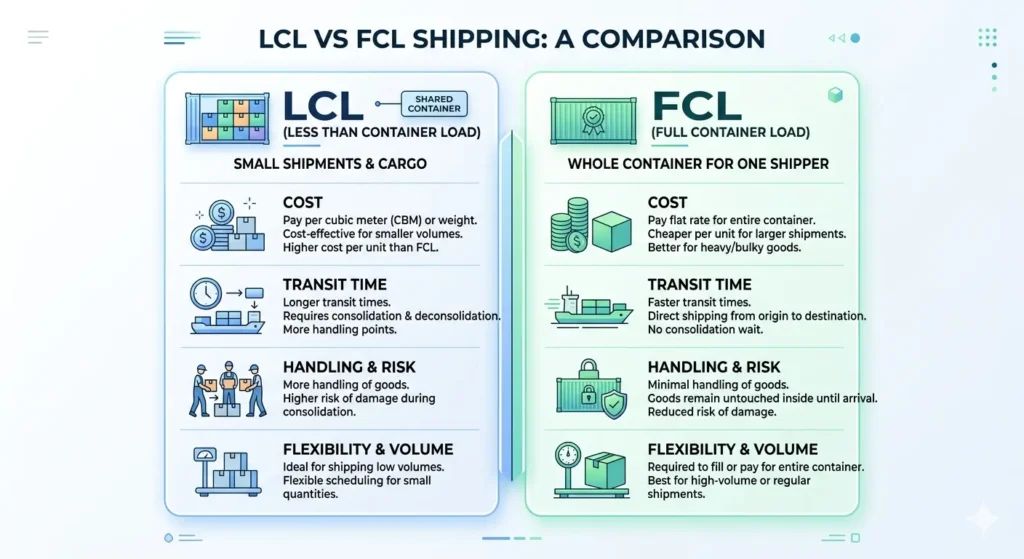
FCL pricing is a flat rate per container. Whether you fill it 60 percent or 100 percent, you pay the same. LCL pricing is usage-based, charged per cubic meter or per 1,000 kilograms, whichever is higher. That makes LCL cheaper for small volumes and dramatically more expensive once your shipment grows.
Transit Time
FCL is faster door to door. The container moves from factory to vessel to terminal to warehouse with minimal handling. LCL adds days because the cargo has to be consolidated at an origin Container Freight Station (CFS) before sailing, and deconsolidated at a destination CFS before delivery. Five to ten extra days is common, and it can be more during peak season.
Risk and Damage
FCL is lower risk because the container is sealed and your goods are not handled by anyone else after loading. LCL involves multiple consolidation steps and shared space with cargo you cannot inspect. If another shipper packs poorly or includes wet cargo, your goods can be affected.
Customs Clearance
An FCL container clears U.S. Customs and Border Protection as one unit. With LCL, the entire container often cannot be released until every consignee in it has cleared their portion. If one shipper has a documentation problem or gets flagged for an exam, every shipment in that container can be delayed.
Documentation
FCL paperwork is straightforward. One bill of lading, one customs entry, one set of charges. LCL involves a master bill of lading from the carrier and a house bill from the consolidator, plus extra documentation fees. The paperwork itself is not hard, but it is more of it.
When FCL Is the Right Choice
FCL almost always wins under these conditions:
- Volume above 13 to 15 cubic meters. This is the rough breakeven where LCL fees catch up to a 20-foot FCL rate on most lanes.
- High-value cargo. Sealed containers reduce handling and theft risk.
- Time-sensitive shipments. FCL skips the consolidation delays at both ends.
- Fragile or sensitive goods. Less handling means less damage.
- Mixed product lines you want to keep separated. FCL gives you full control over how your container is loaded.
- Predictable, repeating shipments. Once you commit to FCL volumes, you can negotiate better contract rates with carriers.
When LCL Is the Right Choice
LCL is the better fit in these situations:
- Volume under 13 cubic meters. Below this point, paying per cubic meter usually beats paying for a full 20-foot container.
- Sample shipments and product testing. Small initial orders rarely justify a full container.
- Entering a new market. Test demand with small volumes before committing to FCL contracts.
- E-commerce sellers with frequent small orders. More frequent, smaller shipments can reduce inventory carrying costs.
- Cash flow management. Smaller, more frequent shipments can be easier on working capital than committing to large container loads.
- Seasonal product lines. Avoid getting stuck with a full container of inventory you cannot sell.
The Hidden Costs of LCL Most Importers Miss
LCL looks cheap on the front-end quote and then surprises importers at the back end. These are the charges that get missed most often.
CFS Handling Fees
Both the origin and destination Container Freight Stations charge for unloading, sorting, and consolidating cargo. These fees are usually quoted in dollars per cubic meter and they add up fast on smaller shipments.
Chargeable Weight Surprises
LCL pricing uses the greater of actual weight or volume, where 1 cubic meter typically equals 1,000 kilograms for billing purposes. If your cargo is light and bulky, like apparel or foam products, you pay for the volume. If it is dense, like machinery or tile, you pay for the weight. Importers who only think about volume sometimes get a much higher invoice than they expected.
Documentation and Handling Surcharges
LCL involves more parties and more paperwork, and each step can come with its own charge. Documentation fees, port handling charges, ISF filing, terminal fees, and CFS receiving fees can stack up to a meaningful percentage of the freight cost.
Storage at the Destination CFS
If your customs clearance takes longer than the free time at the destination CFS, storage charges start. This is especially common when documentation is incomplete, which is why the customs side of the move matters as much as the freight side.
Higher Insurance Cost Per Cubic Meter
Insurance for LCL shipments is often more expensive per cubic meter than FCL because of the handling exposure. Our companion guide on cargo insurance covers how to think about coverage based on your shipping mode.
How Volume Affects Your Choice: The Breakeven Point
On most major trade lanes, the rough breakeven between LCL and a 20-foot FCL container sits between 13 and 15 cubic meters. Below that volume, LCL is usually cheaper. Above that volume, the per-cubic-meter math starts favoring FCL even if you do not fill the container.
Here is a simplified way to think about it. A 20-foot container holds roughly 28 to 33 cubic meters of usable space. A 40-foot container holds 56 to 66 cubic meters. If your volume is creeping above 13 cubic meters, do not default to LCL just because the container will not be full. Run the math both ways. We have seen importers save thousands per shipment by switching to FCL even when their cargo only filled half the box.
There are also strategic reasons to go FCL even when LCL is technically cheaper. Faster transit time, lower damage risk, and simpler customs clearance can all be worth the extra cost when the cargo is high-value or time-critical.
Common Mistakes Importers Make
After helping clients move thousands of containers a year, we see the same mistakes again and again.
- Defaulting to LCL because the volume sounds small. Always run the math both ways before booking.
- Ignoring chargeable weight on light, bulky goods. Apparel and foam products often surprise importers with much higher LCL invoices than expected.
- Forgetting to factor in destination CFS time. Add 3 to 7 days to your inbound planning if you are shipping LCL.
- Choosing LCL for fragile or high-value cargo just to save a small amount of freight. Damage claims often eat the savings.
- Booking FCL for tiny volumes because it feels safer. A 2 cubic meter shipment in a 20-foot container is rarely the right call.
- Not asking about all-in landed cost. The cheapest ocean freight rate is not the cheapest total cost.
How TEU Global Helps You Choose Between LCL and FCL
At TEU Global, our freight forwarding team runs LCL versus FCL math for clients on every quote where the answer is not obvious. We look at your actual cargo dimensions and weight, the lane, the time of year, your customs profile, and your warehouse intake capacity to recommend the option that gives you the lowest total landed cost, not just the lowest freight rate.
Because we also handle customs clearance and warehouse management under the same roof, we see the full picture. We know how a CFS delay at destination can erase the savings on a cheap LCL booking, and we know when an underutilized FCL is still worth it because of speed or risk. That kind of integrated thinking is hard to get from a forwarder who only handles one piece of the move.
We also help importers transition between modes as their business grows. A client who started with LCL test orders three years ago might now be moving 50 FCLs a month with us, and the planning along the way matters. The right ocean freight strategy is not static. It changes with your volume, your lanes, and your customer expectations.
FAQs About LCL vs FCL Shipping
1. What is the breakeven point between LCL and FCL? On most major trade lanes, it sits between 13 and 15 cubic meters. Below that, LCL is usually cheaper. Above that, FCL often wins even if the container is not completely full.
2. How much longer does LCL take compared to FCL? LCL typically adds 5 to 10 days door to door because of consolidation at origin and deconsolidation at destination. During peak season, the gap can be larger.
3. What is chargeable weight in LCL shipping? It is the greater of actual weight or volumetric weight, where 1 cubic meter typically equals 1,000 kilograms for billing. Light, bulky cargo gets billed on volume. Dense cargo gets billed on weight.
4. Can I track LCL shipments the same way as FCL? You can track them, but visibility is less granular because the container is shared. You see the master container’s progress and your house bill milestones.
5. Does TEU Global handle both LCL and FCL? Yes. We move both, and we help clients run the math each time so they pick the option that minimizes their total landed cost, not just the freight rate.
Final Thoughts
LCL versus FCL is not a once-and-for-all decision. It is a question you should ask on every shipment, especially when your volume is sitting near the breakeven point. The importers who get this right are not the ones with the cheapest forwarder. They are the ones with a partner who runs the math honestly, considers all the hidden costs, and adjusts the strategy as the business changes.
If you are not sure whether your current ocean freight strategy is the right one, a quick review can pay for itself many times over. A few small adjustments on a high-frequency lane can translate into real annual savings.