LogisticsInformational
Modern distribution logistics depends on efficient freight movement between suppliers, manufacturers, and retailers. One of the most effective strategies for achieving this is cross docking, a process that transfers goods directly from inbound to outbound transportation with little or no storage. Unlike traditional warehousing, this approach reduces handling, lowers storage costs, and speeds up deliveries.
In this guide, we’ll explain how the process works, compare it with conventional warehousing, and discuss how TEU Global supports businesses with reliable logistics solutions across major U.S. distribution hubs.
What Is Cross Docking? A Complete Explanation
This logistics method involves unloading incoming goods from an inbound truck or container and transferring them almost immediately to an outbound vehicle, with little or no time spent in storage. The name comes from the physical layout of the facility, where inbound docks are located on one side of the building and outbound docks are positioned on the opposite side, allowing freight to move efficiently through the distribution center.
What Is Cross Docking in Supply Chain Operations?
This logistics process supports the efficient movement of freight between:
- Inbound suppliers and outbound retail destinations
- Manufacturing plants and assembly lines
- Ports and regional distribution networks
- Multiple carriers consolidating into full truckloads
It plays a vital role in modern distribution logistics by allowing freight to move through the supply chain with minimal storage time. These short transfer windows help businesses reduce handling costs, improve inventory flow, and deliver products to customers more quickly
Cross Docking Definition
The transfer of goods from inbound transportation directly to outbound transportation, with minimal or no warehouse storage in between.
Without efficient cross docking operations, businesses risk higher storage costs, slower delivery times, and unnecessary handling that increases the chance of damage.
How Cross Docking Works
A standard cross docking process follows five steps:
- Inbound arrival – A truck or container arrives carrying goods from a manufacturer, supplier, or port.
- Unloading and sorting – Items are unloaded and sorted by final destination.
- Staging – Goods are briefly staged, often consolidated with shipments from other inbound trucks heading the same direction.
- Loading – Sorted goods are loaded onto outbound trucks, rail cars, or containers.
- Departure – The outbound shipment heads to its next stop, whether that’s a retail store, distribution center, or end customer.
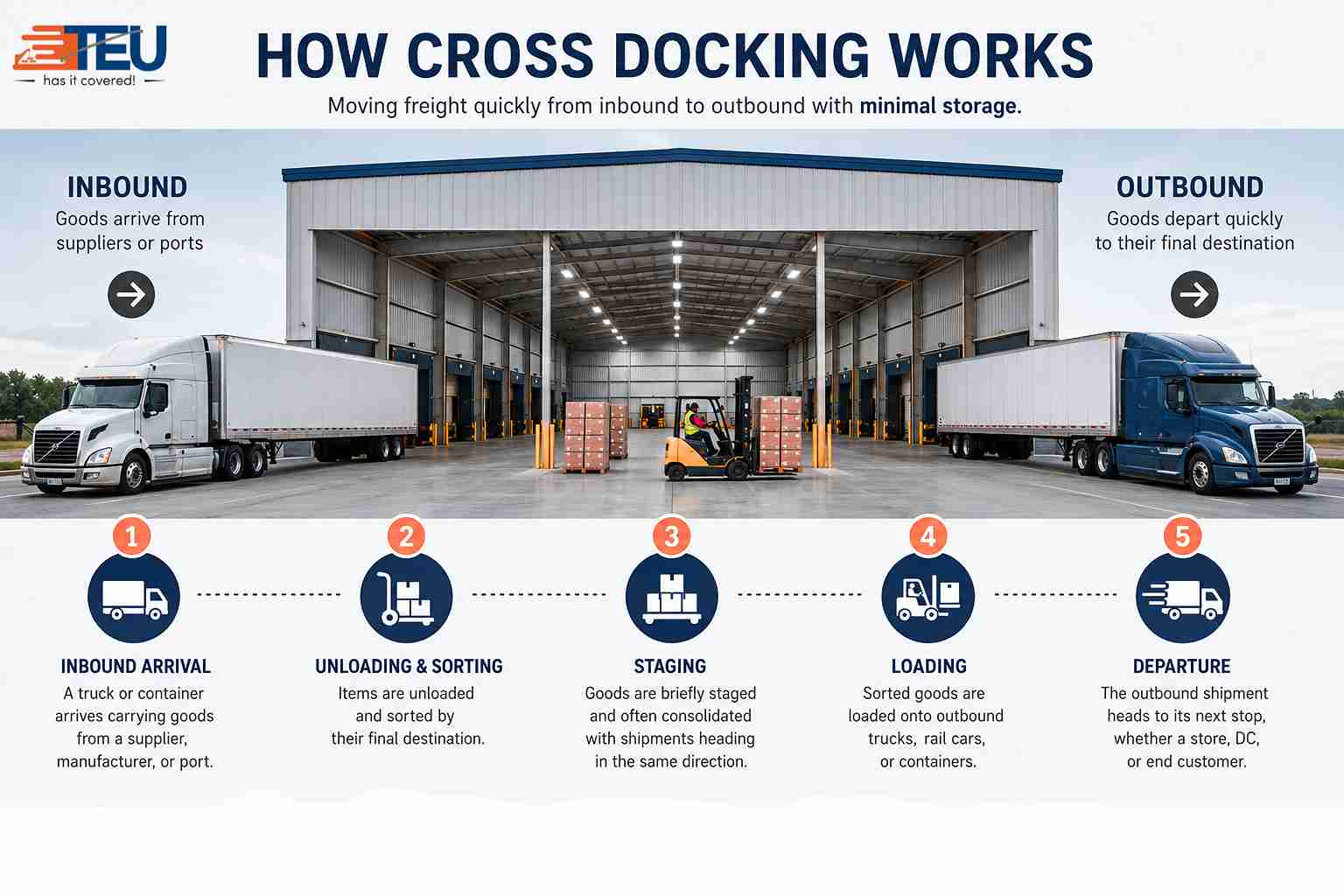
This cycle typically takes a few hours to about a day, compared to the days or weeks goods might spend sitting in a traditional warehouse.
Types of Cross Docking Services
Different shipping requirements call for different cross docking solutions. Understanding these categories helps businesses choose the right approach for their freight.
Pre-Distribution Cross Docking
Goods already have a destination assigned before they arrive, so sorting and routing decisions are made in advance. This is common in retail replenishment programs.
Post-Distribution Cross Docking
Goods arrive without a predetermined destination, and allocation happens at the facility based on real-time demand or order data.
Manufacturing Cross Docking
Components or sub-assemblies are received and routed immediately to a production line, reducing the need for raw material storage.
Retail Cross Docking
Products from multiple suppliers are consolidated into store-ready shipments, a model widely used by large retail chains replenishing hundreds of locations.
Transportation Cross Docking
Partial loads from multiple carriers are consolidated into full truckloads, a core tactic in freight consolidation for less-than-truckload (LTL) networks.
Cross Docking vs Warehousing vs Transloading
Many businesses use these terms interchangeably, but there are important distinctions to understand.
| Factor | Cross Docking | Traditional Warehousing | Transloading |
| Storage time | Hours to about 1 day | Days, weeks, or months | Same-day to a few days |
| Primary purpose | Fast consolidation and transfer | Inventory holding and fulfillment | Switching freight between transport modes |
| Handling | Minimal, direct dock-to-dock | High, includes put-away and picking | Moderate, repackaging or mode switch |
| Best for | High-velocity, predictable demand | Slow-moving or seasonal stock | International freight changing modes |
| Cost structure | Lower storage cost, higher coordination cost | Higher storage cost, lower coordination need | Mode-dependent, tied to port/rail fees |
| Inventory visibility needed | Very high, real-time data | Moderate | High, especially for customs |
Comparing these logistics methods helps businesses understand when each approach is most effective. Traditional warehousing is designed to store inventory for future order fulfillment, while transloading focuses on transferring freight between different transportation modes, such as moving cargo from an ocean container to a domestic truck. By contrast, this approach is built to keep freight moving through a facility with little or no storage, reducing handling time and improving supply chain efficiency.
Benefits of Cross Docking
This logistics strategy has become a core part of modern distribution and supply chain optimization because it improves efficiency while reducing operational costs.
- Lower storage and labor costs – less time in a warehouse means less racking, less long-term space, and less labor spent on put-away and picking.
- Faster delivery times – with no extended storage, the gap between manufacturing and final delivery shrinks significantly.
- Reduced handling and damage risk – fewer touches on a product means fewer chances for damage or loss.
- Stronger freight consolidation – combining partial loads into full truckloads improves trailer utilization and lowers per-unit shipping costs.
- Better inventory turnover – supports a leaner supply chain since capital isn’t tied up in stored goods.
- Smaller warehouse footprint – less need for permanent storage space lowers real estate and overhead costs.
Cross Docking Costs & Common Savings
One of the most common questions shippers ask is how cross docking actually reduces logistics costs.
Storage Cost Reduction
A mid-sized importer bringing goods through a busy port can cut warehousing costs significantly by cross docking instead of storing full containers for weeks while orders process. Reducing 30 days of storage down to a same-day transfer eliminates the bulk of storage fees and cuts down repeated picking and put-away labor to a single sort-and-load event.
Freight Consolidation Savings
For LTL shippers, consolidating several partial truckloads into one full truckload through freight consolidation commonly reduces per-unit shipping cost, since carriers charge a premium for partial loads.
Factors That Influence Cross Docking Savings
Several operational factors determine how much a business can reduce logistics costs through this approach:
- Freight volume and shipping frequency
- Number of suppliers being consolidated
- Distance between origin and destination
- Facility location relative to ports and highway corridors
- Quality of inbound and outbound scheduling coordination
Common Mistakes Businesses Make
- Underestimating data requirements. Cross docking depends on real-time visibility into inbound and outbound schedules. Without reliable tracking, it can create bottlenecks instead of improving efficiency.
- Mismatched inbound and outbound timing. If trucks aren’t synchronized, goods remain at the facility longer than planned, reducing the benefits of this logistics approach.
- Choosing the wrong products. This method works best for high-volume, predictable, fast-moving goods rather than slow-moving or highly variable inventory.
- Inadequate carrier coordination. Tight scheduling agreements between carriers and suppliers are essential; otherwise, delays can quickly ripple through the entire operation.
- Skipping a pilot phase. Implementing the process across an entire supply chain without first testing it on a smaller scale increases the risk of avoidable disruptions.
Industries That Use Cross Docking
This logistics strategy is widely used across industries that depend on fast, efficient freight movement and minimal storage time, including:
- Retail and grocery – high-volume, fast-moving goods that need to reach stores quickly
- Automotive and manufacturing – just-in-time delivery of components for production lines
- E-commerce and parcel delivery – where delivery speed is a competitive differentiator
- Food and beverage – especially perishables that can’t sit in storage long
- Pharmaceuticals – time-sensitive products that benefit from minimal handling
When Should a Business Use Cross Docking?
Cross docking tends to be the right fit when a business has:
- High-volume, predictable demand for specific products
- A need to reduce delivery times to customers or retail locations
- Multiple suppliers whose shipments could be consolidated into fuller truckloads
- Strong systems for real-time inventory and shipment tracking
- Products that don’t require long-term storage, such as fast-moving consumer goods
It’s generally not the right fit for businesses with highly seasonal or unpredictable inventory that benefits from a storage buffer.
Why Companies Use TEU Global Cross Docking
TEU Global supports businesses with efficient cross docking operations by combining strategically located facilities near major ports and highway corridors with expert logistics coordination. Our team manages both inbound and outbound shipment scheduling to ensure freight moves quickly and efficiently while providing real-time shipment visibility throughout the process. We also consolidate freight from multiple suppliers and carriers to optimize transportation costs and improve delivery performance. As a flexible 3PL provider, TEU Global delivers customized cross docking solutions tailored to each customer’s unique freight patterns, purchase order management, drayage requirements, and domestic truck deliveries. By minimizing delays, reducing handling costs, and keeping freight moving seamlessly from the port to its final destination, we help businesses build faster and more efficient supply chains.
FAQ’s
What is cross docking and how does it work?4
Cross docking is the process of unloading goods from an inbound truck and loading them directly onto an outbound truck with little or no time spent in storage. It works by sorting freight at a facility based on final destination, briefly staging it, and loading it onto outbound transportation, often within hours.
What industries commonly use cross docking services?
Cross docking services are widely used by retailers, automotive manufacturers, e-commerce companies, food and beverage distributors, and pharmaceutical companies to move high-volume, time-sensitive freight efficiently.
Why is cross docking important in distribution logistics?
Cross docking reduces storage costs, minimizes handling, and speeds up delivery times by eliminating the need for extended warehouse storage. It also supports stronger freight consolidation, improving trailer utilization and lowering per-unit shipping costs.
How can businesses reduce cross docking costs?
Businesses can reduce cross docking costs by improving inbound and outbound scheduling coordination, consolidating shipments from multiple suppliers, and working with an experienced logistics partner that has strong real-time visibility systems.
What factors affect cross docking efficiency?
Cross docking efficiency depends on freight volume, scheduling accuracy, facility location relative to ports and highway corridors, and the quality of coordination between inbound and outbound carriers.
How do I know if cross docking is right for my business?
Cross docking works best for businesses with high-volume, predictable demand and products that don’t require long-term storage. Businesses with highly seasonal or unpredictable inventory typically benefit more from traditional warehousing.