InformationalLogistics
Every importer and exporter eventually faces the same question: should this shipment go by air or by sea? The choice affects your landed cost, your delivery date, your inventory risk, and ultimately your customer’s experience.
There is no universal winner in the air freight vs ocean freight debate. Air is faster and more predictable. Ocean is dramatically cheaper for heavy and bulky cargo. The right answer depends on what you ship, how urgently you need it, and how much margin you can afford to spend on transportation.
In this guide, we break down the difference between air and ocean freight across every factor that matters, explain how freight is priced, list the documents you need for each mode, and show you when a blended strategy makes the most sense. If you are looking for the cheapest way to ship internationally, this article will help you decide with confidence.
Table of Contents
Air Freight or Ocean Freight?
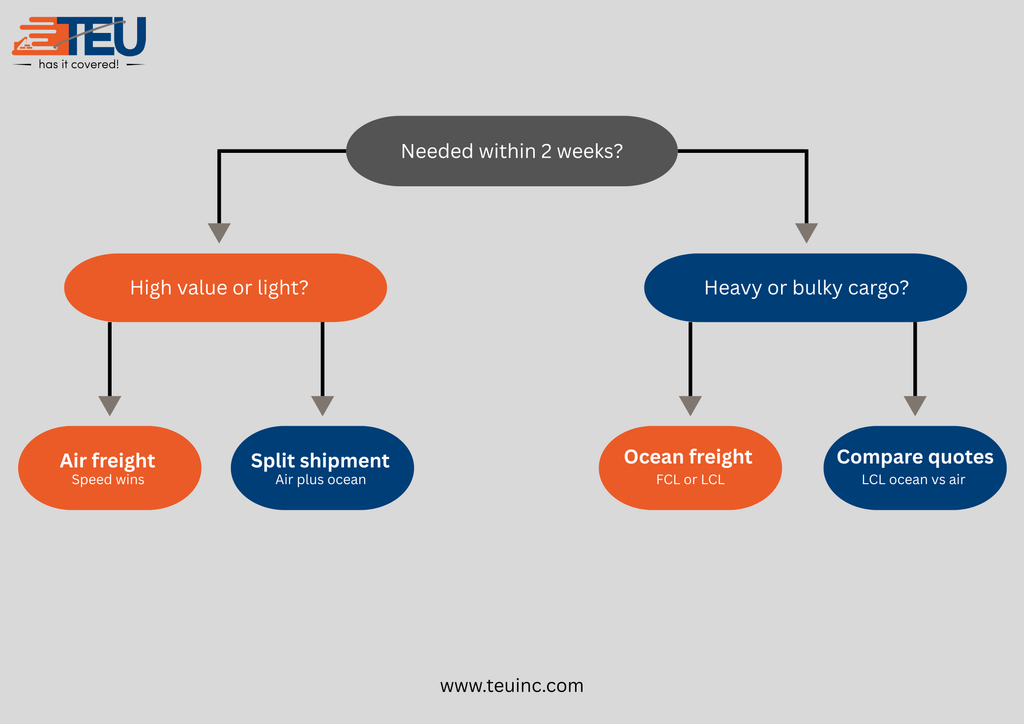
- Choose air freight when speed matters most: urgent, high-value, perishable, time-sensitive, or lightweight cargo.
- Choose ocean freight when cost matters most: heavy, bulky, high-volume, non-urgent cargo that can plan ahead.
- Use both when you want to balance cost and speed, for example ocean for regular replenishment and air for emergency restocks.
What Is Air Freight Shipping?
Air freight is the transportation of cargo on commercial passenger aircraft (in the belly hold) or dedicated cargo aircraft. Shipments move from origin airport to destination airport and are handled under an Air Waybill (AWB).
Key characteristics:
- Transit time typically measured in days, often 1 to 7 days airport to airport
- Frequent departures on major routes
- Strict size and weight limits per piece and per aircraft type
- Priced by chargeable weight (the greater of actual weight or volumetric weight)
- Heavier security screening and carrier handling controls
Air freight is ideal for products where the cost of delay is higher than the cost of transportation. Learn more about our air freight services at TEU Global.
What Is Ocean Freight Shipping?
Ocean freight (also called sea freight) moves cargo on container vessels between ports. Cargo travels as a Full Container Load (FCL), where you use an entire container, or Less than Container Load (LCL), where your cargo shares container space with other shippers. Documentation is handled under a Bill of Lading (B/L).
Key characteristics:
- Transit time typically measured in weeks, often 3 to 6 weeks port to port depending on the lane and routing
- Lowest cost per kilogram for large shipments
- Very high capacity: a standard 20-foot container holds roughly 28 tons subject to carrier and road limits
- Port, terminal, and inland drayage steps add handling time
- More exposed to port congestion, weather, and schedule changes
As a Non-Vessel Operating Common Carrier (NVOCC), TEU Global works with vessel-owning carriers to offer flexible FCL, LCL, and transshipment options. Explore our ocean freight services for details.
Air Freight vs. Ocean Freight: Side-by-Side Comparison
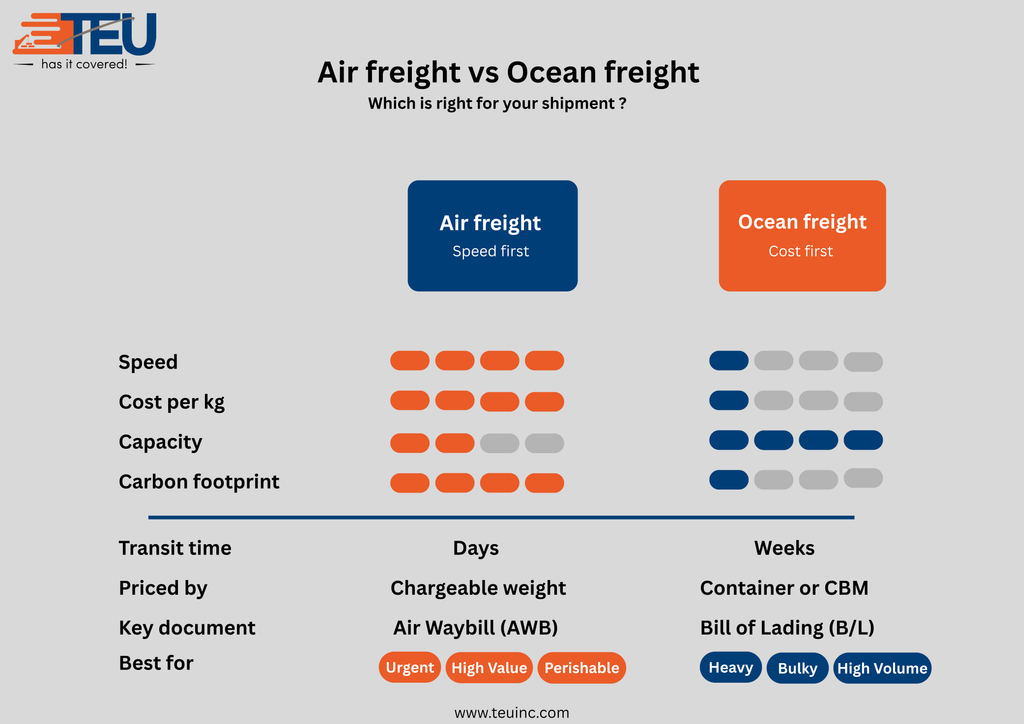
| Factor | Air Freight | Ocean Freight |
| Speed | Fastest (days) | Slowest (weeks) |
| Cost per kg | Highest | Lowest for large volumes |
| Best for | Urgent, high-value, lightweight, perishable | Heavy, bulky, high-volume, non-urgent |
| Capacity | Limited by aircraft dimensions | Very large (containers, break-bulk, project cargo) |
| Schedule reliability | Generally high on major routes | Varies with port congestion, weather, blank sailings |
| Pricing basis | Chargeable weight (actual vs. volumetric) | Container size (FCL) or cubic meter / weight (LCL) |
| Cargo risk | Fewer handling touches, shorter exposure | More handling steps and longer time at sea |
| Carbon footprint | Significantly higher per tonne-kilometer | Significantly lower per tonne-kilometer |
| Inventory impact | Lower safety stock needed | Higher safety stock and carrying costs |
| Key document | Air Waybill (AWB) | Bill of Lading (B/L) |
1. Cost: Which Is the Cheapest Way to Ship Internationally?
For most commercial cargo, ocean freight is the cheapest way to ship internationally. Because a single vessel carries thousands of containers, the cost per unit of cargo is far lower than air. Depending on the commodity, lane, and market conditions, air freight can cost several times more per kilogram than ocean.
But the freight rate is only part of the picture. To compare fairly, look at total landed cost:
- Freight charges: base rate, fuel surcharges, peak season surcharges
- Origin and destination charges: terminal handling, documentation, pickup and delivery
- Customs duties, taxes, and brokerage fees
- Insurance: see our cargo insurance options
- Inventory carrying cost: ocean ties up capital for weeks while goods are in transit
- Stockout cost: lost sales when you run out of product
How air freight is priced
Airlines charge by chargeable weight, which is the higher of the actual gross weight or the volumetric (dimensional) weight. The IATA standard formula is:
Volumetric weight (kg) = Length x Width x Height (cm) / 6,000
This means light but bulky cargo, such as furniture, plastics, or packaged goods, can become very expensive by air.
How ocean freight is priced
- FCL: a flat rate per container (20′, 40′, or 40′ High Cube) plus surcharges
- LCL: priced per cubic meter or per metric ton, whichever is greater (often called W/M), usually with minimum charges
Rule of thumb: if your shipment is large enough to fill most of a container, FCL is usually more economical than LCL. If you ship smaller volumes, LCL avoids paying for empty space.
2. Speed and Transit Time
Speed is the strongest argument for air freight. A shipment that would take a month or more by ocean can often arrive in a matter of days by air.
Keep in mind that transit time is not just flight or sailing time. Consider the full door-to-door timeline:
- Air: origin pickup, airline cut-off, flight, destination customs clearance, final delivery
- Ocean: origin pickup or drayage, port cut-off, vessel transit (plus possible transshipment), discharge, customs clearance, container pickup, drayage to your warehouse
Plan ocean shipments with a buffer for delays. Port congestion, equipment shortages, and vessel schedule changes can extend timelines.
3. Capacity and Cargo Type
Air freight suits:
- Electronics, medical devices, pharmaceuticals (with proper temperature control)
- Fashion and apparel for seasonal launches
- Samples, prototypes, and spare parts
- Perishables and time-critical goods
Ocean freight suits:
- Furniture, machinery, building materials, and automotive parts
- Consumer goods in large volumes
- Food and beverage in containers (including reefers)
- Heavy, oversized, or project cargo
Air freight has strict limits on dimensions and weight, and some goods (certain dangerous goods, very large machinery) are restricted or impractical. Ocean offers far more flexibility for oversized and heavy cargo.
4. Reliability and Risk
Air freight offers shorter exposure time and typically more predictable schedules on major routes. Ocean freight involves more handling steps and longer transit, which increases exposure to delay, damage, and loss, along with events like port congestion, weather, strikes, and blank sailings.
Regardless of mode, we recommend insuring your cargo. Carrier liability is limited by international conventions and is usually far below the actual value of your goods. A proper cargo insurance policy protects your investment against loss and damage. See our cargo insurance services.
5. Environmental Impact
Ocean freight produces far lower carbon emissions per tonne-kilometer than air freight. If sustainability reporting is important to your business or customers, shifting appropriate volume from air to ocean is one of the most effective ways to reduce your transport footprint. The International Maritime Organization and IATA both publish industry sustainability initiatives and data.
6. Inventory and Cash Flow Considerations
Air freight lets you hold less stock, respond faster to demand, and reduce warehousing costs. Ocean freight requires you to forecast demand earlier and hold more safety stock, but the lower freight cost often outweighs the added carrying cost, especially for high-volume, low-margin products.
For storage and distribution after arrival, TEU Global offers warehousing and distribution services to help you manage inventory flow.
When Should You Choose Air Freight?
- Your product has a high value-to-weight ratio (electronics, jewelry, pharmaceuticals)
- You are launching a product and need to hit a market window
- You face a stockout or production line stoppage
- Your goods are perishable or time-sensitive
- The shipment is small or lightweight
- You need faster cash conversion and lower inventory holding
When Should You Choose Ocean Freight?
- Your cargo is heavy, bulky, or high-volume
- Your freight cost is a large share of product margin
- You can plan 4 to 8 weeks ahead
- You ship consistent replenishment orders
- You want to minimize environmental impact
- You need to move oversized or project cargo
Hybrid Strategy: Sea-Air and Mixed-Mode Shipping
Many successful importers do not pick one mode permanently. Common blended approaches include:
- Ocean for base demand, air for peaks: ship planned inventory by sea and top up urgent orders by air
- Split shipments: send a small first batch by air to start selling, with the balance following by ocean
- Sea-air routing: cargo travels by ocean to a transit hub, then continues by air to the final destination, often cheaper than all-air and faster than all-ocean on certain lanes
A forwarder that handles both modes, like TEU Global, can model the cost and timeline of each option on your specific lane so you can decide with real numbers.
Documents Required for Air and Ocean Freight Shipping
Proper documentation prevents customs holds, storage fees, and delivery delays. Below is a practical checklist. Exact requirements vary by country, commodity, and Incoterms, so always confirm with your forwarder or customs broker before shipping.
Documents Needed for Both Air and Ocean Freight
| Document | Purpose |
| Commercial Invoice | Declares the transaction value, buyer, seller, description, and terms of sale. The foundation of customs clearance and duty calculation. |
| Packing List | Details quantity, weight, dimensions, and packaging of each item or carton. Used for cargo verification and inspection. |
| Purchase Order (PO) | Confirms the agreed order between buyer and seller and helps reconcile the shipment. |
| Customs Power of Attorney (POA) | Authorizes your customs broker to file entries and act on your behalf. |
| Customs Entry Documents | Filed with U.S. Customs and Border Protection (CBP) for import clearance and duty payment. See CBP trade resources. |
| Certificate of Origin | Confirms where goods were made. May be needed to claim preferential duty rates under trade agreements. |
| Cargo Insurance Certificate | Proof of coverage for loss or damage during transit. |
| Import/Export Licenses and Permits | Required for regulated goods (for example food, chemicals, electronics, or controlled items). |
| Product-Specific Certificates | Such as phytosanitary, fumigation, FDA, or conformity documents, depending on the product. |
Additional Documents for Air Freight
| Document | Purpose |
| Air Waybill (AWB) | The contract of carriage and receipt for air cargo. It is non-negotiable and is not a document of title. |
| Shipper’s Letter of Instruction (SLI) | Gives your forwarder instructions on routing, handling, and documentation. |
| Shipper’s Declaration for Dangerous Goods | Required if cargo contains regulated dangerous goods. |
| Security Declaration | Supports air cargo security screening requirements. Forwarders operate under security programs such as the Indirect Air Carrier (IAC) program. |
Additional Documents for Ocean Freight
| Document | Purpose |
| Ocean Bill of Lading (B/L) | Serves as the contract of carriage, receipt for cargo, and in its original form, a document of title. Can be a House B/L issued by an NVOCC or a Master B/L issued by the carrier. |
| Importer Security Filing (ISF / 10+2) | Required for U.S.-bound ocean cargo and must be filed before the cargo is loaded at the foreign port. Late or inaccurate filing can lead to penalties. |
| Verified Gross Mass (VGM) | Container weight declaration required under SOLAS regulations before loading. |
| Dangerous Goods Declaration (IMDG) | Required for hazardous materials shipped by sea. |
| Wood Packaging Compliance (ISPM 15) | Wooden pallets and crates must be treated and marked to meet international standards. |
| Delivery Order / Release Documents | Needed at destination to release the container for pickup. |
Documentation Tips
- Make sure all documents match. Descriptions, quantities, values, and consignee details should be identical across the invoice, packing list, and transport document.
- Use accurate HS codes. Incorrect classification can cause delays, penalties, or overpayment of duties.
- Understand your Incoterms. Terms like FOB, CIF, EXW, and DDP define who is responsible for cost, risk, and documentation at each stage. See the ICC Incoterms rules for official guidance.
- Submit early. Many cut-offs, especially for ISF and air cargo security, are strict.
- Work with a licensed broker. Importers must use reasonable care when dealing with U.S. Customs. Our customs clearance team can help you stay compliant.
Understanding the Role of an NVOCC and Freight Forwarder
A freight forwarder arranges the movement of your goods across borders, handling bookings, documentation, consolidation, customs, and delivery. An NVOCC issues its own house bills of lading and contracts with ocean carriers, which can give shippers flexible options and competitive rates without owning vessels. NVOCCs operating in U.S. trades are regulated by the Federal Maritime Commission (FMC).
TEU Global is a licensed NVOCC, Indirect Air Carrier, and customs broker, so one team can manage your air freight, ocean freight, clearance, drayage, and final delivery.
Tips to Reduce Your International Shipping Costs
- Book early to secure space and avoid peak season surcharges
- Consolidate shipments to move from LCL to FCL where possible
- Optimize packaging to cut volumetric weight (especially for air)
- Compare door-to-door quotes, not just port-to-port or airport-to-airport rates
- Choose the right Incoterms to control which costs you pay
- Insure your cargo to avoid out-of-pocket loss
- Use a forwarder with both modes so you can compare options objectively
Frequently Asked Questions
Is air freight or ocean freight cheaper?
Ocean freight is generally cheaper, especially for heavy, bulky, or large-volume shipments. Air freight can be competitive only for small, lightweight, high-value cargo, or when you factor in the cost of delay.
What is the difference between air and ocean freight?
The main differences are speed, cost, capacity, and environmental impact. Air freight is faster and more expensive; ocean freight is slower, cheaper, and handles much larger volumes.
How long does ocean freight take compared to air freight?
Air freight usually takes days, while ocean freight usually takes weeks. Exact times depend on the origin, destination, routing, and port conditions.
Is air freight safer than ocean freight?
Air freight has shorter transit and less exposure time, but both modes are generally safe when cargo is properly packed, documented, and insured.
What is the difference between air freight and sea freight in terms of documents?
Air uses an Air Waybill (AWB), while sea uses a Bill of Lading (B/L). U.S.-bound ocean shipments also require an Importer Security Filing (ISF), and both modes require a commercial invoice, packing list, and customs entry documents.
Can I combine air and ocean freight?
Yes. Many businesses split shipments, use ocean for regular stock and air for urgent orders, or use sea-air routing to balance cost and speed.
What is the cheapest way to ship internationally?
For most cargo, FCL ocean freight is the cheapest per unit. For smaller volumes, LCL ocean consolidation is usually the next most economical option.
Final Thoughts: Air Freight or Ocean Freight?
The best choice comes down to a balance of speed, cost, cargo characteristics, and risk tolerance. Air freight protects your timelines. Ocean freight protects your margins. The smartest importers evaluate both on every lane and adjust as demand, urgency, and market conditions change.
Ship Smarter with TEU Global
As a licensed NVOCC, Indirect Air Carrier, and customs broker, TEU Global gives you a single partner for air freight, ocean freight, customs clearance, cargo insurance, drayage, and warehousing. Our team will compare air and ocean options for your exact shipment and recommend the most cost-effective and reliable solution.
Request a freight quote | Explore air freight | Explore ocean freight