Informational
If you bring goods into the United States by sea, ISF filing is the first customs step you need to get right, and it happens before your container is even loaded. A late, missing or inaccurate Importer Security Filing can mean liquidated damages of $5,000 per violation, cargo holds and delayed delivery.
This guide explains what an Importer Security Filing is, who must file, the 10 data elements, the ISF filing deadline, how penalties work and how to file without surprises. It is written for importers, e-commerce sellers, exporters and forwarders shipping ocean freight to U.S. ports.
In this guide: What is ISF filing · Who must file · The 10+2 data elements · ISF filing requirements · The deadline · How to file step by step · Penalties · Common mistakes · Costs · What is new for 2026 and 2027 · FAQs
What Is ISF Filing?
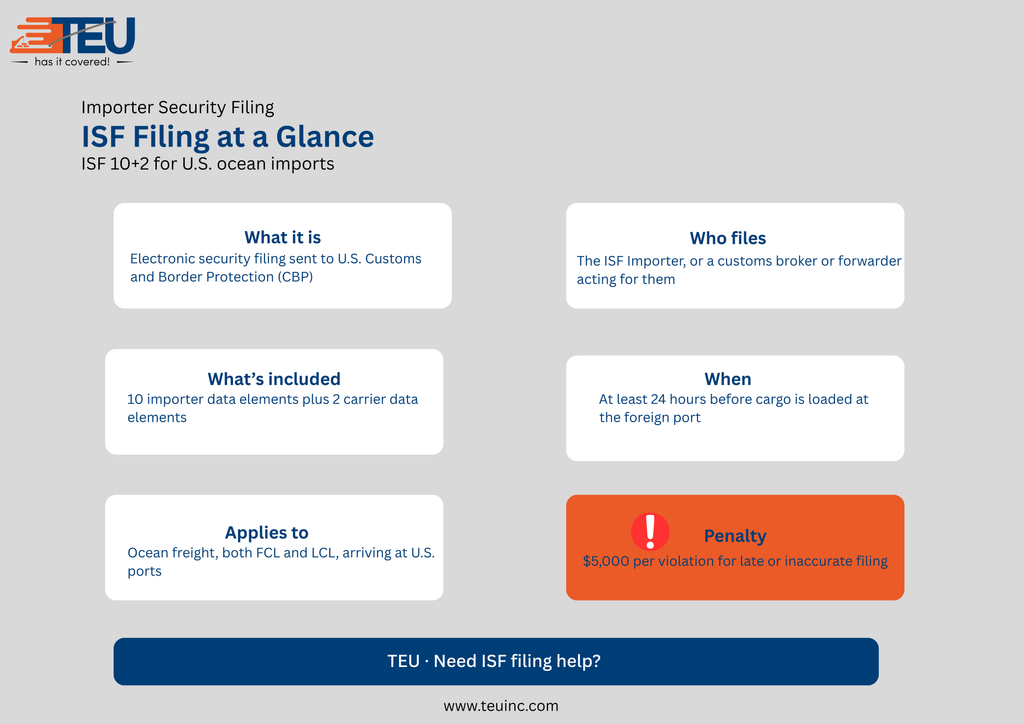
ISF filing is the electronic submission of advance cargo information to U.S. Customs and Border Protection (CBP) for goods arriving in the U.S. by vessel. The Importer Security Filing is better known as ISF 10+2 because it consists of 10 data elements supplied by the importer and 2 supplied by the ocean carrier.
CBP uses this data to screen containers for security risk before they are loaded overseas, not after they arrive. The rule is set out in 19 CFR Part 149 on the eCFR, and CBP publishes its own overview on the Importer Security Filing 10+2 page.
Two points often confuse first-time importers:
- The ISF is not the same as your customs entry. It is a separate, earlier filing, and filing one does not replace the other. Learn how the entry works in our guide to U.S. customs clearance.
- It is a security filing, not a duty filing. It does not calculate or pay duties.
Who Must File an ISF?
The party responsible is the ISF Importer, usually the importer of record, owner, purchaser or consignee. In practice, most ISFs are transmitted by a licensed customs broker or authorized agent using a power of attorney, but the importer stays legally accountable even when someone else files.
ISF applies to:
- Ocean freight (FCL and LCL) arriving at U.S. ports
- Cargo that will be entered into the U.S. and cargo moving in-bond or into a Foreign Trade Zone
ISF generally does not apply to:
- Air freight, trucking and rail shipments from Canada or Mexico
- Bulk cargo, U.S. government cargo, used household goods and personal effects, and international mail (confirm current exemptions with CBP or your broker)
For shipments that only pass through the U.S. (foreign cargo remaining on board, or goods moving under bond for immediate export or transportation and exportation), a shorter ISF-5 with five data elements applies. Standard imports use ISF-10.
The 10+2 Data Elements
Importer elements (the “10”):
- Manufacturer (or supplier) name and address
- Seller (or owner) name and address
- Buyer (or owner) name and address
- Ship-to party name and address
- Container stuffing location
- Consolidator (stuffer) name and address
- Importer of record number or foreign trade zone applicant identification number
- Consignee number(s)
- Country of origin
- Commodity Harmonized Tariff Schedule (HTSUS) number, at least six digits
Carrier elements (the “+2”):
- Vessel stow plan
- Container status messages
The carrier handles the two carrier elements. Your job is to deliver clean, consistent data for the ten importer elements, and that data must match your commercial invoice, packing list and later customs entry.
ISF Filing Requirements: What You Need Before You File
To meet ISF filing requirements without delays, have the following ready:
- Importer of record number: an IRS EIN, Social Security number or CBP-assigned number. Make sure your CBP Form 5106 details are accurate; see the 2026 updates below.
- A valid customs bond: either a continuous bond or a single-transaction bond that covers ISF. Your broker can arrange this.
- Power of attorney for the broker or forwarder filing on your behalf.
- Complete supplier data: manufacturer, seller, buyer and ship-to names and full addresses.
- Product details: accurate country of origin and a six-digit HTS classification for every product on the shipment. Multiple HTS codes in one container mean multiple lines in the ISF.
- Stuffing and consolidator details: where the container was loaded and by whom. For LCL, the consolidator is a critical element.
- Booking information: bill of lading number, vessel and voyage, so the ISF can be matched to the manifest.
Filings are made electronically through CBP-approved systems, typically a broker’s ABI/AMS connection into the Automated Commercial Environment (ACE). The filing must be in English.
ISF Filing Deadline: When Must You File?
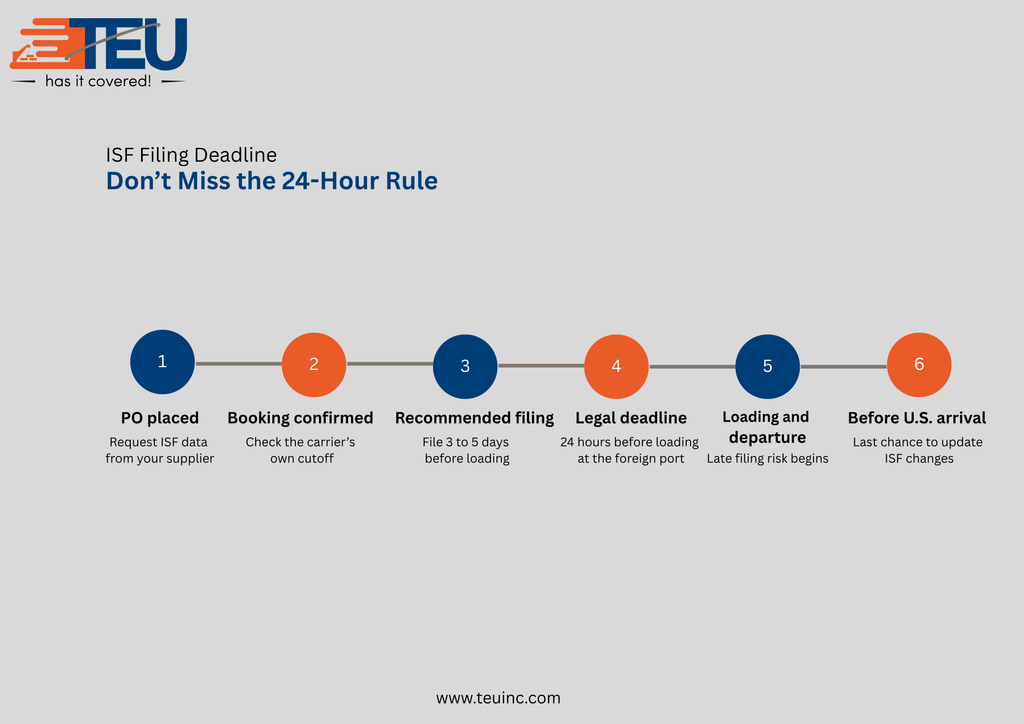
The ISF filing deadline is 24 hours before the cargo is loaded onto the vessel at the foreign port of departure. Filing means being accepted by CBP, not merely submitted to your forwarder, so build in time for corrections.
| Situation | Deadline |
| Standard ocean import (ISF-10) | At least 24 hours before loading at the foreign port |
| Foreign cargo remaining on board (ISF-5) | Before arrival at the first U.S. port |
| Break bulk cargo | Before arrival at the U.S. port |
| Changes after filing | Update as soon as more accurate data is known, and no later than 24 hours before arrival at the U.S. port |
Practical tip: the 24-hour rule is a legal minimum, not a target. Most compliant importers aim to file 3 to 5 days before loading, which leaves time to fix missing addresses or HTS issues without risking a loading hold. Always confirm the carrier’s own cutoff, which is often earlier.
How to File an ISF: Step by Step
- Confirm the filer. Decide whether your customs broker, forwarder or in-house team will transmit the ISF, and sign the power of attorney.
- Check your bond and importer number. Confirm that a valid bond is on file and your IOR number is active.
- Collect the 10 data elements from your supplier. Send suppliers a data request when the purchase order is placed, not when the cargo is ready.
- Validate the data against your commercial invoice and packing list. Names, addresses and HTS codes should match across documents.
- Transmit the ISF to CBP. Your broker submits it electronically and receives an acceptance or rejection message.
- Fix rejections immediately. Correct errors and resubmit before the 24-hour cutoff.
- Update if anything changes. New container, changed consignee or revised stuffing location requires an update before arrival.
- Withdraw if the cargo will not ship to the U.S., and give CBP the reason.
- Keep records of the filing and supporting documents.
If you would rather not manage this yourself, our customs brokerage team handles ISF filing for ocean freight alongside entry and clearance.
ISF Filing Penalties: What a Mistake Costs
CBP can assess liquidated damages of $5,000 per violation for late, inaccurate or incomplete filings. The penalties can apply to each transmission, including updates, and CBP reserves the right to take further action for serious or repeated violations.
What triggers a penalty:
- Filing late or not at all
- Filing inaccurate or incomplete data
- Failing to update the ISF when information changes
- Not withdrawing an ISF for cargo that will not be imported
Beyond the fine:
- Container holds and exams
- A Do Not Load instruction from CBP in serious cases
- Demurrage, detention and storage charges while cargo waits
- A weaker compliance record that can draw closer scrutiny on future shipments
Penalties can sometimes be reduced through CBP’s mitigation guidelines, but mitigation is discretionary and never guaranteed. Prevention is far cheaper than petitioning, so treat ISF accuracy as part of your logistics plan.
Need help staying penalty-free? Talk to a TEU customs specialist about ISF filing for your next ocean shipment.
Common ISF Filing Mistakes (and How to Avoid Them)
| Mistake | Why it happens | How to prevent it |
| Filing after the cargo is loaded | Supplier data arrives late | Request ISF data at PO stage; set an internal cutoff of 3 to 5 days before loading |
| Wrong manufacturer or seller | Trading companies or agents used instead of the real manufacturer | Verify manufacturer address with the supplier, not the invoice header alone |
| Vague or missing HTS code | Classification left for the entry stage | Classify products early; at least six digits are required |
| Missing consolidator or stuffing location | LCL cargo handled by multiple parties | Get stuffing details in writing from the origin forwarder |
| Not updating after changes | Booking or consignee changes after filing | Add an update step to your change-management process |
| ISF does not match the entry | Different teams prepare each filing | Use the same source data for ISF and customs entry |
ISF Filing for Ocean Freight: FCL vs LCL
FCL (full container load): one shipper’s goods fill the container, so the ISF is usually simpler. The stuffing location is typically the supplier’s factory or warehouse.
LCL (less than container load): several shippers share a container, so the consolidator and each cargo owner’s data matter. Each house bill of lading usually needs its own ISF, so coordination between your forwarder, the consolidator and the carrier is essential. Learn more about LCL shipping to the USA.
For either mode, your ocean freight service provider should align the booking, bill of lading and ISF so the data matches throughout.
How Much Does ISF Filing Cost?
Broker fees for ISF filing vary by provider, shipment volume and whether you need a single-transaction bond or already have a continuous bond. Because pricing differs widely, ask for a written quote that shows the filing fee, any amendment fees and the bond cost. The real cost to compare against is the $5,000-per-violation exposure from filing late or wrongly.
What Is New for 2026 and 2027? Stay Current
The core ISF 10+2 rule has not changed, and CBP’s recent notice to renew its information collection for ISF and related ocean filings indicated no new fees or major changes. However, importer-of-record rules are tightening, and these affect the importer number you use on your ISF:
- CBP Form 5106 enforcement: since September 18, 2026, CBP may void an importer-of-record number if the identity data on file is inaccurate or incomplete. Keep your name, address and EIN current.
- Heightened foreign importer requirements: a CBP interim final rule takes effect on January 5, 2027. It refines how U.S. importer-of-record status is defined and adds broker verification duties. Foreign-based importers and U.S. subsidiaries should review their status now.
Because these developments are recent and may evolve, confirm details with your customs broker and the official CBP notices before relying on them.
Why Work With TEU for ISF Filing?
An ISF is only as good as the data behind it. TEU combines ocean freight booking, documentation and customs support so that your ISF, bill of lading and entry all draw from the same verified information. That means fewer rejections, earlier filing and no last-minute scramble before vessel cutoff.
Ready to ship to the U.S.? Get a quote or contact our team for ISF filing support.
Frequently Asked Questions About ISF Filing
What is ISF filing? ISF filing is the electronic submission of 10 importer data elements to U.S. Customs and Border Protection before ocean cargo is loaded for the United States. Together with 2 carrier elements, it forms the ISF 10+2.
What does ISF 10+2 mean? The importer provides 10 data elements and the ocean carrier provides 2: the vessel stow plan and container status messages.
When is the ISF filing deadline? At least 24 hours before the cargo is loaded on the vessel at the foreign port. Filing earlier, typically 3 to 5 days before loading, is safer.
What is the penalty for not filing an ISF? CBP can assess liquidated damages of $5,000 per violation, and further penalties or holds may apply for serious or repeated violations.
Who is responsible for filing the ISF? The ISF Importer is legally responsible. A licensed customs broker or forwarder can file on the importer’s behalf under a power of attorney, but liability remains with the importer.
Do I need an ISF for air freight? No. ISF applies to cargo arriving by vessel. Air freight has its own advance data requirements.
Do I need a bond to file an ISF? Yes. A qualifying bond is required, such as a continuous bond or an ISF single-transaction bond.
Can I amend an ISF after filing? Yes. You must update the filing when information changes or better data becomes available, before the goods enter the limits of a U.S. port. Note that updates can also be subject to penalties if they are inaccurate.
What is the difference between ISF-10 and ISF-5? ISF-10 is the full filing for goods being imported. ISF-5 is a shorter filing with five elements for cargo only transiting the U.S., such as foreign cargo remaining on board.
Key Takeaways
- ISF filing is mandatory for most ocean imports into the U.S. and must be accepted by CBP at least 24 hours before loading.
- The Importer Security Filing requires 10 importer data elements and 2 carrier elements.
- Penalties start at $5,000 per violation, and hold and storage costs add to the damage.
- Accurate supplier data, early collection and a reliable customs partner are the best protection.