Informational
The US importer of record regulations 2026 are the biggest overhaul of who may import goods into the United States in decades. If your company sells into the US market from abroad, the rules for acting as the importer of record (I444OR) changed substantially this year, and the next big deadline is January 5, 2027.
This guide explains what changed, who is affected, how CTPAT and customs brokers fit in, and what to do before each compliance date.
What Is an Importer of Record, and Why Do the Rules Matter?
The importer of record is the party legally responsible for a shipment entering the United States. The IOR is accountable to U.S. Customs and Border Protection (CBP) for the accuracy of the entry, the classification and valuation of the goods, and payment of duties, taxes and fees.
Historically, a foreign company could often act as a non-resident importer by obtaining an importer number, posting a customs bond and hiring a licensed customs broker. In 2026, CBP began tightening each of those steps. The goal, according to the government, is to make it easier to collect duties and hold importers accountable.
Why Are the Rules Changing? Executive Order 14411
On June 3, 2026, the President signed Executive Order 14411, “Strengthening Customs Enforcement.” The order directs the Department of Homeland Security and CBP to draw a sharper line between U.S. and foreign importers of record. Its main themes are:
- Stricter eligibility standards for foreign IORs
- Limits on the use of continuous bonds by foreign IORs for formal entries
- CTPAT validation, or the use of a CTPAT-validated customs broker
- Restrictions on informal entries by foreign IORs
- Greater disclosure about ownership and supply chains
CBP has been implementing the order in stages. Three actions matter most to foreign importers right now.
Step 1: CBP Form 5106 Accuracy Enforcement (Already in Effect)
On August 19, 2026, CBP published a Federal Register notice announcing a comprehensive review of the importer identity data on CBP Form 5106. Since September 18, 2026, CBP can immediately void an importer of record number if the information on file is inaccurate or incomplete. A voided number cannot be used for any purpose, including entering merchandise.
Common problem areas flagged by trade advisers include:
- Registered agent, PO box, broker or freight forwarder addresses listed as the importer’s own
- Email addresses and phone numbers that belong to a broker or third party rather than the importer
- Outdated company names, ownership details or contacts
The person certifying Form 5106 data may face exposure under federal false-statement law, so this is not a paperwork formality. If you have not reviewed your Form 5106 record recently, do it now.
Step 2: The Interim Final Rule on Foreign Importers of Record
On November 5, 2026, CBP issued an interim final rule, published in the Federal Register on November 6, titled “Heightened Requirements for Foreign Importers of Record.” It takes effect on January 5, 2027, and CBP is accepting comments through the same date.
The rule creates a new Part 110 in Title 19 of the Code of Federal Regulations and changes several other parts. Here are the key points.
Who counts as a U.S. importer of record?
Any importer that does not meet the new definition of a U.S. IOR is treated as a foreign importer of record. This catches some companies that assume they are “American.” To qualify as a U.S. IOR, an entity must:
- Be organized under U.S. law
- Be located in the United States, and
- Have either at least 51 percent beneficial ownership by U.S. citizens or lawful permanent residents who control the entity, or direct ownership of a significant amount of unencumbered U.S. real property
A “beneficial owner” is generally a natural person who exercises substantial control over the entity or owns or controls at least 25 percent of it, directly or indirectly. CBP looks through layers of ownership to the real people behind them.
CBP will also look past a mailing address or state of incorporation. Factors it may weigh include your principal place of business, real U.S. operations and employees, U.S. assets, profitability, capitalization, and whether the entity is simply an instrument of a foreign manufacturer.
The CTPAT requirement
A foreign IOR may generally make consumption entries on its own only if it is validated under the Customs Trade Partnership Against Terrorism (CTPAT) program. If it is not, it must use a CTPAT-validated licensed customs broker to make the entry. A non-validated broker cannot file entries for a non-validated foreign IOR. If the foreign company is not the owner or purchaser of the goods, the validated broker must act as the IOR.
This matters because validated brokers are scarce. Law firm analysis of the rule notes that only about one in five U.S. customs brokers is CTPAT validated, and CBP itself estimates roughly one-third of foreign IORs will need to change brokers.
Need a CTPAT-certified partner? TEU Global is CTPAT certified. Talk to our team about getting your imports ready before January 5, 2027.
Informal entries
The executive order called for a ban on informal entries by foreign IORs. The rule stops short for now: foreign IORs may still use informal entry procedures if they are CTPAT validated or use a CTPAT-validated broker. CBP has said it is monitoring this and has asked for comment on a stricter alternative that would prohibit informal consumption entries by foreign IORs entirely.
A new status declaration on entries
Importers, or brokers filing for them, must affirmatively declare on CBP Forms 3461 and 7501 whether the importer qualifies as a U.S. IOR. In the electronic versions this appears as a Yes/No field.
Consequences of a wrong declaration
If an importer inaccurately declares itself a U.S. IOR, CBP may require a live entry (the entry summary and estimated duties must be submitted before release) and may withdraw immediate delivery privileges. Both can mean slower clearance and higher costs.
What the New Rules Mean for Customs Brokers
Brokers carry a heavier load under the rule:
- Verify before declaring. Before telling CBP that a client is a U.S. IOR, the broker must request and review records proving it. Examples include citizenship or residency documents, corporate charters, financial records, purchase receipts and documents of title.
- Keep records for five years from the date of verification.
- Hold a valid power of attorney from the principal whenever transacting customs business, including when the broker acts as the IOR.
- Identify the principal on the entry and entry summary when a non-CTPAT broker acts as IOR, and make sure that principal has a Form 5106 on file.
Brokers may ask CBP for delayed compliance with the client-verification requirements, but all brokers are expected to be fully compliant by May 6, 2027. Expect more document requests from your broker in the meantime, and potentially higher brokerage fees and longer onboarding for foreign IORs.
Step 3: More Disclosure Rules Are Coming
The interim final rule is not the end of the process. On September 2, 2026, CBP published an advance notice of proposed rulemaking on “Heightened Import Disclosures for Supply Chain Visibility,” with comments due December 1, 2026. It signals CBP’s interest in seeing more of the supply chain, including documentation that foreign exporters file with their own customs authorities. Bonding requirements, asset requirements and vetting rules for foreign IORs are also still being developed under the executive order.
Separately, Congress is considering the SAFE Act, introduced in March 2026, which would restrict who can serve as an importer of record and raise bond requirements. It is a bill, not law, but it shows the direction of travel.
2026 to 2027 Compliance Timeline
| Date | Milestone |
| June 3, 2026 | Executive Order 14411 signed |
| August 19, 2026 | CBP notice on Form 5106 accuracy published |
| September 2, 2026 | ANPRM on heightened import disclosures published |
| September 18, 2026 | CBP begins voiding IOR numbers with inaccurate or incomplete Form 5106 data |
| November 5-6, 2026 | Interim final rule on foreign IORs issued and published |
| December 1, 2026 | Comments due on the supply chain visibility ANPRM |
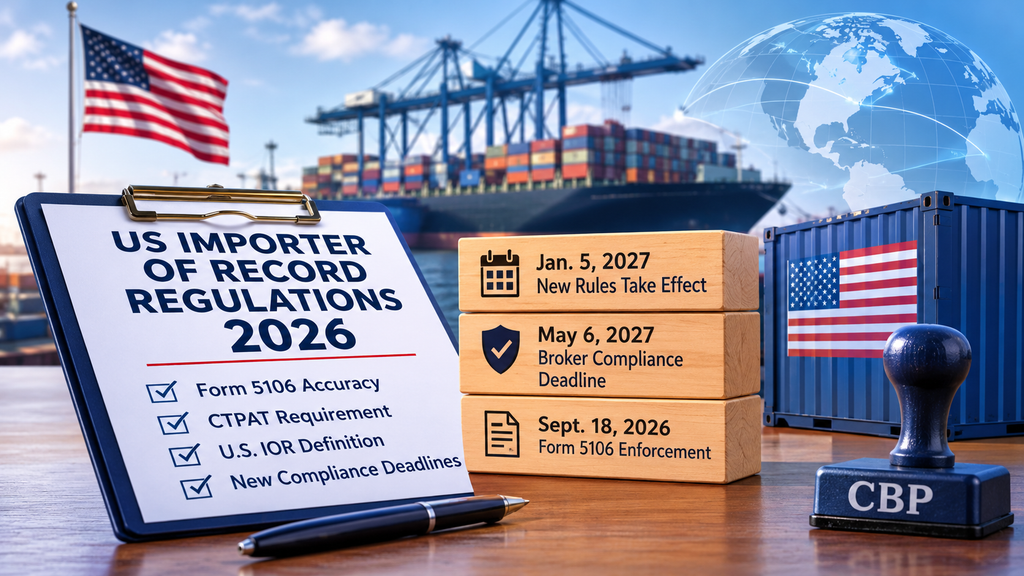
| January 5, 2027 | Interim final rule takes effect; comment period closes |
| May 6, 2027 | Deadline for all brokers to be fully compliant with client-verification requirements |
Action Checklist for Foreign Importers
- Audit your Form 5106. Replace any registered agent, broker or PO box details with the importer’s own contact information, and confirm it is accurate.
- Determine your status. Test every entity that acts as IOR against the new U.S. IOR definition. Do not assume a U.S. address or incorporation is enough.
- Map your ownership. Be ready to document beneficial owners at the 25 percent level and the entity’s U.S. operations, assets and capitalization.
- Check your broker’s CTPAT status. If your broker is not validated, plan a switch before January 5, 2027, or consider applying for CTPAT validation yourself if you are eligible.
- Refresh powers of attorney. Brokers are already requesting new ones.
- Review your bond. Foreign IORs should expect closer scrutiny of continuous bonds on formal entries.
- Consider your import structure. In some cases a different party may be able to serve as a qualifying U.S. IOR, or the validated broker may need to act as IOR.
- Submit comments. The rule is interim, and CBP has asked specific questions, including about banning informal entries for foreign IORs. Comments are due January 5, 2027.
Frequently Asked Questions
When do the new importer of record rules take effect?
CBP’s interim final rule on foreign importers of record takes effect on January 5, 2027. Form 5106 accuracy enforcement has been in place since September 18, 2026.
Can a foreign company still be the importer of record in 2026?
Yes, but with conditions. A foreign IOR generally must be CTPAT validated or use a CTPAT-validated licensed customs broker, and it faces stricter verification, bonding and disclosure expectations.
Can a U.S. company be treated as a foreign importer of record?
Yes. A U.S.-incorporated company that lacks sufficient U.S. beneficial ownership or real property, or that does not have a genuine U.S. presence, may fall into the foreign IOR category.
What is CTPAT, and do I need it?
CTPAT is a voluntary CBP supply chain security partnership program. Under the new rule it becomes effectively necessary for foreign IORs, either directly or through a validated broker. TEU Global is CTPAT certified and can help you get ready.
What happens if CBP voids my importer of record number?
A voided number is invalid for any purpose, including entering goods, so shipments can be held at the port until the record is corrected and the number is reinstated.
Stay Compliant With TEU Global
The new US importer of record regulations reward importers that prepare early, and TEU Global is CTPAT certified, so you can meet the CTPAT requirement for foreign importers of record without scrambling for a new partner. Our team can help you review your importer of record status, clean up your CBP Form 5106 record and keep your entries moving under the new rules.
Contact TEU Global today for a free compliance review before the January 5, 2027 effective date.