InformationalLogistics
If you have ever shipped goods internationally, you have probably come across the term bill of lading. It’s one of the most important documents in the shipping and logistics industry, yet many people find it confusing at first.
In this guide, TEU Global breaks down the bill of lading meaning, its purpose, its types, and why it matters for anyone involved in shipping, freight forwarding, or international trade. By the end, you’ll understand exactly what a bill of lading is and how to use one with confidence.
What Is a Bill of Lading?
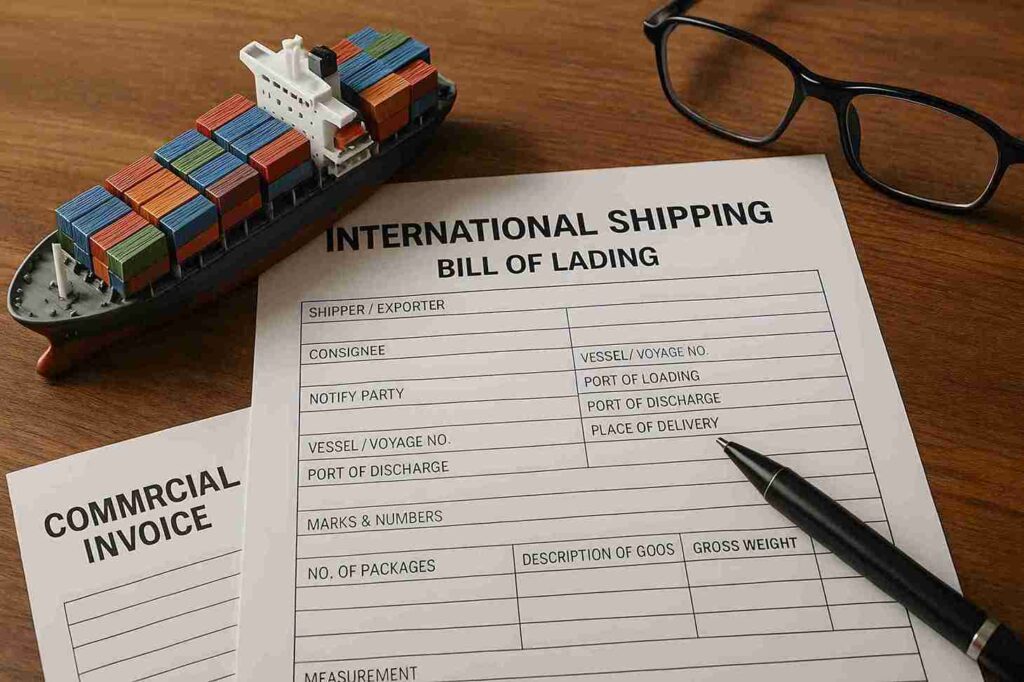
A bill of lading (BOL or BL) is a legal document issued by a carrier (such as a shipping line, trucking company, or freight forwarder) to a shipper. It confirms that goods have been received for shipment and outlines the terms under which they will be transported and delivered.
In simple terms, this shipping document acts as:
- A receipt — proof that the carrier has received the cargo in good condition.
- A contract of carriage — an agreement between the shipper and the carrier detailing the terms of transport.
- A document of title — proof of ownership of the goods, which can be transferred to another party.
Because it serves these three roles at once, this document is considered as the backbone of the shipping process. Without it, cargo cannot legally move from origin to destination, and the consignee cannot claim the goods at the port of arrival.
Why Is the Bill of Lading Important in Shipping?
The shipping document is essential for several reasons:
- Legal protection — It protects both the shipper and the carrier by clearly defining responsibilities and liabilities.
- Proof of shipment — It confirms the exact quantity, condition, and description of the cargo at the time of loading.
- Facilitates payment — Banks often require a bill of lading before releasing payment under a letter of credit.
- Enables cargo release — The consignee must present the original bill of lading (or an authorized copy) to collect the goods.
- Supports customs clearance — Customs authorities use the BOL to verify shipment details during import and export processing.
Without a properly issued bill of lading, shipments can face delays, disputes, or even be held at customs.
Types of Bill of Lading
There isn’t just one type of BOL — different shipments and trade arrangements call for different formats. Here are the most common types of bill of lading used in global trade:
1. Straight BOL
Used when cargo is assigned to a specific person or company. It is non-negotiable, meaning ownership cannot be transferred to another party.
2. Order BOL
A negotiable document that allows ownership of the goods to be transferred by endorsement. This is commonly used in international trade financing.
3. Bearer BOL
Whoever holds the physical document can claim the goods. This type carries higher risk since no specific consignee is named.
4. Ocean BOL
An ocean bill of lading is issued for sea freight shipments. It can be either a “received for shipment” bill (issued when cargo is handed over) or a “shipped on board” bill (issued once cargo is loaded onto the vessel).
5. Multimodal or Combined Transport BOL
Covers shipments that involve more than one mode of transport, such as sea, rail, and road, under a single contract.
6. House Bill of Lading (HBL) and Master Bill of Lading (MBL)
- The Master BOL is issued by the shipping line to the freight forwarder.
- The House BOL is issued by the freight forwarder to the actual shipper or customer.
7. Electronic Bill of Lading (eBL)
A digital version of the traditional paper BOL, increasingly used to speed up documentation and reduce fraud risk in modern freight operations.
What Information Does a Bill of Lading Include?
A standard shipping document sample typically contains:
- Shipper and consignee details
- Carrier information
- Description of goods (quantity, weight, packaging type)
- Port of loading and port of discharge
- Vessel name and voyage number
- Freight charges and payment terms
- Date of issue and number of original copies
- Special handling instructions, if any
Accuracy in these details is critical — even small errors can cause delays in customs clearance or cargo release.
Bill of Lading vs Invoice: What’s the Difference?
A common point of confusion is the difference between a bill of lading vs invoice. While both are important shipping documents, they serve different purposes:
| Bill of Lading | Commercial Invoice |
| Proof of shipment and contract of carriage | Proof of sale and value of goods |
| Issued by the carrier | Issued by the seller/exporter |
| Required to release cargo | Required for customs valuation and payment |
| Can act as a document of title | Does not transfer ownership |
Both documents work together to ensure smooth international trade, but they are not interchangeable.
How Does the Shipping Documentation Process Work?
- Booking confirmation — The shipper books space with a carrier or freight forwarder.
- Cargo handover — Goods are delivered to the carrier’s terminal or warehouse.
- BOL issuance — The carrier issues the BOL once cargo is received or loaded.
- Document transfer — The shipper sends the original BOL to the consignee (directly or via bank, depending on payment terms).
- Cargo release — The consignee presents the original bill of lading at the destination port to collect the goods.
Common Mistakes to Avoid with Shipping Documents
- Incorrect or incomplete consignee details
- Mismatched cargo description between the BOL and invoice
- Missing endorsements on negotiable bills
- Delayed issuance causing demurrage charges
- Using the wrong type of BOL for the trade terms agreed upon
Working with an experienced logistics partner like TEU Global helps avoid these costly errors and keeps your shipments moving without unnecessary delays.
Final Thoughts
This document is far more than paperwork — it’s a legal safeguard, a contract, and a key to unlocking your cargo at its final destination. Understanding its types and purpose helps businesses ship smarter, avoid disputes, and stay compliant with international trade regulations.
At TEU Global, we help businesses manage every stage of the shipping process, from documentation to final delivery. If you need expert guidance on preparing or reviewing your bill of lading, our team is here to help.
Ready to simplify your shipping documentation? Contact TEU Global today to get started.
Frequently Asked Questions (FAQs)
Q1: What is a bill of lading in simple terms?
A bill of lading is a document issued by a carrier that acts as a receipt for goods, a contract of carriage, and proof of ownership during shipping.
Q2: Is a bill of lading the same as a shipping label?
No. A shipping label is used for tracking and delivery, while a BOL is a legal document tied to the contract of carriage and ownership of goods.
Q3: Can a BOL be transferred to another party?
Yes, if it is an order bill of lading, ownership can be transferred through endorsement. Straight BOL cannot be transferred.
Q4: Who issues the bill of lading?
The carrier, shipping line, or freight forwarder issues the BOL once cargo is received or loaded for shipment.
Q5: What happens if the original bill of lading is lost?
The consignee may need to provide an indemnity bond and follow the carrier’s procedure for issuing a replacement or releasing cargo without the original document.